

A uniformly distributed random variable X with probability density function $${f_x}\left( x \right) = \frac{1}{{10}}\left( {u\left( {x + 5} \right) - u\left( {x - 5} \right)} \right)$$
Where u(⋅) is the unit step function is passed through a transformation given in the figure below. The probability density function of the transformed random variable Y would be
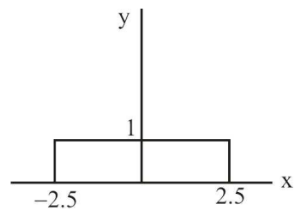
A. $${f_Y}\left( y \right) = \frac{1}{5}\left( {u\left( {y + 2.5} \right) - u\left( {y - 2.5} \right)} \right)$$
B. $${f_Y}\left( y \right) = 0.5\delta \left( y \right) + 0.5\delta \left( {y - 1} \right)$$
C. $${f_Y}\left( y \right) = 0.25\delta \left( {y + 2.5} \right) + 0.25\delta \left( {y - 2.5} \right) + 0.5\delta \left( y \right)$$
D. $${f_Y}\left( y \right) = 0.25\delta \left( {y + 2.5} \right) + 0.25\delta \left( {y - 2.5} \right) + \frac{1}{{10}}\left( {u\left( {y + 2.5} \right) - u\left( {y - 2.5} \right)} \right)$$
Answer: Option B
It is found that a ship to ship communication suffers from fading. This can be avoided by using
A. Space diversity
B. Frequency diversity
C. Broad band antenna
D. Directional antenna
A. A double-tuned amplifier
B. A high gain D.C. amplifier
C. A cathode follower stage
D. None of the above
A. Filter method
B. Phase cancellation method
C. Good attenuation characteristics
D. All of the above
Join The Discussion