

An infinitely long wire carrying a current $$I\left( t \right) = {I_0}\cos \left( {\omega t} \right)$$ is placed at a distance a from a square loop of side a as shown in the figure. If the resistance of the loop is R, then the amplitude of the induced current in the loop is
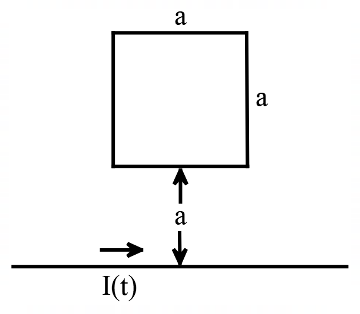
A. $$\frac{{{\mu _0}}}{{2\pi }} \cdot \frac{{a{I_0}\omega }}{R}\ln 2$$
B. $$\frac{{{\mu _0}}}{\pi } \cdot \frac{{a{I_0}\omega }}{R}\ln 2$$
C. $$\frac{{2{\mu _0}}}{\pi } \cdot \frac{{a{I_0}\omega }}{R}\ln 2$$
D. $$\frac{{{\mu _0}}}{{2\pi }} \cdot \frac{{a{I_0}\omega }}{R}$$
Answer: Option A
A. $$\frac{2}{{{\mu _0}}}\left( {x{\bf{\hat i}} + y{\bf{\hat j}}} \right)$$
B. $$ - \frac{2}{{{\mu _0}}}\left( {{\bf{\hat i}} + {\bf{\hat J}}} \right)$$
C. $$ - \frac{2}{{{\mu _0}}}\left( {{\bf{\hat i}} - {\bf{\hat j}}} \right)$$
D. $$\frac{2}{{{\mu _0}}}\left( {x{\bf{\hat i}} - y{\bf{\hat j}}} \right)$$
A. 0.033 μm
B. 0.330 μm
C. 3.300 μm
D. 33.000 μm
A. $${\bf{\hat z}}k$$
B. $${\bf{\hat x}}k\sin \alpha + {\bf{\hat y}}k\cos \alpha $$
C. $${\bf{\hat x}}k\cos \alpha + {\bf{\hat y}}k\cos \alpha $$
D. $$ - {\bf{\hat z}}k$$
A. vp = vg
B. vp = $${\text{v}}_{\text{g}}^{\frac{1}{2}}$$
C. vp vg = c2
D. vg = $${\text{v}}_{\text{p}}^{\frac{1}{2}}$$
Join The Discussion