ExamVeda
Login
Home
11
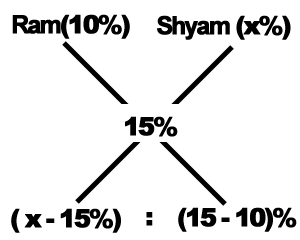
Weights of two friends Ram and Shyam are in the ratio 4 : 5. If Ram's weight is increased by 10% and total weight of Ram and Shyam become 82.8 kg, with an increases of 15%. By what percent did the weight of Shyam has to be increased?
Discuss
Answer & Solution
Answer: Option A
Solution:
Alligation mcq Solution 9
Now, given ratio of Ram and Shayam's weight = 4 : 5
Hence, $$\frac{{x - 15}}{{15 - 10}} = \frac{4}{5}$$
Or, x = 19%
12
A lump of two metals weighing 18 g is worth Rs. 87 but if their weight is interchanged, it would be worth Rs. 78.60. If the price of one metal be Rs. 6.70 per gram, find the weight of the other metal in the mixture.
Discuss
Answer & Solution
Answer: Option A
Solution:
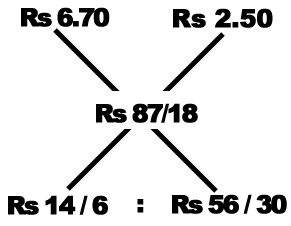
Cost of (18g of 1st metal + 18g of 2nd metal) = Rs. 165.60
Cost of (1g of 1st metal + 1g metal of 2nd metal) = Rs. 9.20
Hence cost of 1g of 2nd metal,
= 9.20 - 6.70
= Rs. 2.5
Mean price = Rs. $$\frac{{87}}{{18}}$$
Alligation mcq Solution 10
Now, $$\frac{{{\text{quantity}}\,{\text{of}}\,{1^{{\text{st}}}}\,{\text{metal}}}}{{{\text{quantity}}\,{\text{of}}\,{2^{{\text{nd}}}}\,{\text{metal}}}}$$     $$ = $$ $$\frac{{14}}{6}:\frac{{56}}{{30}} = 5:4$$
Quantity of 2nd metal = $$\frac{{18 \times 4}}{9}$$  = 8g
13
A vessel contains milk and water in the ratio 3 : 2. The volume of the contents is increased by 50% by adding water to it. From this resultant solution 30 L is withdrawn and then replaced with water. The resultant ratio of milk water in the final solution is 3 : 7. Find the original volume of the solution.
Discuss
Answer & Solution
Answer: Option A
Solution:
Let the original volume be x.
then, quantity of milk and water,
= $$\frac{{3x}}{5}$$ and $$\frac{{2x}}{5}$$ respectively.
After adding water to it, the volume becomes 150%, the quantity of milk and water,
= $$\frac{{3x}}{5}$$ and $$\frac{{9x}}{10}$$
$$\frac{{\frac{{3x}}{5} - 12}}{{\frac{{9x}}{{10}} + 12}} = \frac{3}{7}$$
14(3x - 60) = 3(9x + 120)
Or, x = 80 L

14
3 L water is taken out from vessel full of water and substituted by pure milk. This process is repeated two more times. Finally, the ratio of milk and water in the solution becomes 1728 : 27. Find the volume of the original solution.
Discuss
Answer & Solution
Answer: Option C
Solution:
We use formula for it where
n = number of time process of out going repeated.
y = Out going milk in process.
x = Volume of original solution.
F = Final milk left in mixture.
$$F = x{\left( {1 - \frac{y}{x}} \right)^n}$$
Final quantity of water,
$$F = x{\left( {1 - \frac{3}{x}} \right)^3}$$
$$\frac{F}{x} = {\left( {\frac{{x - 3}}{x}} \right)^3}$$
$$\frac{{27}}{{1728}} = {\left( {\frac{{x - 3}}{x}} \right)^3}$$
$${\left( {\frac{3}{{12}}} \right)^3} = {\left( {\frac{{x - 3}}{x}} \right)^3}$$
$$\frac{3}{{12}} = \frac{{x - 3}}{x}$$
$$x = 4 \,\text{L}$$
15
One quantity of wheat at Rs 9.30 per Kg is mixed with another quality at a certain rate in the ratio 8 : 7. If the mixture so formed be worth Rs 10 per Kg, what is the rate per Kg of the second quality of wheat?
Discuss
Answer & Solution
Answer: Option B
Solution:
Let the rate of second quality be Rs. x per Kg.
C.P of 1 Kg wheat of 1st kind = 930 p
C.P of 1 Kg wheat of 2nd kind = 100x p
Mean price = 1000 p
By rule of alligation we have required ratio 8 : 7
930 x / (Mean Price) (1000) / (x-10) : 0.7
So we get required ratio, (x-10) : 0.7 :: 8 : 7
⇒ x = 10.80 per Kg

16
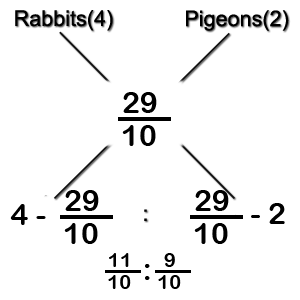
In a zoo, there are Rabbits and Pigeons. If heads are counted, there are 200 and if legs are counted, there are 580. How many pigeons are there?
Discuss
Answer & Solution
Answer: Option C
Solution:
Heads Count = 200
Legs count = 580
Average Legs count for per head = $$\frac{{580}}{{200}}$$ = $$\frac{{29}}{{10}}$$
Alligation mcq solution image
Rabbits : Pigeons = $$\frac{{9}}{{10}}$$ : $$\frac{{11}}{{10}}$$ = 9 : 11
Number of Pigeons = $$200 \times \frac{{11}}{{20}}$$  = 110
17
A vessel is filled with liquid, 3 parts of which are water and 5 parts syrup. How much of the mixture must be drawn off and replaced with water so that the mixture may be half water and half syrup?
Discuss
Answer & Solution
Answer: Option C
Solution:
Suppose the vessel initially contains 8 litres of liquid.
Let x litres of this liquid be replaced with water.
Quantity of water in new mixture = $$\left( {3 - \frac{{3x}}{8} + x} \right)$$   litres
Quantity of syrup in new mixture = $$\left( {5 - \frac{{5x}}{8}} \right)$$   litres
$$\eqalign{ & \therefore {3 - \frac{{3x}}{8} + x} = {5 - \frac{{5x}}{8}} \cr & \Rightarrow 5x + 24 = 40 - 5x \cr & \Rightarrow 10x = 16 \cr & \Rightarrow x = \frac{8}{5} \cr} $$
So, part of the mixture replaced
$$\eqalign{ & = {\frac{8}{5} \times \frac{1}{8}} \cr & = \frac{1}{5} \cr} $$
18
Tea worth Rs. 126 per kg and Rs. 135 per kg are mixed with a third variety in the ratio 1 : 1 : 2. If the mixture is worth Rs. 153 per kg, the price of the third variety per kg will be:
Discuss
Answer & Solution
Answer: Option C
Solution:
Since first and second varieties are mixed in equal proportions.
So, their average price
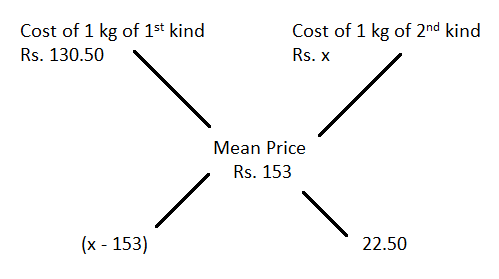
$$\eqalign{ & = {\text{Rs}}{\text{.}}\,\,\left( {\frac{{126 + 135}}{2}} \right) \cr & = {\text{Rs}}{\text{.}}\,\,130.50 \cr} $$
So, the mixture is formed by mixing two varieties, one at Rs. 130.50 per kg and the other at say, Rs. x per kg in the ratio 2 : 2, i.e., 1 : 1. We have to find x.
By the rule of alligation, we have:
Alligation mcq solution image
$$\eqalign{ & \therefore \frac{{x - 153}}{{22.50}} = 1 \cr & \Rightarrow x - 153 = 22.50 \cr & \Rightarrow x = 175.50 \cr} $$
19
A can contains a mixture of two liquids A and B is the ratio 7 : 5. When 9 litres of mixture are drawn off and the can is filled with B, the ratio of A and B becomes 7 : 9. How many litres of liquid A was contained by the can initially?
Discuss
Answer & Solution
Answer: Option C
Solution:
$$\eqalign{ & {\text{Suppose}}\,{\text{the}}\,{\text{can}}\,{\text{initially}}\,{\text{contains}}\, \cr & 7x\,{\text{and}}\,5x\,{\text{of}}\,{\text{mixtures}}\,{\text{A}}\,{\text{and}}\,{\text{B}}\,{\text{respectively}}. \cr & {\text{Quantity}}\,{\text{of}}\,{\text{A}}\,{\text{in}}\,{\text{mixture}}\,{\text{left}} \cr & = \left( {7x - \frac{7}{{12}} \times 9} \right)\,{\text{litres}} \cr & = \left( {7x - \frac{{21}}{4}} \right)\,{\text{litres}} \cr & {\text{Quantity}}\,{\text{of}}\,{\text{B}}\,{\text{in}}\,{\text{mixture}}\,{\text{left}} \cr & = \left( {5x - \frac{5}{{12}} \times 9} \right)\,{\text{litres}} \cr & = \left( {5x - \frac{{15}}{4}} \right)\,{\text{litres}} \cr & \therefore \frac{{\left( {7x - \frac{{21}}{4}} \right)}}{{\left( {5x - \frac{{15}}{4}} \right) + 9}} = \frac{7}{9} \cr & \Rightarrow \frac{{28x - 21}}{{20x + 21}} = \frac{7}{9} \cr & \Rightarrow 252x - 189 = 140x + 147 \cr & \Rightarrow 112x = 336 \cr & \Rightarrow x = 3 \cr} $$
So, the can contained 21 litres of A
20
A milk vendor has 2 cans of milk. The first contains 25% water and the rest milk. The second contains 50% water. How much milk should he mix from each of the containers so as to get 12 litres of milk such that the ratio of water to milk is 3 : 5?
Discuss
Answer & Solution
Answer: Option B
Solution:
Let the cost of 1 litre milk be Rs. 1
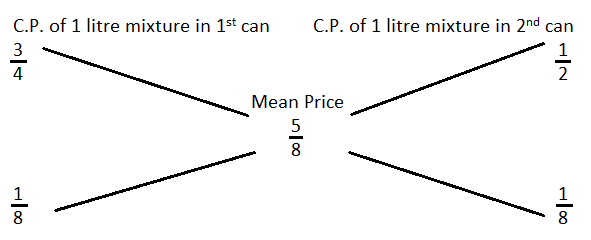
Milk in 1 litre mixture in 1st can = $$\frac{{3}}{{4}}$$ litre, C.P. of 1 litre mixture in 1st can Rs. $$\frac{{3}}{{4}}$$
Milk in 1 litre mixture in 2nd can = $$\frac{{1}}{{2}}$$ litre, C.P. of 1 litre mixture in 2nd can Rs. $$\frac{{1}}{{2}}$$
Milk in 1 litre of final mixture = $$\frac{{5}}{{8}}$$ litre, Mean price = Rs. $$\frac{{5}}{{8}}$$
By the rule of alligation, we have:
Alligation mcq solution image
∴ Ratio of two mixtures = $$\frac{{1}}{{8}}$$ : $$\frac{{1}}{{8}}$$ = 1 : 1
So, quantity of mixture taken from each can = $$\left( {\frac{1}{2} \times 12} \right)$$  = 6 litres