ExamVeda
Login
Home
11
A string of length 24 cm is bent first into a square and then into a right-angled triangle by keeping one side of the square fixed as its base. Then the area of triangle equals to:
Discuss
Answer & Solution
Answer: Option A
Solution:
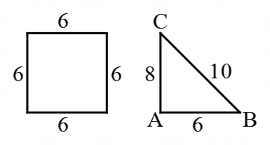
Mensuration 2D mcq question image
$$\eqalign{ & {\text{Side of square}} = \frac{{24}}{4} = 6 \cr & {\text{Then area of }}\Delta ABC = \frac{1}{2} \times 8 \times 6 = 24{\text{ c}}{{\text{m}}^2} \cr} $$
12
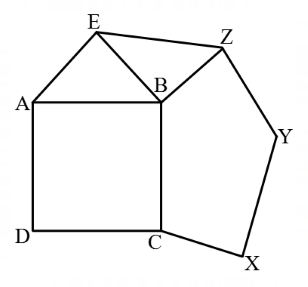
In the given figure, ABCD is a square, BCXYZ is a regular pentagon and ABE is an equilateral triangle. What is the value (in degrees) of ∠EBZ ?
Mensuration 2D mcq question image
Discuss
Answer & Solution
Answer: Option A
Solution:
Mensuration 2D mcq question image
AB = BC = CD = DA
BC = CX = XY = YZ = BZ
AB = BE = AE
In ΔABE
∠A = ∠B = ∠E = 60°
In Pentagon BCXYZ
Each internal angle of a pentagon = $$\frac{{\left( {n - 2} \right) \times 180}}{n}$$
∠ZBC = $$\frac{{3 \times 180}}{5} \times {108^ \circ }$$
∠EBZ + ∠ABE + ∠ABC + ∠ZBC = 360°
∠EBZ + 60° + 90° + 180° = 360°
∠EBZ = 102°
13
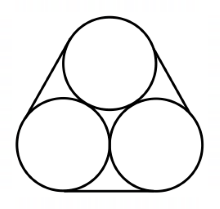
Three circles of diameter 10 cm each are bound together by a rubber band as shown in the figure.
Mensuration 2D mcq question image
The length of the rubber band (in cm) if it is stretched is
Discuss
Answer & Solution
Answer: Option B
Solution:
Length of rubber band
= 3d + 2πr
= 30 + 10π
14
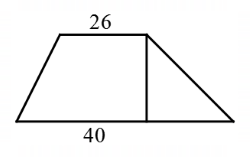
Parallel sides of a trapezium are 26 cm and 40 cm and the area is 792 cm2. What is the value of distance between parallel sides?
Discuss
Answer & Solution
Answer: Option A
Solution:
Mensuration 2D mcq question image
Area of trapezium = $$\frac{1}{2}$$ × sum of parallel side × Distance between them
792 = $$\frac{1}{2}$$ (26 + 40) × Distance
$$\frac{{792 \times 2}}{{66}}$$   = Distance
∴ Distance = 24
15
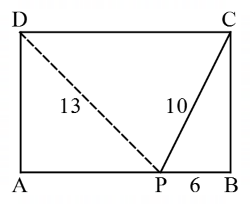
ABCD is a rectangle. P is a point on the side AB as shown in the given figure. If DP = 13, CP = 10 and BP = 6, then what is the value of AP?
Mensuration 2D mcq question image
Discuss
Answer & Solution
Answer: Option A
Solution:
Mensuration 2D mcq question image
$$\eqalign{ & {\text{In }}\Delta PCB \cr & BC = \sqrt {{{10}^2} - {6^2}} = 8\,{\text{cm}} \cr & BC = AD = 8\,{\text{cm}} \cr & {\text{In }}\Delta ADP \cr & AP = \sqrt {{{13}^2} - {8^2}} \cr & AP = \sqrt {169 - 64} = \sqrt {105} \cr} $$
16
A hall 25 metres long and 15 metres broad is surrounded by a varandah of uniform width of 3.5 metres. The cost of flooring the varandah, at Rs. 27.50 per square metre is:
Discuss
Answer & Solution
Answer: Option C
Solution:
Area of verandah
Area of verandah on outer boundary = 2x($$l$$ + b + 2x)
= 2 × 3.5(25 + 15 + 2 × 3.5) = 329 m2
Cost of flooring = 329 × 27.5 = Rs. 9047.50 (approx.)
17
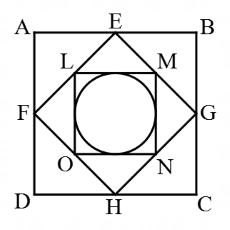
In the given figure, ABCD is a square, EFGH is a square formed by joining mid points of sides of ABCD. LMNO is a square formed by joining mid points of sides of EFGH. A circle is inscribed inside EFGH. If area of circle is 38.5 cm2, then what is the area (in cm2) of square ABCD ?
Mensuration 2D mcq question image
Discuss
Answer & Solution
Answer: Option B
Solution:
Area of circle = 38.5
πr2 = 38.5
r2 = $$\frac{{385}}{{10}} \times \frac{7}{{22}}$$
r = $$\frac{7}{2}$$ cm
MN = 2r = 7 cm
Mensuration 2D mcq question image
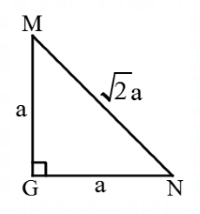
$${\sqrt 2 }$$ a = 7 cm
a = $$\frac{7}{{\sqrt 2 }}$$ cm
Side of square EFGH = 2 × a
EG = 7$${\sqrt 2 }$$ cm
Mensuration 2D mcq question image
$${\sqrt 2 }$$ b = 7$${\sqrt 2 }$$
b = 7 cm
Side of square ABCD = 7 × 2 = 14 cm
Area = a2 = 142 = 196 cm2
18
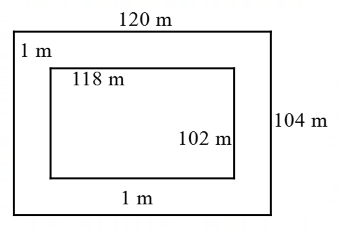
A rectangular park is 120 m long and 104 m wide. A 1-m wide path runs along the boundary of the park, remaining completely inside the park area. Thus, the outside edges of the path run along the boundary wall of the park. The inside edges of the path are marked with a white line of negligible thickness. If it costs Rs. 2.50 to mark each metre with the white line, then how much would it cost (in Rs.) to fully mark the inside edges of the path?
Discuss
Answer & Solution
Answer: Option A
Solution:
Mensuration 2D mcq question image
Perimeter of road = 2(118 + 102)
= 2 × (220)
= 440
Required cost = 440 × $$\frac{5}{2}$$
= Rs. 1110
19
The sides of a triangle are in the ratio $$\frac{1}{3}:\frac{1}{5}:\frac{1}{6}.$$   If the perimeter is 147 cm, then the length of the smallest side is . . . . . . . .
Discuss
Answer & Solution
Answer: Option D
Solution:
$$\eqalign{ & {\text{Side ratio}} = \frac{1}{3}:\frac{1}{5}:\frac{1}{6} = \boxed{10:6:5} \cr & 21\mu \to 147 \cr & 1\mu \to 7 \cr & {\text{Smallest side, }}5\mu \to 5 \times 7 = 35 \cr} $$
20
What is the area (in sq cm) of a regular hexagon of side 14 cm?
Discuss
Answer & Solution
Answer: Option D
Solution:
$$\eqalign{ & {\text{Area of the hexagon}} \cr & \Rightarrow 6 \times \frac{{\sqrt 3 }}{4} \times {a^2} \cr & \Rightarrow 6 \times \frac{{\sqrt 3 }}{4} \times 14 \times 14 \cr & \Rightarrow 294\sqrt 3 \cr} $$