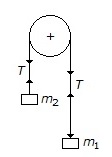
If the masses of both the bodies, as shown in the below figure, are doubled, then the acceleration in the string will be

A. Same
B. Half
C. Double
D. None of these
Answer: Option A

A. Same
B. Half
C. Double
D. None of these
Answer: Option A
The resultant of two equal forces P making an angle $$\theta ,$$ is given by
A. $$2{\text{P}}\sin \frac{\theta }{2}$$
B. $$2{\text{P}}\cos \frac{\theta }{2}$$
C. $$2{\text{P}}\tan \frac{\theta }{2}$$
D. $$2{\text{P}}\cot \frac{\theta }{2}$$
A. Equal to
B. Less than
C. Greater than
D. None of these
If a number of forces are acting at a point, their resultant is given by
A. $${\left( {\sum {\text{V}} } \right)^2} + {\left( {\sum {\text{H}} } \right)^2}$$
B. $$\sqrt {{{\left( {\sum {\text{V}} } \right)}^2} + {{\left( {\sum {\text{H}} } \right)}^2}} $$
C. $${\left( {\sum {\text{V}} } \right)^2} + {\left( {\sum {\text{H}} } \right)^2} + 2\left( {\sum {\text{V}} } \right)\left( {\sum {\text{H}} } \right)$$
D. $$\sqrt {{{\left( {\sum {\text{V}} } \right)}^2} + {{\left( {\sum {\text{H}} } \right)}^2} + 2\left( {\sum {\text{V}} } \right)\left( {\sum {\text{H}} } \right)} $$
A. $${\text{a}} = \frac{\alpha }{{\text{r}}}$$
B. $${\text{a}} = \alpha {\text{r}}$$
C. $${\text{a}} = \frac{{\text{r}}}{\alpha }$$
D. None of these
Acceleration will be same and Tension will be doubled