

The figure shows the plot of y as a function of x
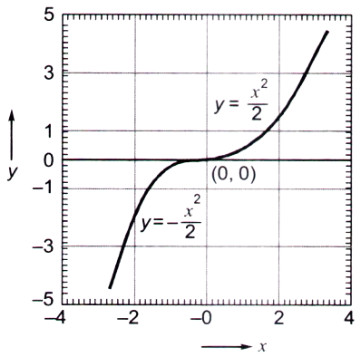
The function shown is the solution of the differential equation (assuming all initial conditions to be zero) is
A. $$\frac{{{{\text{d}}^2}{\text{y}}}}{{{\text{d}}{{\text{x}}^2}}} = 1$$
B. $$\frac{{{\text{dy}}}}{{{\text{dx}}}} = {\text{x}}$$
C. $$\frac{{{\text{dy}}}}{{{\text{dx}}}} = - {\text{x}}$$
D. $$\frac{{{\text{dy}}}}{{{\text{dx}}}} = \left| {\text{x}} \right|$$
Answer: Option D
A. $${\text{y}} = \left( {{{\text{C}}_1} - {{\text{C}}_2}{\text{x}}} \right){{\text{e}}^{\text{x}}} + {{\text{C}}_3}\cos {\text{x}} + {{\text{C}}_4}\sin {\text{x}}$$
B. $${\text{y}} = \left( {{{\text{C}}_1} + {{\text{C}}_2}{\text{x}}} \right){{\text{e}}^{\text{x}}} - {{\text{C}}_2}\cos {\text{x}} + {{\text{C}}_4}\sin {\text{x}}$$
C. $${\text{y}} = \left( {{{\text{C}}_1} + {{\text{C}}_2}{\text{x}}} \right){{\text{e}}^{\text{x}}} + {{\text{C}}_3}\cos {\text{x}} + {{\text{C}}_4}\sin {\text{x}}$$
D. $${\text{y}} = \left( {{{\text{C}}_1} + {{\text{C}}_2}{\text{x}}} \right){{\text{e}}^{\text{x}}} + {{\text{C}}_3}\cos {\text{x}} - {{\text{C}}_4}\sin {\text{x}}$$
A. $$\sqrt {1 - {{\text{x}}^2}} = {\text{c}}$$
B. $$\sqrt {1 - {{\text{y}}^2}} = {\text{c}}$$
C. $$\sqrt {1 - {{\text{x}}^2}} + \sqrt {1 - {{\text{y}}^2}} = {\text{c}}$$
D. $$\sqrt {1 + {{\text{x}}^2}} + \sqrt {1 + {{\text{y}}^2}} = {\text{c}}$$
Join The Discussion