

The input voltage V1 and current I1 for linear passive network is given by V1 = AV2 - BI2 and I1 = CV2 - DI2
Now consider the following network:
Which one of the following is the transfer matrix \[\left[ {\begin{array}{*{20}{c}}
{\text{A}}&{\text{B}} \\
{\text{C}}&{\text{D}}
\end{array}} \right]\] of the network shown above?
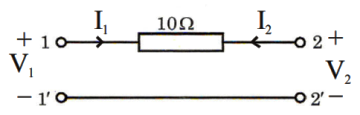
A. \[\left[ {\begin{array}{*{20}{c}} 1&0 \\ 0&{10} \end{array}} \right]\]
B. \[\left[ {\begin{array}{*{20}{c}} 1&{10} \\ 0&1 \end{array}} \right]\]
C. \[\left[ {\begin{array}{*{20}{c}} 0&1 \\ {10}&0 \end{array}} \right]\]
D. \[\left[ {\begin{array}{*{20}{c}} 0&{10} \\ 1&0 \end{array}} \right]\]
Answer: Option B
A. Negative
B. Positive
C. Determined by battery e.m.f.
D. Zero
The number of independent equations to solve a network is equal to
A. The number of chords
B. The number of branches
C. Sum of the number of branches and chords
D. Sum of number of branches, chords and nodes
A closed path made by several branches of the network is known as
A. Branch
B. Loop
C. Circuit
D. Junction
Which of the following is not a nonlinear element ?
A. Gas diode
B. Heater coil
C. Tunnel diode
D. Electric arc
Join The Discussion