
?
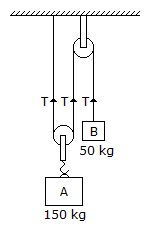
Two blocks ‘A’ and ‘B’ of masses 150 kg and 50 kg respectively are connected by means of a string as shown in the below figure. The tension in all the three strings __________ be same.
Competitive Exams MCQs
Aptitude
English
Verbal Reasoning
Non Verbal Reasoning
General Knowledge(GK)
General Science(GS)
Data Interpretation(DI)
Banking Awareness
Current Affairs
Computer Fundatmental MCQs
Computer Fundamentals
Microsoft Word
Microsoft Excel
MS Power Point
Tally
Operating System
Python
AI(Artificial Intelligence)

Join the Discussion
Login to post a comment or share your explanation.
LoginSo, the tension in 1st string from the right side is 75. Which is the same in the other two as 150/2 =75.
So 75 n tension in each string