

A source produces binary data at the rate of 10 kbps. The binary symbols are represented as shown in the figure.
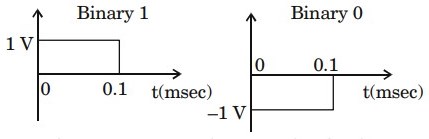
The source output is transmitted using two modulation schemes, namely Binary PSK (BPSK) and Quadrature PSK (QPSK). Let and B2 be the bandwidth requirements of BPSK and QPSK respectively. Assuming that the bandwidth of the above rectangular pulses is 10 kHz, B1 and B2 are
A. B1 = 20 kHz, B2 = 20 kHz
B. B1 = 10 kHz, B2 = 20 kHz
C. B1 = 20 kHz, B2 = 10 kHz
D. B1 = 10 kHz, B2= 10 kHz
Answer: Option C
Related Questions on Digital Communication
A. Only 800 Hz component
B. 800 Hz and 900 Hz components
C. 800 Hz and 1000 Hz components
D. 800 Hz, 900 Hz and 100 Hz components
Increased pulse width in the flat top sampling, leads to
A. Attenuation of high frequencies in reproduction
B. Attenuation of low frequencies in reproduction
C. Greater aliasing errors in reproduction.
D. No harmful effects in reproduction
Join The Discussion