
ExamVeda
Login
Home
41
The circumferences of two circle are 132 metres and 176 metres respectively. What is the difference between the area of the larger circle and the smaller circle ?
Discuss
Answer & Solution
Answer: Option C
Solution:
$$\eqalign{ & \Rightarrow 2\pi {R_1} = 132 \cr & \Rightarrow {R_1} = \frac{{132 \times 7}}{{2 \times 22}} \cr & \Rightarrow {R_1} = 21\,m \cr & \Rightarrow 2\pi {R_2} = 176 \cr & \Rightarrow {R_2} = \frac{{176 \times 7}}{{2 \times 22}} \cr & \Rightarrow {R_2} = 28\,m \cr & \therefore {\text{Required difference :}} \cr & = \pi \left( {R_2^2 - R_2^2} \right) \cr & = \pi \left( {{R_2} + {R_1}} \right)\left( {{R_2} - {R_1}} \right) \cr & = \left( {\frac{{22}}{7} \times 49 \times 7} \right){m^2} \cr & = 1078\,{m^2} \cr} $$
42
The ratio of the radii of two circles is 1 : 3. Then the ratio of their areas is :
Discuss
Answer & Solution
Answer: Option C
Solution:
Let the radii of the two circle be r and 3r respectively.
Then, required ratio :
$$ = \frac{{\pi {r^2}}}{{\pi {{\left( {3r} \right)}^2}}} = \frac{{\pi {r^2}}}{{9\pi {r^2}}} = 1:9$$
43
The circumference of a circular ground is 88 metres. A strip of land, 3 metres wide, inside and along the circumference of the ground is to be levelled. What is the budgeted expenditure if the levelling costs Rs. 7 per square metre ?
Discuss
Answer & Solution
Answer: Option D
Solution:
Let the radius of the ground be R metres.
Then,
$$\eqalign{ & \Rightarrow 2\pi R = 88 \cr & \Rightarrow R = \left( {\frac{{88 \times 7}}{{2 \times 22}}} \right) \cr & \Rightarrow R = 14\,m \cr} $$
Area of land strip :
$$\eqalign{ & = \pi \left[ {{{\left( {14} \right)}^2} - {{\left( {11} \right)}^2}} \right]{m^2} \cr & = \left( {\frac{{22}}{7} \times 25 \times 3} \right){m^2} \cr & = \left( {\frac{{1650}}{7}} \right){m^2} \cr} $$
∴ Cost of levelling :
$$\eqalign{ & = {\text{Rs}}{\text{.}}\left( {\frac{{1650}}{7} \times 7} \right) \cr & = {\text{Rs}}{\text{. 1650}} \cr} $$
44
If the circumference of a circle is 100 units, then what will be the length of the arc described by an angle of 20 degrees ?
Discuss
Answer & Solution
Answer: Option A
Solution:
$$2\pi r = 100$$
So, length of the arc :
$$\eqalign{ & = \frac{{2\pi r\theta }}{{360}} \cr & = \left( {\frac{{100 \times 20}}{{360}}} \right){\text{units}} \cr & = \left( {\frac{{50}}{9}} \right){\text{ units}} \cr & = 5.55{\text{ units}} \cr} $$
45
If in a triangle, the area is numerically equal to the perimeter, then the radius of the inscribed circle of the triangle is :
Discuss
Answer & Solution
Answer: Option C
Solution:
$$\eqalign{ & {\text{Radius}} = \frac{{{\text{Area}}}}{{{\text{Semi - perimeter}}}} \cr & {\text{Radius}} = \left( {{\text{Area}} \times \frac{2}{{{\text{Area}}}}} \right) \cr & {\text{Radius}} = 2 \cr} $$
46
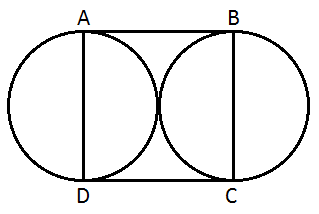
Two equal circle are drawn in square in such a way that a side of the square forms diameter of each circle. If the remaining area of the square is 42 cm2, how much will the diameter of the circle measure ?
Discuss
Answer & Solution
Answer: Option C
Solution:
Area mcq solution image
Let length of each side of square = 2π
According to the question,
$$\eqalign{ & \frac{{\pi {r^2}}}{2} + \frac{{\pi {r^2}}}{2} + 42 = {\text{Area of square}} \cr & \Rightarrow \pi {r^2} + 42 = 4{r^2} \cr & \Rightarrow 4{r^2} - \pi {r^2} = 42 \cr & \Rightarrow {r^2}\left( {4 - \frac{{22}}{7}} \right) = 42 \cr & \Rightarrow {r^2}\left( {\frac{{28 - 22}}{7}} \right) = 42 \cr & \Rightarrow \frac{{6{r^2}}}{7} = 42 \cr & \Rightarrow {r^2} = \frac{{42 \times 7}}{6} \cr & \Rightarrow {r^2} = 7 \times 7 \cr & \Rightarrow r = 7 \cr & \therefore 2r = 14\,cm \cr} $$
47
The base of triangle is 15 cm and height is 12 cm the height of another triangle of double the area having base 20 cm is :
Discuss
Answer & Solution
Answer: Option C
Solution:
Given base of triangle and its height is 15 cm and 12 cm respectively
Area of first triangle :
$$\eqalign{ & = \frac{1}{2} \times {\text{Base}} \times {\text{Height}} \cr & = \frac{1}{2} \times 15 \times 12 \cr & = 90{\text{ sq}}{\text{. cm}} \cr} $$
According to the question,
Let height of triangle be h cm
Area of new triangle = 180 sq. cm
Base = 20 sq. cm
$$\eqalign{ & \Rightarrow 180 = \frac{1}{2} \times 20 \times {\text{Height}} \cr & \Rightarrow {\text{h}} = \frac{{2 \times 180}}{{20}} \cr & \Rightarrow {\text{h}} = 18{\text{ cm}} \cr} $$
48
The difference between the length and breadth of a rectangle is 23 m. If its perimeter is 206 m, then its area is :
Discuss
Answer & Solution
Answer: Option D
Solution:
We have :
(l - b) = 23 and 2(l + b) = 206 or (l + b) = 103
Solving the two equations, we get :
l = 63 and b = 40
∴ Area = (l × b) = (63 × 40)m2 = 2520 m2
49
The length of a rectangle is three times of its width. If the length of the diagonal is $$8\sqrt {10} $$ cm, then the perimeter of the rectangle is :
Discuss
Answer & Solution
Answer: Option D
Solution:
Let breadth = x cm
Then, length = 3x cm
$$\eqalign{ & \Rightarrow {x^2} + {\left( {3x} \right)^2} = {\left( {8\sqrt {10} } \right)^2} \cr & \Rightarrow 10{x^2} = 640 \cr & \Rightarrow {x^2} = 64 \cr & \Rightarrow x = 8 \cr} $$
So, length = 24 cm and breadth = 8 cm
∴ Perimeter = [2(24 + 8)] cm = 64 cm
50
A typist uses a paper 30 cm by 15 cm. He leaves a margin of 2.5 cm at the top and bottom and 1.25 cm on either side. What percentage of paper area is approximately available for typing ?
Discuss
Answer & Solution
Answer: Option C
Solution:
Area of the sheet = (30 × 15) cm2 = 450 cm2
Area used for typing
= [(30 - 5) × (15 - 2.5)] cm2
= 312.5 cm2
∴ Required percentage :
$$\eqalign{ & = \left( {\frac{{312.5}}{{450}} \times 100} \right)\% \cr & = 69.4\% \approx 70\% \cr} $$