ExamVeda
Login
Home
11
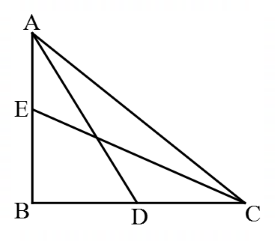
In a right-angled triangle, the length of the medians from the vertices of acute angles are 7 cm and $$4\sqrt 6 $$  cm. What is the length of the hypotenuse of the triangle (in cm)?
Discuss
Answer & Solution
Answer: Option D
Solution:
Geometry mcq question image
$$\eqalign{ & AD = 7{\text{ cm}} \cr & CE = 4\sqrt 6 {\text{ cm}} \cr & {\text{Since, }}4\left( {A{D^2} + C{E^2}} \right) = 5A{C^2} \cr & 4\left( {{{\left( 7 \right)}^2} + {{\left( {4\sqrt 6 } \right)}^2}} \right) = 5A{C^2} \cr & 4\left( {49 + 96} \right) = 5A{C^2} \cr & 4\left( {145} \right) = 5A{C^2} \cr & A{C^2} = \frac{{4 \times 145}}{5} \cr & AC = \sqrt {4 \times 29} \cr & AC = 2\sqrt {29} {\text{ cm}} \cr} $$
12
Three sides of a triangle measure 6 cm, 10 cm and x cm. The minimum integral value of x is:
Discuss
Answer & Solution
Answer: Option D
Solution:
Sides of triangle are 6 cm, 10 cm, x cm. As we know in a triangle sum of two sides is always greater than the 3rd side. So minimum integral value of x is 5.
Hence option (D) is correct answer.
13
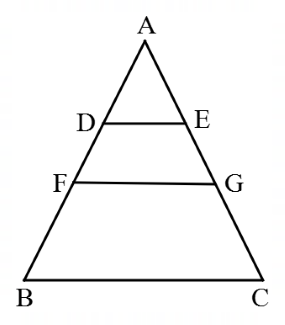
In the given triangle, D and E are the mid-points of AF and AG, F and G are the mid-points of AB and AC. If DE = 2.4 cm, then value of BC is:-
Geometry mcq question image
Discuss
Answer & Solution
Answer: Option C
Solution:
As D and E are mid-points of AF and AG,
∴ Length
⇒ DE = $$\frac{1}{2}$$ FG
⇒ FG = 2 × DE
⇒ FG = 2 × 2.4
⇒ FG = 4.8 cm
As F and G are the mid-points of AB and AC
∴ Length
⇒ FG = $$\frac{1}{2}$$ BC
⇒ BC = 2 × FG
⇒ BC = 2 × 4.8
⇒ BC = 9.6 cm
14
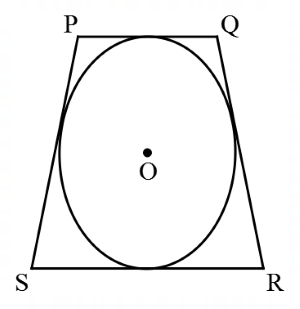
In the given figure, a circle touches the sides of the quadrilateral PQRS. The radius of the circle is 9 cm. ∠RSP = ∠SRQ = 60° and ∠PQR = ∠QPS = 120°. What is the perimeter (in cm) of the quadrilateral?
Geometry mcq question image
Discuss
Answer & Solution
Answer: Option C
Solution:
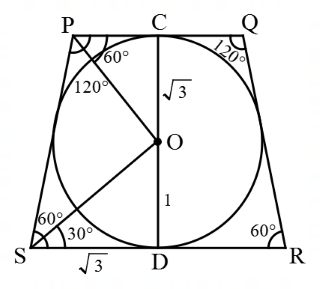
Geometry mcq question image
In ΔODS
1 unit → 9 cm
√3 units → 9√3 cm
So, D is the mid point of SR
So DS = 9√3
SR = 18√3
In ΔPCO
√3 units → 9 unit
1 unit → $$\frac{9}{{\sqrt 3 }}$$ = 3√3 = PC
⇒ PQ = 6√3
Sum of pair of 2 opposite side is equal to sum of pair of other two opposite sides.
So, PQ + SR = SP + QR
Perimeter = 2(18√3 + 6√3) = 48√3
15
ln ΔABC, M is midpoint of the side AB. N is a point in the interior of ΔABC such that CN is the bisector of ∠C and CN ⊥ NB. What is the length (in cm) of MN, if BC = 10 cm and AC = 15 cm?
Discuss
Answer & Solution
Answer: Option D
No explanation is given for this question. Let's Discuss on Board
16
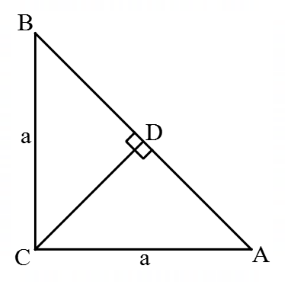
ABC is an isosceles right angle triangles having ∠C = 90°. If D is mid point on AB, then AD2 + BD2 is equal to
Discuss
Answer & Solution
Answer: Option B
Solution:
Geometry mcq question image
ΔABC is a right angle triangle.
In which ∠C = 90° and D is a point on AB such that D is perpendicular on AB.
Let AC = BC = a
∴ AB2 = AC2 + BC2 = a2 + a2
$$\eqalign{ & \boxed{AB = a\sqrt 2 } \cr & \therefore BD = AD = \frac{{a\sqrt 2 }}{2} = \frac{a}{{\sqrt 2 }} \cr & {\text{Now in }}\Delta ACD \cr & = A{C^2} = C{D^2} + A{D^2} \cr & {a^2} = C{D^2} + \frac{{{a^2}}}{2} \cr & {a^2} - \frac{{{a^2}}}{2} = C{D^2} \cr & \boxed{\frac{{{a^2}}}{2} = C{D^2}} \cr & C{D^2} = \frac{{{a^2}}}{2} \cr & 2C{D^2} = {a^2} \cr & {\text{and }}A{D^2} + B{D^2} = {\left( {\frac{a}{{\sqrt 2 }}} \right)^2} + {\left( {\frac{a}{{\sqrt 2 }}} \right)^2} \cr & = \frac{a}{{\sqrt 2 }} + \frac{a}{{\sqrt 2 }} \cr & = {a^2} \cr & \therefore \boxed{2C{D^2} = A{D^2} + B{D^2}} \cr} $$
17
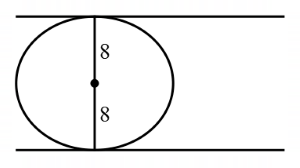
What is the distance between two parallel tangents of a circle of radius 8 cm?
Discuss
Answer & Solution
Answer: Option C
Solution:
Geometry mcq question image
Distance = 8 + 8 = 16
18
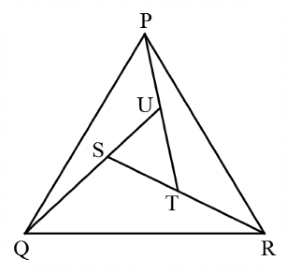
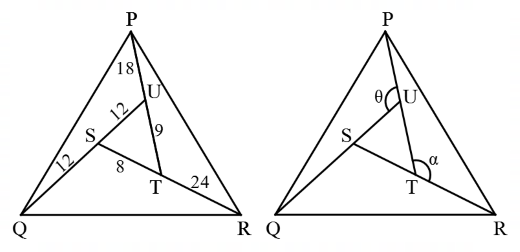
In the given figure, in triangle STU, ST = 8 cm, TU = 9 cm and SU = 12 cm. QU = 24 cm, SR = 32 cm and PT = 27 cm. What is the ratio of the area of triangle PQU and area of triangle PTR?
Geometry mcq question image
Discuss
Answer & Solution
Answer: Option C
Solution:
Geometry mcq question image
$$\eqalign{ & {\text{Let }}\angle PUQ = \theta \cr & {\text{Then }}\angle SUT = 180 - \theta \cr & {\text{And}}\,{\text{let }}\angle RTP = \alpha \cr & {\text{Then }}\angle STU = 180 - \alpha \cr & \therefore {\text{Ratio of area of }}\frac{{\Delta PUQ}}{{\Delta SUT}} \cr & = \frac{{\frac{1}{2} \times 18 \times 24 \times \sin \theta }}{{\frac{1}{2} \times 12 \times 9 \times \sin \left( {180 - \theta } \right)}} = \frac{{4\sin \theta }}{{\sin \theta }} \cr & \frac{{\Delta PUQ}}{{\Delta SUT}} = \frac{4}{1} \cr & {\text{Now, ratio of area of }}\frac{{\Delta PTR}}{{\Delta SUT}} \cr & = \frac{{\frac{1}{2} \times 27 \times 24 \times \sin \alpha }}{{\frac{1}{2} \times 9 \times 8 \times \sin \left( {180 - \alpha } \right)}} = \frac{{9\sin \alpha }}{{\sin \alpha }} \cr & \frac{{\Delta PTR}}{{\Delta SUT}} = \frac{9}{1} \cr & \therefore {\text{Ratio of area of }}\frac{{\Delta PQU}}{{\Delta PTR}} = \frac{4}{9} \cr} $$
19
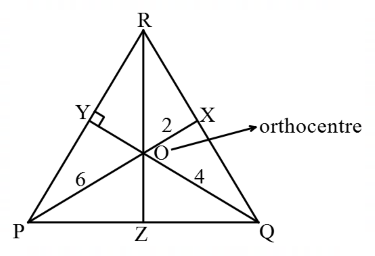
In a triangle PQR, PX, QY and RZ be altitudes intersecting at O. If PO = 6 cm, PX = 8 cm and QO = 4 cm, then what is the value (in cm) of QY?
Discuss
Answer & Solution
Answer: Option D
Solution:
Geometry mcq question image
PO × OX = QO × OY = RO × OZ
6 × 2 = 4 × OY
OY = 3
∴ Then QY = QO + OY = 4 + 3 = 7 cm
20
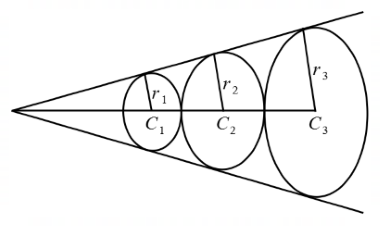
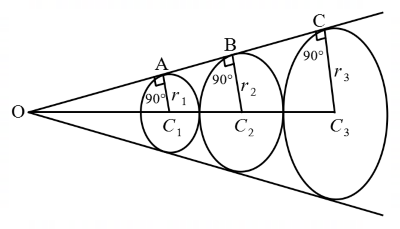
Three circle C1, C2 and C3 with radii r1, r2 and r3 (where r1 < r2 < r3) are placed as shown in the given figure. What is the value of r2?
Geometry mcq question image
Discuss
Answer & Solution
Answer: Option A
Solution:
Geometry mcq question image
$$\eqalign{ & AB = \sqrt {4{r_1}.{r_2}} \cr & BC = \sqrt {4{r_2}.{r_3}} \cr & AC = \sqrt {{{\left( {{r_1} + 2{r_2} + {r_3}} \right)}^2} - {{\left( {{r_3} - {r_1}} \right)}^2}} \cr & AB + BC = AC \cr & \sqrt {4{r_1}.{r_2}} + \sqrt {4{r_2}.{r_3}} = \sqrt {{{\left( {{r_1} + 2{r_2} + {r_3}} \right)}^2} - {{\left( {{r_3} - {r_1}} \right)}^2}} \cr & {\text{Squaring both sides}} \cr & \Rightarrow 4{r_1}.{r_2} + 4{r_2}.{r_3} + 2\sqrt {16{r_1}.{r_2}^2.{r_3}} = {\left( {{r_1} + 2{r_2} + {r_3}} \right)^2} - {\left( {{r_3} - {r_1}} \right)^2} \cr & \Rightarrow 4{r_1}.{r_2} + 4{r_2}.{r_3} + 8{r_2}\sqrt {{r_1}.{r_3}} = {r_1}^2 + 4{r_2}^2 + {r_3}^2 + 4{r_1}.{r_2} + 4{r_2}.{r_3} + 2{r_1}.{r_3} - {r_3}^2 - {r_1}^2 + 2{r_1}.{r_3} \cr & \Rightarrow 8{r_2}\sqrt {{r_1}.{r_3}} = 4{r_2}^2 + 4{r_1}.{r_3} \cr & \Rightarrow 2{r_2}\sqrt {{r_1}.{r_3}} = {r_2}^2 + {r_1}.{r_3} \cr & {\text{Squaring both sides}} \cr & \Rightarrow 4{r_2}^2.{r_1}.{r_3} = {r_2}^4 + {r_1}^2.{r_3}^2 + 2{r_2}^2.{r_1}.{r_3} \cr & \Rightarrow {\left( {{r_2}^2 - {r_1}.{r_3}} \right)^2} = 0 \cr & \Rightarrow {r_2}^2 = {r_1}.{r_3} \cr & \Rightarrow {r_2} = \sqrt {{r_1}.{r_3}} \cr} $$