ExamVeda
Login
Home
1
ABC is an isosceles triangle inscribed in a circle. If AB = AC = 12√5 and BC = 24 cm then radius of circle is
Discuss
Answer & Solution
Answer: Option B
Solution:

Geometry mcq question image
$$\eqalign{ & {R_2} = \frac{{abc}}{{4\Delta }} \cr & \Delta = \sqrt {s\left( {s - a} \right)\left( {s - b} \right)\left( {s - c} \right)} \cr & = \sqrt {12\left( {\sqrt 5 + 1} \right)\left( {12} \right) \times 12 \times 12\left( {\sqrt 5 - 1} \right)} \cr & {\text{Where, }}a = 12\sqrt 5 ,\,b = 12\sqrt 5 \,\& \,c = 24 \cr & s = \frac{{a + b + c}}{2} = \frac{{24\sqrt 5 + 24}}{2} = 12\left( {\sqrt 5 + 1} \right) \cr & {R_2} = \frac{{12\sqrt 5 \times 12\sqrt 5 \times 24}}{{4 \times 12 \times 12 \times 2}} = \frac{{30}}{2} = 15 \cr} $$
2
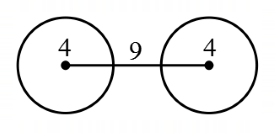
The distance between the centres, of two equal circles each of radius 4 cm is 17 cm. The length of a transverse tangent is:
Discuss
Answer & Solution
Answer: Option A
Solution:
Let the length of a transverse tangent = x
Geometry mcq question image
$$\eqalign{ & = \sqrt {{a^2} - {{\left( {{r_1} + {r_2}} \right)}^2}} \cr & = \sqrt {289 - 64} \cr & = \sqrt {225} \cr & = 15{\text{ cm}} \cr} $$
3
In the given figure, AD is bisector of angle ∠CAB and BD is bisector of angle ∠CBF. If the angle at C is 34°, the angle ∠ADB is:
Geometry mcq question image
Discuss
Answer & Solution
Answer: Option C
Solution:
Geometry mcq question image
$$\eqalign{ & \angle {\text{D}} = \frac{{\angle {\text{C}}}}{2}\left( {{\text{by angle bisector theorem}}} \right) \cr & \angle {\text{D}} = \frac{{34}}{2} \cr & \angle {\text{D}} = {17^ \circ } \cr} $$
4
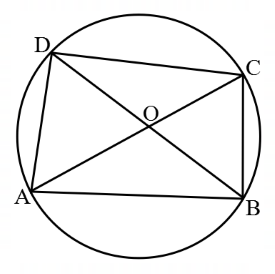
A cyclic quadrilateral ABCD is such that AB = BC, AD = DC and AC and BD intersect at O. If ∠CAD = 46°, then measure of ∠AOB is equal to:
Geometry mcq question image
Discuss
Answer & Solution
Answer: Option A
Solution:
Geometry mcq question image
∠DCA = 46°
∠DAB + ∠DCB = 180°
46° + β + 46° + β = 180°
β = 44°
∠BCA = ∠ADB = 44°
∠DOC = ∠ADO + ∠OAD
(By exterior angle theorem)
∠DOC = 44° + 46° = 90°
Note:
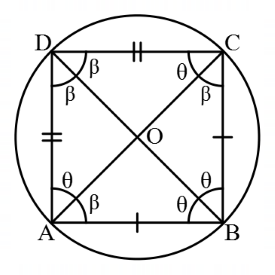
In $$\square $$ ABCD
AB = BC (Given)
AD = DC (Given)
Geometry mcq question image
Let ∠DAC = θ
So, ∠DCA = θ (angle opposite to equal side).
∠DBC = θ (angle made by same arc DC).
∠DBA = θ (angle made by same arc AD).
Similarly,
∠ADB = ∠BDC = β
So, we can say that in a cyclic quadrilateral. If pair of adjacent sides are equal then the diagonal made by the vertex situated between equals sides is angle bisector.
In ΔAOB & ΔBOC
∠OAB = ∠OCB = β
AB = BC
∠OBA = ∠OBC = θ
ΔAOB ≅ ΔBOC (By ASA)
∴ AO = OC
Hence we can say that diagonal BD bisect diagonal AC into two equal parts.
5
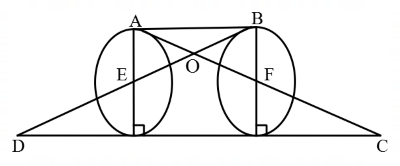
If the given figure, E and F are the centers of two identical circles. What is the ratio of area of triangle AOB to the area of triangle DOC?
Geometry mcq question image
Discuss
Answer & Solution
Answer: Option B
Solution:
Geometry mcq question image
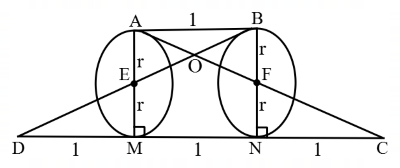
$$\eqalign{ & \Delta DEM \sim \Delta DBN \cr & \therefore \frac{{EM}}{{BN}} = \frac{{DM}}{{DN}} \cr & \frac{r}{{2r}} = \frac{{DM}}{{DN}} \cr & \Rightarrow DM:MN = 1:1 \cr & {\text{Similarly }}MN:NC = 1:1 \cr & \frac{{{\text{ar}}{\text{. }}\Delta AOB}}{{{\text{ar}}{\text{. }}\Delta DOC}} = {\left( {\frac{1}{3}} \right)^2} = \frac{1}{9} = 1:9 \cr} $$
6
In ΔABC, ∠A = 52° and O is the orthocentre of the triangle (BO and CO meet AC and AB at E and F respectively when produced). If the bisectors of ∠OBC and ∠OCB meet at P, then the measure of ∠BPC is:
Discuss
Answer & Solution
Answer: Option D
Solution:
Geometry mcq question image
$$\eqalign{ & \angle BOC = {180^ \circ } - {52^ \circ } = {128^ \circ } \cr & \angle BPC = {90^ \circ } + \frac{{\angle BOC}}{2} \cr & = {90^ \circ } + \frac{{128}}{2} \cr & = {90^ \circ } + {64^ \circ } \cr & = {154^ \circ } \cr} $$
7
AC is a transverse common tangent to two circle with centres P and Q and radii 6 cm and 3 cm at the point A and C respectively. If AC cuts PQ at the point B and AB = 8 cm, then the length of PQ is:
Discuss
Answer & Solution
Answer: Option B
Solution:
Geometry mcq question image
According to the question,
⇒ AP = 6 cm   (Radius1)
⇒ QC = 3 cm   (Radius2)
As we know, any line drawn from centre to the tangent is perpendicular.
⇒ So, ∠PAB = ∠QCB = 90°
⇒ ∠APB = ∠CQB = θ   (same alternative angle)
⇒ So, ΔAPB ∽ ΔCQB
$$\eqalign{ & \Rightarrow \frac{{{\text{AP}}}}{{{\text{CQ}}}} = \frac{{{\text{AB}}}}{{{\text{CB}}}} \cr & \Rightarrow \frac{6}{3} = \frac{8}{{{\text{CB}}}} \cr} $$
⇒ CB = 4 cm
⇒ In right angled triangle ΔPAB
⇒ (PB)2 = (PA)2 + (AB)2
⇒ (PB)2 = 62 + 82
⇒ PB = 10 cm
⇒ Again, in right angled triangle ΔCQB
⇒ (BQ)2 = (BC)2 + (CQ)2
⇒ (BQ)2 = 32 + 42
⇒ BQ = 5 cm
⇒ Therefore PQ = PB + BQ
⇒ PQ = 10 + 5
⇒ PQ = 15 cm
8
The area of the largest triangle that can be inscribed in a semicircle of radius 4 cm in square centimetres is
Discuss
Answer & Solution
Answer: Option A
Solution:
Geometry mcq question image
$$\eqalign{ & {\text{Base}} = 8 \cr & {\text{Height}} = 4 \cr & {\text{Area}} = \frac{1}{2} \times {\text{Base}} \times {\text{Height}} \cr & = \frac{1}{2} \times 8 \times 4 \cr & = 16 \cr} $$
9
XYZ is a triangle. If the medians ZL and YM intersect each other at G, then (Area of ΔGLM : Area of ΔXYZ) is:
Discuss
Answer & Solution
Answer: Option B
Solution:
LM = YZ = 1 : 2
Area of ΔGLM : ΔGYZ = 1 : 4
ΔXYZ = 4 × 3 = 12
Geometry mcq question image
Area of ΔGLM : Area of ΔXYZ = 1 : 12
10
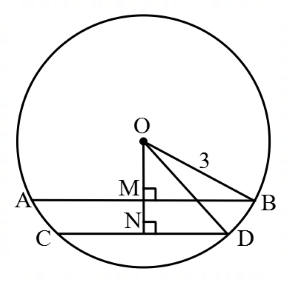
In a circle of radius 3 cm, two chords of length 2 cm and 3 cm lie on the same side of a diameter. What is the perpendicular distance between the two chords?
Discuss
Answer & Solution
Answer: Option B
Solution:
Geometry mcq question image
$$\eqalign{ & {\text{Radius of circle}} = 3 \cr & {\text{Length of chord }}AB = 3 \cr & {\text{Length of chord }}CD = 2 \cr & \Rightarrow {\text{In, }}\Delta OMB, \cr & OM = \sqrt {{3^2} - {{\left( {1.5} \right)}^2}} \cr & = \frac{3}{2}\sqrt 3 \cr & \Rightarrow {\text{In, }}\Delta OND, \cr & ON = \sqrt {{3^2} - {1^2}} \cr & = 2\sqrt 2 \cr & \bot {\text{ distance between two chords}} = ON - OM \cr & = \frac{{2\sqrt 2 }}{1} - \frac{{3\sqrt 3 }}{2} \cr & = \frac{{4\sqrt 2 - 3\sqrt 3 }}{2} \cr} $$