ExamVeda
Login
Home
51
The altitude drawn to the base of an isosceles triangle is 8 cm and its perimeter is 64 cm. The area (in cm2) of the triangle is
Discuss
Answer & Solution
Answer: Option D
Solution:
Mensuration 2D mcq question image
Let AB = AC = a cm
BD = DC = b cm
∴ Altitude of isosceles triangle is also median
In right ΔADC
AD2 = a2 - b2
64 = a2 - b2 . . . . . . (i)
Perimeter = 64
a + a + 2b = 64
2a + 2b = 64
a + b = 32 . . . . . (ii)
On dividing $$ = \frac{{{a^2} - {b^2}}}{{a + b}} = \frac{{64}}{{32}} = 2$$
∴ a2 - b2 = (a + b)(a - b)
a - b = 2
∴ a + b = 32
On solving a = 17, b = 15
Area of ΔABC = $$\frac{1}{2}$$ × AD × BC
= $$\frac{1}{2}$$ × 8 × 30
= 120 cm
52
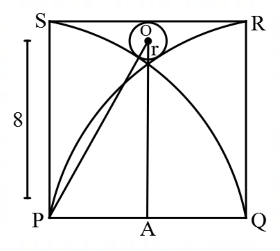
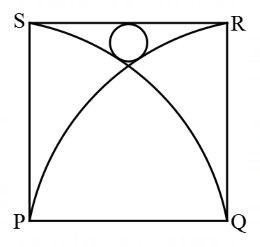
In the given figure, PQRS is square whose side is 8 cm. PQS and QPR are two quadrants. A circle is placed touching both the quadrants and the square as shown in the figure. What is the area (in cm2) of the circle?
Mensuration 2D mcq question image
Discuss
Answer & Solution
Answer: Option B
Solution:
Mensuration 2D mcq question image
Let radius of circle = r
∴ OA = 8 - r and OP = 8 + r
Now ∠OAP is right angle triangle and use pythagoras theorem in ΔOAP
⇒ (8 + r)2 = (8 - r)2 + 42
64 + r2 + 16r = 64 + r2 - 16r + 16
32r = 16
r = $$\frac{1}{2}$$cm
And area of circle = πr2
$$\eqalign{ & = \frac{{22}}{7} \times \frac{1}{2} \times \frac{1}{2} \cr & = \frac{{11}}{{14}}{\text{ c}}{{\text{m}}^2} \cr} $$
53
If the length of a diagonal of a square is (a + b), then the area of the square is:
Discuss
Answer & Solution
Answer: Option B
Solution:
Diagonal of a square = (a + b)
∴ side of square = $$\frac{{\left( {a + b} \right)}}{{\sqrt 2 }}$$
∴ Area of square = (side)2
$$\eqalign{ & = {\left( {\frac{{a + b}}{{\sqrt 2 }}} \right)^2} \cr & = \frac{1}{2}\left( {{a^2} + {b^2} + 2ab} \right) \cr & = \frac{1}{2}\left( {{a^2} + {b^2}} \right) + ab \cr} $$
54
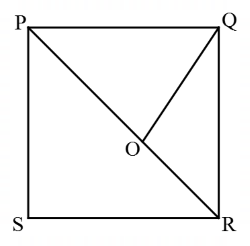
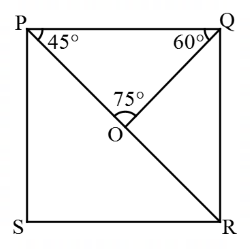
In the given figure, PQRS is a square of side 8 cm. ∠PQO = 60°. What is the area (in cm2) of the triangle POQ?
Mensuration 2D mcq question image
Discuss
Answer & Solution
Answer: Option D
Solution:
Mensuration 2D mcq question image
$$\eqalign{ & {\text{In }}\sin \,{\text{rule}} \cr & \frac{{\sin {{75}^ \circ }}}{{PQ}} = \frac{{\sin {{60}^ \circ }}}{{PO}} \cr & \frac{{\sin \left( {{{30}^ \circ } + {{45}^ \circ }} \right)}}{8} = \frac{{\sin {{60}^ \circ }}}{{PO}} \cr & \frac{{\frac{1}{2} \times \frac{1}{{\sqrt 2 }} + \frac{{\sqrt 3 }}{2} \times \frac{1}{{\sqrt 2 }}}}{8} = \frac{{\sqrt 3 }}{{2PO}} \cr & \frac{{\sqrt 3 + 1}}{{2\sqrt 2 \times 8}} = \frac{{\sqrt 3 }}{{2PO}} \cr & PO = \frac{{8\sqrt 6 }}{{\left( {\sqrt 3 + 1} \right)}} \cr & {\text{After rationaltion}} \cr & PO = \frac{{8\sqrt 6 }}{{\left( {\sqrt 3 + 1} \right)}} = 4\sqrt 6 \left( {\sqrt 3 - 1} \right) \cr & {\text{Then in }}\Delta POD, \cr & {\text{Area}} = \frac{1}{2}PQ \times PO\sin {45^ \circ } \cr & = \frac{1}{2} \times 8 \times 4\sqrt 6 \left( {\sqrt 3 - 1} \right) \times \frac{1}{{\sqrt 2 }} \cr & = 2\sqrt 2 \times 4\sqrt 6 \left( {\sqrt 3 - 1} \right) \cr & = 16\left( {3 - \sqrt 3 } \right) \cr} $$
55
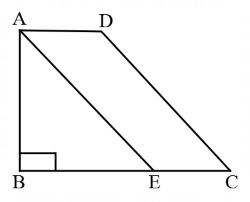
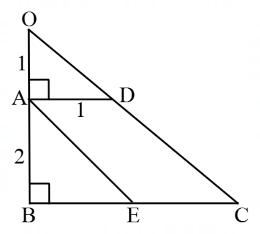
In the given figure area of isosceles triangle ABE is 72 cm2 and BE = AB and AB = 2AD, AE || DC, then what is the area (in cm2) of the trapezium ABCD?
Mensuration 2D mcq question image
Discuss
Answer & Solution
Answer: Option D
Solution:
Mensuration 2D mcq question image
\[\Delta OAD \sim \Delta ABE\left( \begin{gathered} \because AE\,||\,DC \hfill \\ \therefore \angle E = \angle D \hfill \\ \angle B = \angle A \hfill \\ \end{gathered} \right)\]
$$\eqalign{ & \frac{{{\text{ar}}{\text{. }}\Delta OAD}}{{{\text{ar}}{\text{. }}\Delta ABE}} = \frac{1}{4} \cr & \Delta OBC \sim \Delta ABE \cr & \therefore \frac{{{\text{ar}}{\text{. }}\Delta OBC}}{{{\text{ar}}{\text{. }}\Delta ABE}} = \frac{9}{4} \cr & \because 4 = 72{\text{ c}}{{\text{m}}^2} \cr & \therefore 1 = 18{\text{ c}}{{\text{m}}^2} \cr & 9 = 162{\text{ c}}{{\text{m}}^2} \cr & \therefore {\text{ ar}}{\text{. of }}\square ADEC \cr & \Rightarrow 162 - \left( {72 + 18} \right) = 72{\text{ c}}{{\text{m}}^2} \cr & \therefore {\text{Area of trapezium }}ADCB \cr & = 72 + 72 \cr & = 144{\text{ c}}{{\text{m}}^2} \cr} $$
56
The perimeter of a triangle is 40 cm and its area is 60 cm2. If the largest side measures 17 cm, then the length (in cm) of the smallest side of the triangle is
Discuss
Answer & Solution
Answer: Option C
Solution:
Let sides of triangle are, a, b and c respectively
∴ largest side given = 17 cm
= Perimeter = a + b + c
= 40 cm (given)
Area = 60 cm2 (given)
In such questions take the help of triplets which form right angle triangle
Mensuration 2D mcq question image
So, here we have a side 17 cm
⇒ by triplet we get sides 8 and 15
⇒ check the sides
Perimeter = 8 + 15 + 17 = 40
Area = $$\frac{1}{2}$$ × 8 × 15 ⇒ 60
Hence sides are 15, 8
Smaller side = 8 cm
57
The following diagram shows part of a fan. OAD and OFG are sectors of a circle with centre O, having radius 24 cm. The central angle of the sectors is 45° as shown in the figure. B, C, H and E lie on a circle with centre O and radius 8 cm. What is the shaded area (in cm2)?
Take π = 3.14
Mensuration 2D mcq question image
Discuss
Answer & Solution
Answer: Option D
Solution:
It is clear from the figure
Area of shaded region = Area of sector of OFG and OAD + Area of circle BCHE - area of sector OHE and OBC
$$\eqalign{ & = 2 \times \frac{\theta }{{360}} \times \pi {r^2} + \pi {r^2} - 2 \times \frac{\theta }{{360}} \times \pi {r^2} \cr & = 2 \times \frac{{45}}{{360}} \times 3.14 \times 24 \times 24 + 3.14 \times {8^2} - 2 \times \frac{{45}}{{360}} \times 3.14 \times {8^2} \cr & = \frac{1}{4} \times 3.14 \times 24 \times 24 + 3.14 \times 64 - \frac{1}{4} \times 3.14 \times 64 \cr & = 3.14 \times \left( {144 + 64 - 16} \right) \cr & = 3.14 \times 192 \cr & = 602.88{\text{ Answer}} \cr} $$
58
The cost of levelling a circular field at 50 paise per square metre is Rs. 7700. The cost (in Rs.) of putting up a fence all round it at Rs. 1.20 per metre is $$\left( {{\text{Use }}\pi = \frac{{22}}{7}} \right)$$
Discuss
Answer & Solution
Answer: Option C
Solution:
$$\eqalign{ & {\text{According to the question,}} \cr & {\text{Area}} \times {\text{Rate}} = {\text{Expenditure}} \cr & \pi {r^2} \times \frac{1}{2} = {\text{Rs}}{\text{. }}7700 \cr & {r^2} = \frac{{7700 \times 7}}{{22}} \times 2 \cr & \boxed{r = 70} \cr & {\text{Perimeter}} = 2\pi r \cr & = 2 \times \frac{{22}}{7} \times 70 \cr & = 440{\text{ meter}} \cr & {\text{Expenditure}} = 440 \times 1.20 = {\text{Rs}}{\text{. }}528 \cr} $$
59
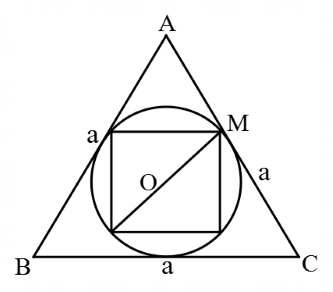
A circle is inscribed in an equilateral triangle and a square is inscribed in that circle. The ratio of the areas of the triangle and the square is
Discuss
Answer & Solution
Answer: Option C
Solution:
Mensuration 2D mcq question image
Let the side of equilateral triangle = 'a' and the side of square = 'b'
In circle radius of equilateral $$\Delta = \frac{a}{{2\sqrt 3 }}$$
$$\eqalign{ & \therefore {\text{Diagonal of square}} = 2 \times \frac{a}{{2\sqrt 3 }} = \frac{a}{{\sqrt 3 }} \cr & {\text{Now, }}b = \frac{{{\text{Diagonal}}}}{{\sqrt 2 }} = \frac{a}{{\frac{{\sqrt 3 }}{{\sqrt 2 }}}} = \frac{a}{{\sqrt 6 }} \cr & {\text{Required ratio}} = \frac{{\frac{{\sqrt 3 }}{4}{a^2}}}{{{{\left( {\frac{a}{{\sqrt 6 }}} \right)}^2}}} \cr & = \frac{{\sqrt 3 }}{4}{a^2} \times \frac{6}{{{a^2}}} \cr & = \frac{{3\sqrt 3 }}{2} \Rightarrow 3\sqrt 3 :2 \cr} $$
60
The perimeters of a circle, a square and an equilateral triangle are same and their areas are C, S and T respectively. Which of the following statement is true?
Discuss
Answer & Solution
Answer: Option B
Solution:
Let radius of circle = R
Side of square = a
Side of equilateral Δ = b
According to question,
$$\eqalign{ & 2\pi R = 4a = 3b \cr & \therefore a = \frac{{\pi R}}{2} \cr & b = \frac{2}{3}\pi R \cr} $$
Ratio of their areas
\[\begin{array}{*{20}{c}} {\pi {R^2}}&:&{{a^2}}&:&{\frac{{\sqrt 3 }}{4}{b^2}} \\ {\pi {R^2}}&:&{{{\left( {\frac{{\pi R}}{2}} \right)}^2}}&:&{\frac{{\sqrt 3 }}{4}{{\left( {\frac{2}{3}\pi R} \right)}^2}} \\ 1&:&{\frac{\pi }{4}}&:&{\frac{{\sqrt 3 }}{9}\pi } \\ {\text{C}}&:&{\text{S}}&:&{\text{T}} \end{array}\]
Here, we can see that C > S > T
Quicker Approach: When perimeter of two or more figures are same then the figure which has more vertex is greater in the area. Since, here, circle has infinite vertex.
Therefore, C > S > T