ExamVeda
Login
Home
51
The curved surface area and volume of a cylindrical object are 88 cm2 and 132 cm3, respectively. The height (in cm) of the cylindrical object is:
Discuss
Answer & Solution
Answer: Option B
Solution:
Curved area of cylinder = 88 cm2
2πrh = 88
2 × $$\frac{{22}}{7}$$ × r × h = 88
r × h = 14
Volume of cylinder = πr2h = 132 cm3
$$\frac{{22}}{7}$$ × r2h = 132
r2h = 42
r × rh = 42
r × 14 = 42
r = 3
r × h = 14
h $$ = \frac{{14}}{3} = 4\frac{2}{3}$$
Height $$ = 4\frac{2}{3}{\text{ cm}}$$
52
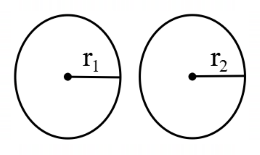
The ratio of weights of two spheres of different materials is 8 : 17 and the ratio of weights per 1 cc of materials of each is 289 : 64. The ratio of radii of the two spheres is
Discuss
Answer & Solution
Answer: Option A
Solution:
Mensuration 3D mcq question image
Ratio of volume of sphere × ratio of weight per 1 cc of material of each = Ratio of weight of two sphere
$$\eqalign{ & \frac{{\frac{4}{3}\pi r_1^3}}{{\frac{4}{3}\pi r_2^3}} \times \frac{{289}}{{64}} = \frac{8}{{17}} \cr & \frac{{r_1^3}}{{r_2^3}} = \frac{{8 \times 64}}{{17 \times 289}} \cr & \frac{{{r_1}}}{{{r_2}}} = \frac{{8 \times 8 \times 8}}{{17 \times 17 \times 17}} \cr & \frac{{{r_1}}}{{{r_2}}} = \frac{8}{{17}} \cr & {r_1}:{r_2} = 8:17 \cr} $$
53
The base of a right prism is a trapezium. The length of the parallel sides are 8 cm and 14 cm and the distance between the parallel sides is 8 cm. If the volume of the prism is 1056 cm3, then the height of the prism is
Discuss
Answer & Solution
Answer: Option C
Solution:
Area of trapezium
= $$\frac{1}{2}$$ × h(AB + CD)
= $$\frac{1}{2}$$ × 8 × (8 + 14)
= 4 × 22
= 88 cm2
Volume of prism = Height of prism × Area of base
⇒ height × 88 = 1056 (given)
⇒ height = $$\frac{{1056}}{{88}}$$
⇒ height = 12 cm
54
Determine the total surface area of a hemisphere closed at bottom. Radius of the hemisphere is $$\sqrt {\frac{{25}}{\pi }} $$  unit.
Discuss
Answer & Solution
Answer: Option A
Solution:
Total surface area (TSA) of hemisphere = 3πr2
Radius of hemisphere = $$\sqrt {\frac{{25}}{\pi }} $$
So, TSA = 3 × π × $${\left( {\sqrt {\frac{{25}}{\pi }} } \right)^2}$$
= 75 unit2
55
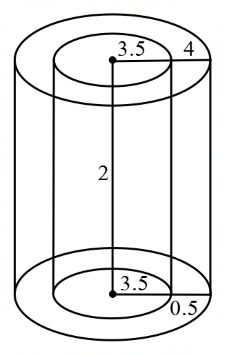
A cylindrical tube, open at both ends, is made of a metal sheet which is 0.5 cm thick. Its outer radius is 4 cm and length is 2 m. How much metal (in cm3) has been used in making the tube?
Discuss
Answer & Solution
Answer: Option A
Solution:
Mensuration 3D mcq question image
Outer radius = 4 cm
Internal radius = 4 - 0.5 = 3.5 cm
Length = 2m = 200 cm
Volume of cylinder = π × (R2 - r2)h
= π × (42 - 3.52) × 200
= π × 7.5 × 0.5 × 200
= 750π
56
If the height of a cylinder is 4 times its circumference, the volume of the cylinder in terms of its circumference, $$c$$ is
Discuss
Answer & Solution
Answer: Option B
Solution:
Here h = 4c,
Volume of cylinder = πr2h
$$ = \frac{{4\pi \times \pi {r^2}h}}{{4\pi }}$$
(Multiply 4π both in Numerator & Denominator)
$$\eqalign{ & = \frac{{{{\left( {2\pi r} \right)}^2} \times \left( {4c} \right)}}{{4\pi }} \cr & = \frac{{{c^3}}}{\pi } \cr} $$
57
The areas of three consecutive faces of a cuboid are 12 cm2, then the volume (in cm3) of the cuboid is
Discuss
Answer & Solution
Answer: Option D
Solution:
Let the three sides of the cuboid be $$l$$, b and h
⇒ $$l$$b = bh = h$$l$$ = 12
⇒$$l$$2b2h2 = 12 × 12 × 12
⇒$$l$$2b2h2 = 1728
⇒ $$l$$bh = $$\sqrt {1728} $$
⇒ $$l$$bh = $$12\sqrt {12} $$
⇒ $$l$$bh = $$24\sqrt 3 {\text{ c}}{{\text{m}}^3}$$
58
The ratio of the height and the diameter of a right circular cone is 6 : 5 and its volume is $$\frac{{2200}}{7}{\text{ c}}{{\text{m}}^3}.$$   What is its slant height? $$\left( {{\text{Take }}\pi = \frac{{22}}{7}} \right)$$
Discuss
Answer & Solution
Answer: Option B
No explanation is given for this question. Let's Discuss on Board
59
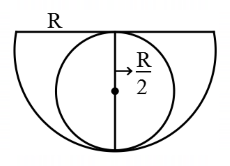
A sphere of maximum volume is cut out from a solid hemisphere. What is the ratio of the volume of the sphere to that of the remaining solid?
Discuss
Answer & Solution
Answer: Option B
Solution:
Mensuration 3D mcq question image
$$\eqalign{ & {\text{Sphere }}\left( {\text{V}} \right) = \frac{4}{3}\pi {\left( {\frac{R}{2}} \right)^3} = \frac{4}{3}\pi \times \frac{{{R^3}}}{8} \cr & {\text{Hemisphere }}\left( {\text{V}} \right) = \frac{2}{3}\pi {R^3} \cr & {\text{Sphere}}:{\text{Hemisphere}} = \frac{{4{R^3}}}{{3 \times 8}}:\frac{{2{R^3}}}{3} = 1:4 \cr & {\text{Sphere}}:{\text{Remaining Solid}} = 1:3 \cr} $$
60
A cube of edge 6 cm is painted on all sides and then cut into unit cubes. The number of unit cubes with no sides painted is
Discuss
Answer & Solution
Answer: Option B
Solution:
Number of cubes with no side painted = (n - 2)3
Where n is the side of the bigger cube
Required number = (6 - 2)3 = 64