Feb 23, 2016
Waves and Tides
The movement of ocean waters takes place in three different ways, viz waves, currents and tides.

The movement of ocean waters takes place in three different ways, viz waves, currents and tides.
The ocean is the final repository of debris from the land.
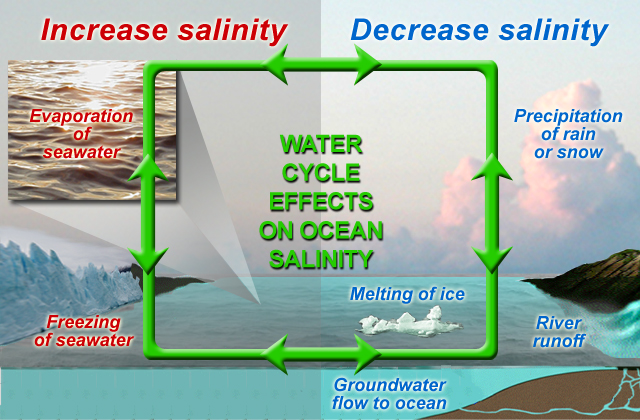
Salinity is defined as the total amount of solid material in grams contained in one kilogram of sea water end is expressed as part per thousand.
The temperature of the oceanic water is important for marine organisms including Phytoplanktons and Zooplanktons.
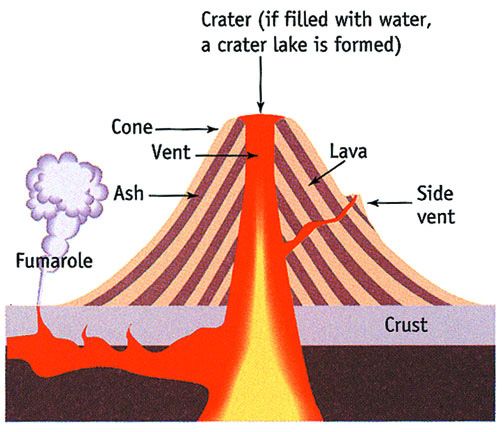
‘A volcano is a vent, or opening, usually circular in form, through which heated materials consisting of gases, water, liquid lava and fragments of rocks are ejected from the highly heated interior to the surface of the earth.’

An air mass may be defined as a large body of air whose physical properties, especially temperature, moisture content and lapse rate are more or less uniform horizontally for hundred kilometer.

Tropical cyclone, representing a closed low pressure system generally having a diameter of about 650 km.

Cloud has been defined as an aggregation of innumerable tiny water droplets, ice particles or mixture of both in the air usually above the ground level.

The process of disintegration and decomposition of rocks in situ is generally called weathering.
Air pressure is defined as total weight of a mass of column of air above per unit area at sea level.
The radiant energy received from the sun, transmitted in a form analogous to shortwave (1/250 - 1/6700 mm in length), and travelling at the rate of 186000 miles a second is called solar radiation or Insolation. It is measured by the amount of solar energy received per square centimetre per minute.
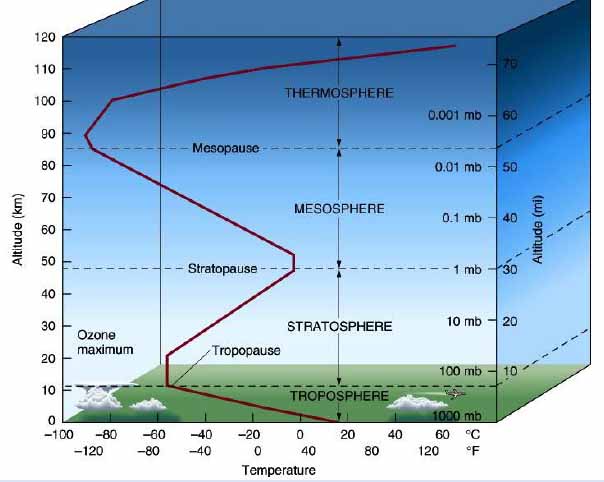
The atmosphere is a thick gaseous envelope which surrounds the earth from all sides and is attached to the earth̢۪s surface by gravitational force.