

The Lagrangian of a particle of mass m moving in a plane is given by L = $$\frac{1}{2}$$ [m(vx2 + vy2)] + a(xvy - yvx) where, vx and vy are velocity components and a is constant, The canonical momenta of the particle are given by
A. px = mvx and py = mvy
B. px = mvx + ay and py = mvy + ax
C. px = mvx - ay and py = mvy + ax
D. px = mvx - ay and py = mvy - ax
Answer: Option C
Related Questions on Classical Mechanics
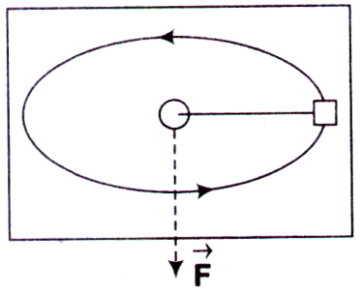
A. increases till mass falls into hole
B. decreases till mass falls into hole
C. remains constant
D. becomes zero at radius r1, where 0 < r1 < r0
A. $$\frac{c}{3}$$
B. $$\frac{{\sqrt 2 }}{3}c$$
C. $$\frac{c}{2}$$
D. $$\frac{{\sqrt 3 }}{2}c$$
The Hamiltonian corresponding to the Lagrangian $$L = a{{\dot x}^2} + b{{\dot y}^2} - kxy$$ is
A. $$\frac{{{p_x}^2}}{{2a}} + \frac{{{p_y}^2}}{{2b}} + kxy$$
B. $$\frac{{{p_x}^2}}{{4a}} + \frac{{{p_y}^2}}{{4b}} - kxy$$
C. $$\frac{{{p_x}^2}}{{4a}} + \frac{{{p_y}^2}}{{4b}} + kxy$$
D. $$\frac{{{p_x}^2 + {p_y}^2}}{{4ab}} + kxy$$
A. circular
B. elliptical
C. parabolic
D. hyperbolic
Join The Discussion