

Which one of the following molecules will have n → \[\mathop \pi \limits^ * \] transition at the longest wavelength?
A. HCHO
B. CH3COC2H5
C. C6H5COC6H5
D. CH3COC6H5
Answer: Option C
A. CH3C$${\text{O}}_2^ - $$ > CH3O- > C6H5O- > N$${\text{O}}_3^ - $$
B. CH3O- > N$${\text{O}}_3^ - $$ > C6H5O- > CH3C$${\text{O}}_2^ - $$
C. CH3O- > C6H5O- > CH3C$${\text{O}}_2^ - $$ > N$${\text{O}}_3^ - $$
D. C6H5O- > CH3O- > N$${\text{O}}_3^ - $$ > CH3C$${\text{O}}_2^ - $$
The most appropriate sequence of the reactions for carrying out the following conversion
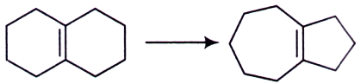
is
A. (i) peracid, (ii) H+, (iii) Zn/dil.HCl
B. (i) Alkaline KMnO4, (ii) NalO4, (iii) N2H4/KOH
C. (i) Alkaline KMnO4, (ii) H+, (iii) Zn/dil.HCl
D. (i) O3/Me2S, (ii) NaOEt, (iii) N2H4/KOH
Conversion of Ph-NH2 into Ph-CN can be accomplished by
A. reaction with sodium cyanide in the presence of nickel catalyst
B. reaction with chloroform and sodium hydroxide
C. diazotisation followed by reaction with CuCN
D. reaction with ethyl formate followed by thermolysis
Join The Discussion