ExamVeda
Login
Home
81
G is the centroid of a triangle ABC, whose sides AB = 35 cm, BC = 12 cm, and AC = 37 cm. The length of BG is (correct to one decimal place):
Discuss
Answer & Solution
Answer: Option D
Solution:
AB = 35 cm, BC = 12 cm and AC = 37 cm
12, 35 and 37 are triplet

Geometry mcq question image
ABC is a right angle triangle at ∠B = 90°
Use appoloneous theorem
$$\eqalign{ & A{B^2} + B{C^2} = 2\left( {A{D^2} + B{D^2}} \right) \cr & {35^2} + {12^2} = 2 \times {\left( {\frac{{AC}}{2}} \right)^2} + 2B{D^2} \cr & {37^2} = 2 \times {\left( {\frac{{37}}{2}} \right)^2} + 2B{D^2} \cr & 2B{D^2} = {37^2}\left( {1 - \frac{1}{2}} \right) \cr & 2B{D^2} = 1369 \times \frac{1}{2} \cr & B{D^2} = \frac{{1369}}{4} \cr & BD = \frac{{37}}{2} \cr & BG = BD \times \frac{2}{3} \cr & BG = \frac{{37}}{2} \times \frac{2}{3} \cr & BG = \frac{{37}}{3} = 12.3{\text{ cm}} \cr} $$

82
ABCD is a rhombus with ∠ABC = 52°. The measure of ∠ACD is:
Discuss
Answer & Solution
Answer: Option D
Solution:
Geometry mcq question image
In ΔACD
∠A + ∠C + ∠D = 180°
θ + θ + 52° = 180°
2θ + 52° = 180°
θ = $$\frac{{{{128}^ \circ }}}{2}$$
θ = 64°
83
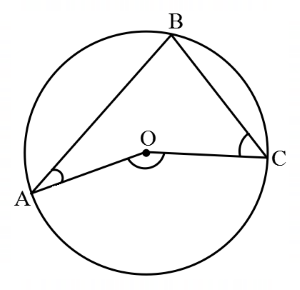
In the given figure, O is the centre of the circle. If ∠BAO = 30° and ∠BCO = 50°, then ∠AOC is equal to:
Geometry mcq question image
Discuss
Answer & Solution
Answer: Option A
Solution:
Geometry mcq question image
Let, Angle ABC = x
Then, Angle AOC = 2x
In Quadrilateral ABCO,
30° + 50° + x + 360° - 2x = 360°
⇒ x = 80°
So, 2x = 160°
84
ΔLMN, LM = 5√2 cm and ∠LMN = 135°. What is the length (in cm) of MN?
Discuss
Answer & Solution
Answer: Option C
No explanation is given for this question. Let's Discuss on Board
85
PQR is a triangle, whose area is 180 cm2. S is a point on side QR, such that PS is the angle bisector of ∠QPR. If PQ : PR = 2 : 3, then what is the area (in cm2) triangle PSR?
Discuss
Answer & Solution
Answer: Option B
Solution:
Geometry mcq question image
$$\eqalign{ & \frac{{PQ}}{{PR}} = \frac{2}{3} \cr & \therefore \frac{{{\text{ar }}\Delta PSR}}{{{\text{ar }}\Delta PQR}} = \frac{3}{{2 + 3}} = \frac{3}{5} \cr & 5{\text{ units}} = 180 \cr & 3{\text{ units}} = \frac{{180}}{5} \times 3 = 108 \cr & {\text{Area of }}\Delta PSR = 108{\text{ c}}{{\text{m}}^2} \cr} $$
86
In the given figure, triangle PQR is a right-angled triangle at Q. If PQ = 35 cm and QS = 28 cm, then what is the value (in cm) of SR?
Geometry mcq question image
Discuss
Answer & Solution
Answer: Option B
Solution:
Geometry mcq question image
$$\eqalign{ & PQ \times QR = QS \times PR \cr & 35 \times QR = 28 \times \sqrt {{{\left( {35} \right)}^2} + Q{R^2}} \cr & {\left( {\frac{5}{4}QR} \right)^2} = {\left( {35} \right)^2} + Q{R^2} \cr & \frac{{25}}{{16}}Q{R^2} - Q{R^2} = 1225 \cr & \frac{9}{{16}}Q{R^2} = 1225 \cr & Q{R^2} = \frac{{1225 \times 16}}{9} \cr & QR = \frac{{35 \times 4}}{3} \cr & QR = \frac{{140}}{3} \cr & S{R^2} = Q{R^2} - Q{S^2} \cr & S{R^2} = {\left( {\frac{{140}}{3}} \right)^2} - {\left( {28} \right)^2} \cr & S{R^2} = \frac{{{{14}^2}\left( {{{10}^2} - 9 \times 4} \right)}}{9} \cr & S{R^2} = \frac{{{{14}^2} \times 64}}{9} \cr & SR = \frac{{14 \times 8}}{3} \cr & SR = \frac{{112}}{3} \cr & SR = 37.33{\text{ cm}} \cr} $$
87
In ΔABC, ∠A - ∠B = 33°, ∠B - ∠C = 18°. What is the sum of the smallest and the largest angles of the triangle?
Discuss
Answer & Solution
Answer: Option A
Solution:
Geometry mcq question image
∠A + ∠B + ∠C = 180° . . . . . . . (i)
∠A - ∠B = 33°
∠A = 33° + ∠B
∠B - ∠C = 18°
∠C = ∠B - 18°
From equation (i)
33° + ∠B + ∠B + ∠B - 18° = 180°
3°∠B + 15° = 180°
∠B = 55°
∠A = 88°
∠C = 37°
The sum of largest and smallest angles of the triangle = 88° + 37° = 125°
88
In triangle PQR, C is the centroid. PQ = 30 cm, QR = 36 cm and PR = 50 cm. If D is the midpoint of QR, then what is the length (in cm) of CD ?
Discuss
Answer & Solution
Answer: Option A
Solution:
Geometry mcq question image
(PQ)2 + (PR)2 = 2(QD2 + PD2)
(30)2 + (50)2 = 2[(18)2 + PD2]
900 + 2500 = 2[324 + PD2]
3400 = 2[324 + PD2]
1700 = 324 + PD2
PD2 = 1376
PD = $$4\sqrt {86} $$
CD = $$\frac{1}{3}$$PD
CD = $$\frac{{4\sqrt {86} }}{3}$$
89
A circle is inscribed in ΔABC, touching AB, BC and AC at the points P, Q and R respectively. If AB - BC = 4 cm, AB - AC = 2 cm and the perimeter of ΔABC = 32 cm, then PB + AR is equal to:
Discuss
Answer & Solution
Answer: Option A
Solution:
Geometry mcq question image
2(x + y + z) = 32
x + y + z = 16
AB - AC = x - y
x - y = 2 . . . . . . . (i)
AB - BC = z - y
z - y = 4 . . . . . . . (ii)
Add equation (i) + equation (ii)
x + z - 2y = 6
$$\frac{{{\text{x}} + {\text{z}} - 6}}{2}$$   = y
x + y + z = 16
x + z + $$\frac{{{\text{x}} + {\text{z}} - 6}}{2}$$   = 16
2(x + z) + x + z - 6 = 32
3(x + z) = 38
x + z = $$\frac{{38}}{3}$$
PB + AR = $$\frac{{38}}{3}$$
90
In the given figure, O is centre of the circle. Circle has 3 tangents. If ∠QPR = 45°, then what is the value (in degrees) of ∠QOR?
Geometry mcq question image
Discuss
Answer & Solution
Answer: Option A
Solution:
Geometry mcq question image
∠PMO = 90° (Angle made on tangent)
∠QOR = 90° - $$\frac{{\angle {\text{P}}}}{2}$$
∠QOR = 90° - 22.5°
∠QOR = 67.5°