
ExamVeda
Login
Home
41
What is the value of the definite integral, $$\int\limits_0^{\text{a}} {\frac{{\sqrt {\text{x}} }}{{\sqrt {\text{x}} + \sqrt {{\text{a}} - {\text{x}}} }}} {\text{dx}}\,{\text{?}}$$
Discuss
Answer & Solution
Answer: Option B
No explanation is given for this question. Let's Discuss on Board
42
The direction of vector A is radially outward from the origin, with |A| = krn where r2 = x2 + y2 + z2 and k is a constant. The value of n for which $$\nabla \cdot {\text{A}} = 0$$   is
Discuss
Answer & Solution
Answer: Option A
No explanation is given for this question. Let's Discuss on Board
43
The angle of intersection of the curves x2 = 4y and y2 = 4x at point (0, 0) is
Discuss
Answer & Solution
Answer: Option D
No explanation is given for this question. Let's Discuss on Board
44
The expression e-$$l$$n x for x > 0 is equal to
Discuss
Answer & Solution
Answer: Option C
No explanation is given for this question. Let's Discuss on Board
45
While minimizing the function f(x), necessary and sufficient conditions for a point x0 to be a minima are
Discuss
Answer & Solution
Answer: Option D
No explanation is given for this question. Let's Discuss on Board
46
The function f(x) = x2 = x + x ...... x times, is defined
Discuss
Answer & Solution
Answer: Option B
No explanation is given for this question. Let's Discuss on Board
47
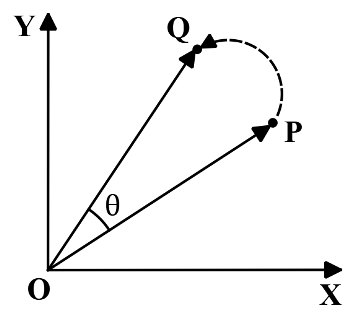
The position vector $$\overrightarrow {{\text{OP}}} $$ of P(20, 10) is rotated anti-clockwise in X-Y plane by an angle θ = 30° such that the point P occupies position Q, as shown in the figure. The coordinates (x, y) of Q are
Calculus mcq question image
Discuss
Answer & Solution
Answer: Option D
No explanation is given for this question. Let's Discuss on Board
48
If z = xy $$l$$n(xy), then
Discuss
Answer & Solution
Answer: Option C
No explanation is given for this question. Let's Discuss on Board
49
If $$\overrightarrow {\text{a}} $$ and $$\overrightarrow {\text{b}} $$ are two arbitrary vectors with magnitudes a and b, respectively, $${\left| {\overrightarrow {\text{a}} \times \overrightarrow {\text{b}} } \right|^2}$$  will be equal to
Discuss
Answer & Solution
Answer: Option A
No explanation is given for this question. Let's Discuss on Board
50
The value of the integral given below is
$$\int\limits_0^\pi {{{\text{x}}^2}\cos \,{\text{x dx}}} $$
Discuss
Answer & Solution
Answer: Option A
No explanation is given for this question. Let's Discuss on Board