
ExamVeda
Login
Home
11
The moment of inertia of a uniform sphere of radius, r about an axis passing through its centre is given by $$\frac{2}{5}\left( {\frac{{4\pi }}{3}{r^5}\rho } \right).$$    A rigid sphere of uniform mass density $$\rho $$ and radius R has two smaller spheres of radii $$\frac{R}{2}$$ hollowed out of it as shown in the figure given below.

Classical Mechanics mcq question image
The moment of inertia of the resulting body about Y-axis is
Discuss
Answer & Solution
Answer: Option B
No explanation is given for this question. Let's Discuss on Board
12
The mass m of a moving particle is $$\frac{{2{m_0}}}{{\sqrt 3 }},$$  where m0 is rest mass. The linear momentum of the particle is
Discuss
Answer & Solution
Answer: Option D
No explanation is given for this question. Let's Discuss on Board
13
A space station moving in a circular orbit around the earth goes into a new bound orbit by fixing its engine radially outwards. This orbit is
Discuss
Answer & Solution
Answer: Option C
No explanation is given for this question. Let's Discuss on Board
14
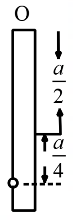
A particle of mass m is attached to a thin uniform rod of length a and mass 4m. The distance of the particle from the centre of mass of the rod is $$\frac{a}{2}.$$
Classical Mechanics mcq question image
The moment of inertia of the combination about an axis passing through a normal to the rod is
Discuss
Answer & Solution
Answer: Option B
No explanation is given for this question. Let's Discuss on Board
15
The Poisson bracket between $$\theta $$ and $${\dot \theta }$$ is
Discuss
Answer & Solution
Answer: Option A
No explanation is given for this question. Let's Discuss on Board
16
If p and q are the position and momentum variables, which one of the following is not canonical transformation?
Discuss
Answer & Solution
Answer: Option C
No explanation is given for this question. Let's Discuss on Board
17
A rigid body is rotating about its centre of mass; fixed at origin with an angular velocity $$\overrightarrow \omega $$ and angular acceleration $$\overrightarrow \alpha $$. If the torque acting on it is $$\overrightarrow \tau $$ and its angular momentum is $$\overrightarrow {\bf{L}} $$, then the rate of change of its kinetic energy is
Discuss
Answer & Solution
Answer: Option C
No explanation is given for this question. Let's Discuss on Board
18
The homogeneity of time leads to the law of conservation of (a)
Discuss
Answer & Solution
Answer: Option C
No explanation is given for this question. Let's Discuss on Board
19
A rigid frictionless rod rotates anticlockwise in a vertical plane with angular velocity $$\overrightarrow \omega $$. A bead of mass m moves outward along the rod with constant velocity $$\overrightarrow {{u_0}} $$ . The bead will experience a coriolis force
Discuss
Answer & Solution
Answer: Option B
No explanation is given for this question. Let's Discuss on Board
20
The Lagrangian for a three-particle system is given by $$L = \frac{1}{2}\left( {\dot n_1^2 + \dot n_2^2 + \dot n_3^2} \right) - {a^2}\left( {n_1^2 + n_2^2 + n_3^2 - {n_1}{n_3}} \right)$$
where, a is real, then one of the normal coordinates has a frequency $$\omega $$ given by
Discuss
Answer & Solution
Answer: Option C
No explanation is given for this question. Let's Discuss on Board