
?
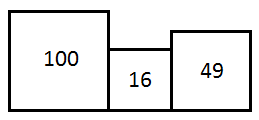
The adjoining figure contains three squares with areas of 100, 16 and 49 lying side by side as shown. By how much should the area of the middle square be reduced in order that the total length PQ of the resulting three squares is 19 ?
The adjoining figure contains three squares with areas of 100, 16 and 49 lying side by side as shown. By how much should the area of the middle square be reduced in order that the total length PQ of the resulting three squares is 19 ?
Answer & Solution
Correct Answer:
Option
D
PQ = $$\sqrt {100} $$ + $$\sqrt {16} $$ + $$\sqrt {49} $$ = (10 + 4 + 7) = 21
Side of middle square = $$\sqrt {16} $$ = 4
Reduction in PQ = (21 - 19) = 2
New side of middle square = (4 - 2) = 2
∴ Reduction in area of middle square = (42 - 22) = 12
Side of middle square = $$\sqrt {16} $$ = 4
Reduction in PQ = (21 - 19) = 2
New side of middle square = (4 - 2) = 2
∴ Reduction in area of middle square = (42 - 22) = 12

Join the Discussion
Login to post a comment or share your explanation.
Login