
ExamVeda
Login
Home
91
A circular swimming pool is surrounded by a concrete wall 4 ft. wide. If the area of the concrete wall surrounding the pool is $$\frac{{11}}{{25}}$$ that of the pool, then the radius of the pool is :
Discuss
Answer & Solution
Answer: Option C
Solution:
Let the radius of the pool be R ft.
Radius of the pool including the wall = (R + 4)ft.
Area of the concrete wall :
$$\eqalign{ & = \pi \left[ {{{\left( {R + 4} \right)}^2} - {R^2}} \right]sq.ft \cr & = \pi \left[ {\left( {R + 4 + R} \right)\left( {R + 4 - R} \right)} \right]sq.ft \cr & = 8\pi \left( {R + 2} \right)sq.ft \cr & 8\pi \left( {R + 2} \right) = \frac{{11}}{{25}}\pi {R^2} \cr & \Rightarrow 11{R^2} = 200\left( {R + 2} \right) \cr & \Rightarrow 11{R^2} - 200R - 400 = 0 \cr & \Rightarrow 11{R^2} - 220R + 20R - 400 = 0 \cr & \Rightarrow 11R\left( {R - 20} \right) + 20\left( {R - 20} \right) = 0 \cr & \Rightarrow \left( {R - 20} \right)\left( {11R + 20} \right) = 0 \cr & \Rightarrow R = 20 \cr} $$
∴ Radius of the pool = 20 ft.
92
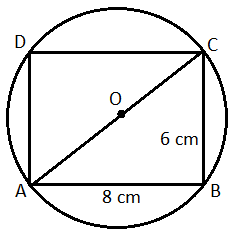
The sides of a rectangle are 8 cm and 6 cm. The corners of the rectangle lie on a circle. Find the are a of the circle without the rectangle :
Discuss
Answer & Solution
Answer: Option A
Solution:
Diameter of the circle :
$$\eqalign{ & = AC = \sqrt {{{\left( {AB} \right)}^2} + {{\left( {BC} \right)}^2}} \cr & \,\,\,\,\,\,\,\,\,\,\,\,\,\,\,\,\, = \sqrt {{8^2} + {6^2}} \cr & \,\,\,\,\,\,\,\,\,\,\,\,\,\,\,\,\, = \sqrt {100} \,cm \cr & \,\,\,\,\,\,\,\,\,\,\,\,\,\,\,\,\, = 10\,cm \cr} $$
Radius = 5 cm
Required area = (Area of the circle) - (Area of the rectangle)
Area mcq solution image
$$\eqalign{ & = \left[ {\left( {\frac{{22}}{7} \times 5 \times 5} \right) - \left( {8 \times 6} \right)} \right]c{m^2} \cr & = \left( {\frac{{550}}{7} - 48} \right)c{m^2} \cr & = \left( {\frac{{214}}{7}} \right)c{m^2} \cr & = 30.57\,c{m^2} \approx 30.6\,c{m^2} \cr} $$
93
A can go round a circular path 8 times in 40 minutes. If the diameter of the circle is increased to 10 times the original diameter, then the time required by A to go round the new path once, travelling at the same speed as before, is :
Discuss
Answer & Solution
Answer: Option C
Solution:
Let original diameter be d metre
Then, its circumference = $$\left( {\pi d} \right)$$ metres
Time taken to cover $$\left( {8\pi d} \right)$$ m = 40 min
New diameter = $$\left( {10d} \right)$$ m
Then, its circumference = $$\left( {\pi \times 10d} \right)$$ m
∴ Time taken to go round it once :
$$\eqalign{ & = \left( {\frac{{40}}{{8\pi d}} \times 10\pi d} \right)\min \cr & = 50\,\min \cr} $$
94
Area of a rectangle is 150 sq. metre. When the breadth of the same rectangle is increased by 2 metres and the length decreased by 5 metres the area of the rectangle decreases by 30 square metres. What is the perimeter of the square whose sides are equal to the length of the rectangle ?
Discuss
Answer & Solution
Answer: Option D
Solution:
Let the length of rectangle be $$l$$ metre and the breadth of the rectangle be $$b$$ metre
Then area of the rectangle = $$l$$ × $$b$$
$$lb$$ = 150 m2 . . . . . (i)
According to the question,
$$\eqalign{ & \left( {l - 5} \right) \times \left( {b + 2} \right) = 150 - 30 \cr & \Rightarrow \left( {l - 5} \right) \times \left( {b + 2} \right) = 120 \cr & \Rightarrow lb - 5b + 2l - 10 = 120 \cr & \Rightarrow 150 - 5b + 2l - 10 = 120 \cr & \Rightarrow 5b - 2l = 20 \cr & \Rightarrow \frac{{5 \times 150}}{l} - 2{l^2} = 20l \cr & \Rightarrow 2{l^2} + 20l - 750 = 0 \cr & \Rightarrow {l^2} + 10l - 375 = 0 \cr & \Rightarrow l\left( {l + 25} \right) - 15\left( {l + 25} \right) = 0 \cr & \Rightarrow \left( {l + 15} \right)\left( {l + 25} \right) = 0 \cr} $$
On solving both equations we get,
$$l$$ = 15 m and $$b$$ = 10 m
Side of square = length of rectangle (given)
So, the perimeter of the square :
= 4 × $$l$$
= 4 × 15
= 60 m
95
If the total surface area of a cube is 864 square cm, find the volume of the cube ?
Discuss
Answer & Solution
Answer: Option A
Solution:
Each edges of cube = a cm
∴ Total surface area of cube = 6a2
⇒ 6a2 = 864
⇒ a2 = $$\frac{864}{6}$$ = 144
⇒ a = $$\sqrt {144} $$ = 12 cm
∴ Volume of cube :
= a3 cm3
= (12 × 12 × 12) cm3
= 1728 cm3
96
A man is walking in a rectangular field whose perimeter is 6 km. If the area of the rectangular field be 2 sq. km, then what is the difference between the length and breadth of the rectangle ?
Discuss
Answer & Solution
Answer: Option B
Solution:
Let the length and breadth of the field be l and b km respectively
Then,
2 (l + b) = 6
⇒ l + b = 3
And lb = 2
(l - b)2 = (l + b)2 - 4lb
⇒ (l - b)2 = 32 - 4 × 2
⇒ (l - b)2 = 1
⇒ (l - b) = 1 km
97
If the diagonal and the area of a rectangle are 25 m2 and 168 m2, what is the length of the rectangle ?
Discuss
Answer & Solution
Answer: Option C
Solution:
Let the length of the rectangle be x metres.
Then, breath of the rectangle = $$\left( {\frac{{168}}{x}} \right)m$$
$$\eqalign{ & \therefore \sqrt {{x^2} + {{\left( {\frac{{168}}{x}} \right)}^2}} = 25 \cr & \Rightarrow \sqrt {{x^2} + \frac{{28224}}{{{x^2}}}} = 25 \cr & \Rightarrow {x^2} + \frac{{28224}}{{{x^2}}} = 625 \cr & \Rightarrow {x^4} - 625{x^2} + 28224 = 0 \cr & \Rightarrow {x^4} - 576{x^2} - 49{x^2} + 28224 = 0 \cr & \Rightarrow {x^2}\left( {{x^2} - 576} \right) - 49\left( {{x^2} - 576} \right) = 0 \cr & \Rightarrow \left( {{x^2} - 576} \right)\left( {{x^2} - 49} \right) = 0 \cr & \Rightarrow {x^2} = 576\,\,or\,\,{x^2} = 49 \cr & \Rightarrow x = 24\,\,\,or\,\,\,x = 7 \cr} $$
Hence, length = 24 m and breadth = 7 m
98
A path of uniform width runs round the inside of a rectangular field 38 m long 32 m wide. If the path occupies 600 m2, then the width of the path is :
Discuss
Answer & Solution
Answer: Option A
Solution:
Let the width of the path be x
Then,
$$\left[ {\left( {38 \times 32} \right) - \left\{ {\left( {38 - 2x} \right)\left( {32 - 2x} \right)} \right\}} \right]$$       $$ = 600$$
$$\eqalign{ & \Rightarrow \left[ {1216 - \left( {1216 - 140x + 4{x^2}} \right)} \right] \cr & \Rightarrow 4{x^2} - 140x + 600 = 0 \cr & \Rightarrow {x^2} - 35x + 150 = 0 \cr & \Rightarrow {x^2} - 30x - 5x + 150 = 0 \cr & \Rightarrow \left( {x - 30} \right)\left( {x - 5} \right) = 0 \cr & \Rightarrow x = 5\,m\,\,\,\,\,\,\,\,\,\,\,\,\,\,\,\,\,\,\,\,\left[ {\therefore x \ne 30} \right] \cr} $$
99
The length and breadth of the floor of the room are 20 feet and 10 feet respectively. Square tiles of 2 feet length of different colours are to be laid on the floor. Black tiles are laid in the first row on all sides. If white tiles are laid in the one-third of the remaining and blue tiles in the rest, how many blue tiles will be there ?
Discuss
Answer & Solution
Answer: Option A
Solution:
Area left after laying black tiles :
$$\eqalign{ & = \left[ {\left( {20 - 4} \right) \times \left( {10 - 4} \right)} \right]{\text{sq}}{\text{.ft.}} \cr & = 96\,{\text{sq}}{\text{.ft.}} \cr} $$
Area under white tiles :
$$\eqalign{ & = \left( {\frac{1}{3} \times 96} \right){\text{sq}}{\text{.ft.}} \cr & = 32\,{\text{sq}}{\text{.ft.}} \cr} $$
Area under blue tiles :
$$\eqalign{ & = \left( {96 - 32} \right){\text{sq}}{\text{.ft.}} \cr & = 64\,{\text{sq}}{\text{.ft.}} \cr} $$
Number of blue tiles :
$$\eqalign{ & = \frac{{64}}{{\left( {2 \times 2} \right)}} \cr & = 16 \cr} $$
100
Of the two square fields, the area of one is 1 hectare while the other one is broader by 1%. The difference in their areas is :
Discuss
Answer & Solution
Answer: Option D
Solution:
Area = 1 hect. = 10000 sq. m
Side = $$\sqrt {10000} $$   m = 100 m
Side of the other square = 101 m
Difference in their areas :
= [(101)2 - (100)2] m2
= [(101 + 100) (101 - 100)] m2
= 201 m2