ExamVeda
Login
Home
31
The diameter of a circle is equal to the perimeter of a square whose area is 3136 cm2 . What is the circumference of the circle ?
Discuss
Answer & Solution
Answer: Option B
Solution:
Area of square = 3136 cm2
Side of squared = $$\sqrt {3136} $$   = 56 cm
Perimeter of square :
= 4a
= (4 × 56) cm
= 224 cm
= diameter of circle
∴ Circumference of circle :
$$\eqalign{ & = \pi d \cr & = \frac{{22}}{7} \times 224 \cr & = 704{\text{ cm}} \cr} $$

32
The area of a rectangular field is 2100 sq. meters. If the field is 60 metres long, what is its perimeter ?
Discuss
Answer & Solution
Answer: Option E
Solution:
$$\eqalign{ & {\text{Breadth}} = \frac{{{\text{Area}}}}{{{\text{Length}}}} \cr & \,\,\,\,\,\,\,\,\,\,\,\,\,\,\,\,\,\,\,\,\,\,\, = \left( {\frac{{2100}}{{60}}} \right)m \cr & \,\,\,\,\,\,\,\,\,\,\,\,\,\,\,\,\,\,\,\,\,\,\, = 35m \cr & \therefore {\text{Perimeter}} = 2\left( {60 + 35} \right)m \cr & \,\,\,\,\,\,\,\,\,\,\,\,\,\,\,\,\,\,\,\,\,\,\,\,\,\,\,\,\,\,\,\,\,\, = 190\,m \cr} $$
33
How many metres of carpet 63 cm wide will be required to cover the floor of a room 14 metres by 9 metres ?
Discuss
Answer & Solution
Answer: Option B
Solution:
Area of the floor = (14 × 9) m2 = 126 m2
∴ Length of the carpet :
$$\eqalign{ & = \left( {\frac{{126}}{{63}} \times 100} \right){\text{m}} \cr & = 200{\text{ metres}} \cr} $$
34
If the length and breadth of a rectangular field are increased, the area increases by 50%. If the increase in length was 20 %, by what percentage was the breadth increased ?
Discuss
Answer & Solution
Answer: Option B
Solution:
Let the original length and breadth of the rectangle be l and b respectively
Then, original area = lb
New length = 120% of l = $$\frac{6l}{5}$$
New area = 150% of lb = $$\frac{3lb}{2}$$
New breadth :
$$\eqalign{ & = \left( {\frac{{3lb}}{2} \times \frac{5}{{6l}}} \right) \cr & = \frac{{5b}}{4} \cr} $$
Increase in breadth :
$$\eqalign{ & = \left( {\frac{{5b}}{4} - b} \right) \cr & = \frac{b}{4} \cr} $$
∴ Increase % :
$$\eqalign{ & = \left( {\frac{b}{4} \times \frac{1}{b} \times 100} \right)\% \cr & = 25\% \cr} $$
35
Total area of 64 small squares of a chessboard is 400 sq. cm. There is 3 cm wide border around the chess board. What is the length of the side of the chess board ?
Discuss
Answer & Solution
Answer: Option D
Solution:
Area of each square :
$$\eqalign{ & = \left( {\frac{{400}}{{64}}} \right)c{m^2} \cr & = 6.25\,c{m^2} \cr} $$
Side of each small square :
$$\eqalign{ & = \sqrt {6.25} \,cm \cr & = 2.5\,cm \cr} $$
Since there are 8 squares along each side of the chess board, we have :
Side = [(8 × 2.5) + 6] cm
        = 26 cm
36
Area of a square natural lake is 50 sq. kms. A driver wishing to cross the lake diagonally, will have to swim a distance of :
Discuss
Answer & Solution
Answer: Option D
Solution:
Let the length of the diagonal be x km
Then,
$$\eqalign{ & \Rightarrow \frac{1}{2}{x^2} = 50 \cr & \Rightarrow {x^2} = 100 \cr & \Rightarrow x = 10\,{\text{km}} \cr & \Rightarrow x = \left( {\frac{{10}}{{1.6}}} \right){\text{miles}} \cr & \Rightarrow x = 6.25{\text{ miles}} \cr & \left[ {\because 1{\text{ mile}} = {\text{1.609 km}}} \right] \cr} $$
37
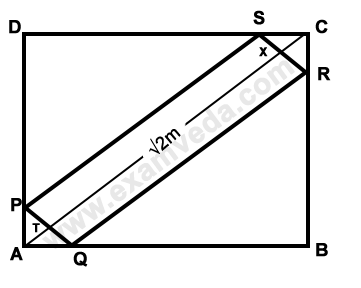
A rectangular plank $$\sqrt 2 $$ metre wide is placed symmetrically on the diagonal of a square of side 8 metres as shown in the figure. The area of the plank is :
Area mcq question image
Discuss
Answer & Solution
Answer: Option B
Solution:
Area mcq solution image
$$\eqalign{ & {\text{ Let }}AP{\text{ }} = {\text{ }}AQ{\text{ }} = {\text{ }}x{\text{ metres}} \cr & {\text{Then,}} \cr & \Rightarrow {x^2} + {x^2} = {\left( {\sqrt 2 } \right)^2} \cr & \Rightarrow 2{x^2} = 2 \cr & \Rightarrow {x^2} = 1 \cr & \Rightarrow x = 1\,m \cr & So,\,\,\vartriangle PAQ{\text{ is isosceles}}{\text{.}} \cr & \therefore PT = QT = \left( {\frac{{\sqrt 2 }}{2}} \right)m = \left( {\frac{1}{{\sqrt 2 }}} \right)m \cr & {\text{In }}\vartriangle {\text{ }}PTA{\text{, we have : }}\angle PTA = {90^ \circ } \cr & \therefore A{T^2} = A{P^2} - P{T^2} \cr & \,\,\,\,\,\,\,\,\,\,\,\,\,\,\,\,\,\, = {1^2} - {\left( {\frac{1}{{\sqrt 2 }}} \right)^2} \cr & \,\,\,\,\,\,\,\,\,\,\,\,\,\,\,\,\,\, = 1 - \frac{1}{2} = \frac{1}{2} \cr & Or,AT = \left( {\frac{1}{{\sqrt 2 }}} \right)m \cr & {\text{Similarly,}} \cr & CX = \left( {\frac{1}{{\sqrt 2 }}} \right)m \cr & \therefore PS = QR = XT \cr & \,\,\,\,\,\,\,\,\,\,\,\,\,\, = AC - 2 \times AT \cr & \,\,\,\,\,\,\,\,\,\,\,\,\,\, = \left[ {8\sqrt 2 - \left( {2 \times \frac{1}{{\sqrt 2 }}} \right)} \right]m \cr & \,\,\,\,\,\,\,\,\,\,\,\,\,\, = \left( {8\sqrt 2 - \frac{2}{{\sqrt 2 }}} \right)m \cr & \,\,\,\,\,\,\,\,\,\,\,\,\,\, = \frac{{14}}{{\sqrt 2 }}m \cr & {\text{Area of the plank :}} \cr & = \left( {\frac{{14}}{{\sqrt 2 }} \times \sqrt 2 } \right){m^2} \cr & = 14\,{m^2} \cr} $$
38
The area of a triangle whose sides are of lengths 3 cm, 4 cm and 5 cm is :
Discuss
Answer & Solution
Answer: Option B
Solution:
Since 32 + 42 = 52,
So it is a right-angled triangle with Base = 3 cm and Height = 4 cm
∴ Area :
$$\eqalign{ & = \left( {\frac{1}{2} \times 3 \times 4} \right)c{m^2} \cr & = 6\,c{m^2} \cr} $$
39
The perimeter of a triangle is 30 cm and its area is 30 cm2. If the largest side measures 13 cm, then what is the length of the smallest side of the triangle ?
Discuss
Answer & Solution
Answer: Option C
Solution:
Let the smallest side be x cm.
Then, other sides are 13 cm and (17 - x) cm
Let a = 13, b = x and c = (17 - x)
So, s = 15
$$\eqalign{ & {\text{Area}} = \sqrt {s\left( {s - a} \right)\left( {s - b} \right)\left( {s - c} \right)} \cr & \,\,\,\,\,\,\,\,\,\,\, = \sqrt {15 \times 2 \times \left( {15 - x} \right)\left( {x - 2} \right)} \cr & \,\,\,\,\,\,\,\,\,\,\, = \sqrt {30\left( {15 - x} \right)\left( {x - 2} \right)} \cr & \therefore 30\left( {15 - x} \right)\left( {x - 2} \right) = {\left( {30} \right)^2} \cr & \Rightarrow \left( {15 - x} \right)\left( {x - 2} \right) = 30 \cr & \Rightarrow {x^2} - 17x + 60 = 0 \cr & \Rightarrow \left( {x - 12} \right)\left( {x - 5} \right) = 0 \cr & \Rightarrow x = 12{\text{ or }}x = 5 \cr & {\text{ Smallest side = 5 cm}} \cr} $$
40
If a parallelogram with area P, a rectangle with area R and a triangle with area T are all constructed on the same base and all have the same altitude, then which of the following statements is false ?
Discuss
Answer & Solution
Answer: Option B
Solution:
Let each have base = b and height = h
Then,
P = b × h, R = b × h, T = $$\frac{1}{2}$$ × b × h
So, P = R, P = 2T and T = $$\frac{1}{2}$$R, are all correct statements.
∴ Option B is false