
ExamVeda
Login
Home
51
The adjoining figure contains three squares with areas of 100, 16 and 49 lying side by side as shown. By how much should the area of the middle square be reduced in order that the total length PQ of the resulting three squares is 19 ?
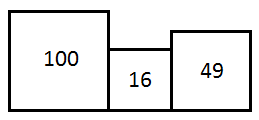
Area mcq question image
Discuss
Answer & Solution
Answer: Option D
Solution:
PQ = $$\sqrt {100} $$  + $$\sqrt {16} $$ + $$\sqrt {49} $$  = (10 + 4 + 7) = 21
Side of middle square = $$\sqrt {16} $$  = 4
Reduction in PQ = (21 - 19) = 2
New side of middle square = (4 - 2) = 2
∴ Reduction in area of middle square = (42 - 22) = 12
52
The three sides of a triangular field are 20 metres, 21 metres and 29 metres long respectively. The area of the field is :
Discuss
Answer & Solution
Answer: Option A
Solution:
Since (20)2 + (21)2 = (29)2
So, it is a right-angled triangle with base = 20 m and height = 21 m
∴ Area = $$\left( {\frac{1}{2} \times 20 \times 21} \right)$$   m2 = 210 m2
53
The diagonal of a square is $$4\sqrt 2 $$ cm. The diagonal of another square whose area is double that of the first square, is :
Discuss
Answer & Solution
Answer: Option A
Solution:
$$\eqalign{ & d = 4\sqrt 2 \,cm \cr & \Rightarrow {\text{Area }} = \frac{1}{2}d_1^2 \cr & \,\,\,\,\,\,\,\,\,\,\,\,\,\,\,\,\,\,\,\,\,\,\,\, = \frac{1}{2} \times {\left( {4\sqrt 2 } \right)^2} \cr & \,\,\,\,\,\,\,\,\,\,\,\,\,\,\,\,\,\,\,\,\,\,\,{\text{ = 16}}\,{\text{c}}{{\text{m}}^2} \cr} $$
Area of new square = (2 × 16) cm2 = 32 cm2
$$\eqalign{ & \therefore \frac{1}{2}d_2^2 = 32 \cr & \Rightarrow d_2^2 = 64 \cr & \Rightarrow {d_2} = 8\,cm \cr} $$
54
What will be the area of 4 metres high wall on all four sides of a rectangular hall having perimeter 64 m ?
Discuss
Answer & Solution
Answer: Option A
Solution:
Perimeter = 64 m
⇒ 2(l + b) = 64
∴ Area of 4 walls
= 2(l + b) × h
= (64 × 4) m2
= 256 m2
55
The altitude of an equilateral triangle of side $$2\sqrt 3 $$ cm is :
Discuss
Answer & Solution
Answer: Option D
Solution:
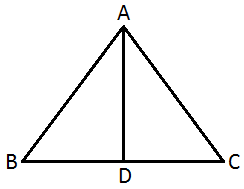
Let ABC be the equilateral triangle and AD be the altitude on base BC
Area mcq solution image
In an equilateral triangle, the altitude and the median coincide.
So, BC = DC = $$\left( {\frac{{2\sqrt 3 }}{2}} \right)$$ cm = $$\sqrt 3 $$ cm
Let the length of the altitude AD be x cm
Then, in right angled ΔADB,
AB2 = AD2 + BD2
⇒ $${\left( {2\sqrt 3 } \right)^2}$$  = x2 + $${\left( {\sqrt 3 } \right)^2}$$
⇒ x2 = (12 - 3)
⇒ x2 = 9
⇒ x = 3 cm
56
One of the diagonals of a rhombus is double the other diagonal. Its area is 25 sq. cm. The sum of the diagonal is ?
Discuss
Answer & Solution
Answer: Option C
Solution:
$$\eqalign{ & \Leftrightarrow \frac{1}{2}{d_1} \times 2{d_1} = 25 \cr & \Leftrightarrow d_1^2 = 25 \cr & \Leftrightarrow {d_1} = 5 \cr} $$
∴ Sum of lengths of diagonals = (5 + 10) cm = 15 cm
57
Cost of fencing a circular plot at the rate of Rs. 15 per metre is Rs. 3300. What will be the cost of flooring the plot at the rate of Rs. 100 per square metre ?
Discuss
Answer & Solution
Answer: Option C
Solution:
Circumference of the plot :
$$\eqalign{ & = \left( {\frac{{3300}}{{15}}} \right)m \cr & = 220\,m \cr & \Rightarrow 2\pi R = 220 \cr & \Rightarrow R = \frac{{220 \times 7}}{{2 \times 22}} \cr & \Rightarrow R = 35\,m \cr} $$
Area of the plot :
$$\eqalign{ & = \left( {\frac{{22}}{7} \times 35 \times 35} \right){m^2} \cr & = 3850\,{m^2} \cr} $$
∴ Cost of flooring :
$$\eqalign{ & = {\text{Rs}}{\text{.}}\left( {3850 \times 100} \right) \cr & = {\text{Rs}}{\text{. 385000}} \cr} $$
58
The ratio of the circumferences of two circles is 2 : 3. What is the ratio of their areas ?
Discuss
Answer & Solution
Answer: Option B
Solution:
$$\eqalign{ & \Rightarrow \frac{{2\pi {R_1}}}{{2\pi {R_2}}} = \frac{2}{3} \cr & \Rightarrow \frac{{{R_1}}}{{{R_2}}} = \frac{2}{3} \cr & \Rightarrow \frac{{\pi R_1^2}}{{\pi R_2^2}} = {\left( {\frac{2}{3}} \right)^2} \cr & \Rightarrow \frac{{\pi R_1^2}}{{\pi R_2^2}} = \frac{4}{9} \text{ or } 4:9 \cr} $$
59
A circular road runs around a circular garden. If the difference between the circumference of the outer circle and the inner circle is 44 m, the width of the road is :
Discuss
Answer & Solution
Answer: Option C
Solution:
Let the radii of the outer and inner circle be R and r respectively
Then,
$$\eqalign{ & 2\pi R - 2\pi r = 44 \cr & \Rightarrow 2\pi \left( {R - r} \right) = 44 \cr & \Rightarrow \left( {R - r} \right) = \frac{{44 \times 7}}{{22 \times 2}} \cr & \Rightarrow \left( {R - r} \right) = 7 \cr} $$
60
The area of the greatest circle which can be inscribed in a square whose perimeter is 120 cm, is :
Discuss
Answer & Solution
Answer: Option D
Solution:
Side of the square :
$$\eqalign{ & = \frac{{120}}{4}cm \cr & = 30\,cm \cr} $$
Radius of the required circle :
$$\eqalign{ & = \left( {\frac{1}{2} \times 30} \right)cm \cr & = 15\,cm \cr & = \pi \times {r^2} \cr & = \left[ {\frac{{22}}{7} \times {{\left( {15} \right)}^2}} \right]c{m^2} \cr} $$