ExamVeda
Login
Home
1
In what ratio does the point T(x, 0) divide the segment joining the points S(-4, -1) and U(1, 4)?
Discuss
Answer & Solution
Answer: Option A
Solution:
$$\eqalign{ & \frac{{K\,\,\,\,\,:\,\,\,\,\,1}}{{S\left( { - 4,\, - 1} \right)\,\,\,\,\,\,\,\,\,\,T\left( {x,\,0} \right)\,\,\,\,\,\,\,\,\,\,U\left( {1,\,4} \right)}} \cr & \Rightarrow x = \frac{{k{x_2} + {x_1}}}{{k + 1}},\,\,y = \frac{{k{y_2} + {y_1}}}{{k + 1}} \cr & \Rightarrow 0 = \frac{{4k - 1}}{{k + 1}} \Rightarrow \boxed{k = \frac{1}{4}} \cr & {\text{Ratio }}\frac{1}{4}:1 = \boxed{1:4} \cr} $$
2
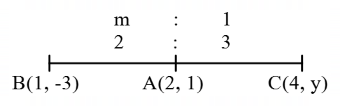
Point A (2, 1) divides segment BC in the ratio 2 : 3. Co-ordinates of B are (1, -3) and C are (4, y). What is the value of y?
Discuss
Answer & Solution
Answer: Option D
Solution:
Coordinate Geometry mcq question image
$$\eqalign{ & {\text{Now,}} \cr & \Rightarrow 1 = \frac{{2y - 9}}{5} \cr & \Rightarrow 5 = 2y - 9 \cr & \Rightarrow y = 7 \cr} $$
3
The graphs of the equations 7x + 11y = 3 and 8x + y = 15 intersect at the point P, which also lies on the graph of the equation:
Discuss
Answer & Solution
Answer: Option D
Solution:
$$\eqalign{ & 7x + 11y = 3\,\,\,\,*1 \cr & \underline {\,8x + y = 15\,} \,\,\,\,\,\underline {\,*11\,} \cr & \,\,7x + 11y = 3 \cr & \,\,88x + 11y = 165 \cr & \underline {\, - \,\,\,\,\,\,\,\,\, - \,\,\,\,\,\,\,\,\,\, - \,\,\,\,\,\,\,\,\,\,} \cr & - 81x = - 162 \cr & x = 2 \cr & y = 15 - 8 \times 2 \cr & y = - 1 \cr} $$ Put value of x and y in options only option 'D' satisfy in this values
3x + 5y = 1
3 × 2 + 5 × (-1) = 1
6 - 5 = 1 = 1 [satisfied]
4
If a linear equation is of the form x = k where k is a constant, then graph of the equation will be
Discuss
Answer & Solution
Answer: Option D
Solution:
x = k, where k is a constant
The graph of the equation will be parallel to y-axis.
Coordinate Geometry mcq question image
5
The total area (in sq. unit) of the triangles formed by the graph of 4x + 5y = 40, x-axis, y-axis and x = 5 and y = 4 is:
Discuss
Answer & Solution
Answer: Option B
Solution:
$$\eqalign{ & 4x + 5y = 40 \cr & \Rightarrow \frac{x}{{10}} + \frac{y}{8} = 1 \cr} $$
Coordinate Geometry mcq question image
Intersection point of 4x + 5y = 40 and y = 4 will be,
4x + 5 × 4 = 40
4x = 20
x = 5
∴ Intersecting point is (5, 4)
Area of ΔABC = $$\frac{1}{2}$$ × (10 - 5) × 4 = 10 sq. units
Area of ΔCDE = $$\frac{1}{2}$$ × 5 × (8 - 4) = 10 sq. units
∴ Area bounded by the graph = 10 + 10 = 20 sq units.
6
The linear equation such that each point on its graph has an ordinate four times its abscissa is:
Discuss
Answer & Solution
Answer: Option B
Solution:
Since ordinate is four times its abscissa, equation of line will be y = 4x
7
What is the area (in square units) of the triangular region enclosed by the graphs of the equations x + y = 3, 2x + 5y = 12 and the x-axis?
Discuss
Answer & Solution
Answer: Option C
Solution:
$$\eqalign{ & \,\,x + y = 3 \cr & \underline {\,2x + 5y = 12\,} \cr & \,\,\,\,\,\,\,\,\,\,y = 2 \cr} $$
Coordinate Geometry mcq question image
Area of ΔABC = $$\frac{1}{2}$$ × 3 × 2 = 3
8
Equation of the straight line parallel to x-axis and also 3 units below x-axis is:
Discuss
Answer & Solution
Answer: Option C
Solution:
Equation of straight line parallel to x-axis and also 3 units below x-axis is y = -3
Coordinate Geometry mcq question image
9
The equation of circle with centre (1, -2) and radius 4 cm is:
Discuss
Answer & Solution
Answer: Option D
Solution:
(x - a)2 + (y - b)2 = r2
(x - 1)2 + [y - (-2)]2 = 42
x2 - 1 - 2x + y2 + 4 + 4y = 16
x2 + y2 - 2x + 4y = 11
10
An equation of the form ax + by + c = 0 where a ≠ 0, b ≠ 0, c = 0 represents a straight line which passes through:
Discuss
Answer & Solution
Answer: Option A
Solution:
ax + by + c = 0
Where c = 0, a ≠ 0 & b ≠ 0
∴ ax + by = 0
Since ax + by = 0, therefore x = 0 & y = 0
Therefore, the straight line passes through (0, 0)