ExamVeda
Login
Home
51
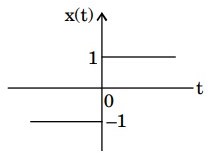
The function x(t) is shown in the figure. Even and odd parts of a unit-step function u(t) are respectively,
Signal Processing mcq question image
Discuss
Answer & Solution
Answer: Option A
No explanation is given for this question. Let's Discuss on Board
52
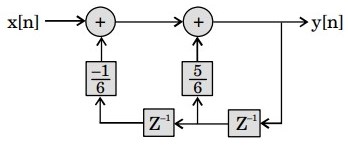
For the discrete-time system shown in the figure, the poles of the system transfer function are located at
Signal Processing mcq question image
Discuss
Answer & Solution
Answer: Option C
No explanation is given for this question. Let's Discuss on Board
53
Let $$x\left[ n \right] = {\left( { - {1 \over 9}} \right)^n}u\left( n \right) - {\left( { - {1 \over 3}} \right)^n}u\left( { - n - 1} \right).$$
The Region of Convergence (ROC) of the z-transform of x[n]
Discuss
Answer & Solution
Answer: Option C
No explanation is given for this question. Let's Discuss on Board
54
An LTI system having transfer function $$\frac{{{s^2} + 1}}{{{s^2} + 2s + 1}}$$   and input x(t) = sin(t + 1) is in steady state. The output is sampled at a rate ωs rad/s to obtain the final output {y(k)}. Which of the following is true?
Discuss
Answer & Solution
Answer: Option A
No explanation is given for this question. Let's Discuss on Board
55
Let x[n] = x[-n]. Let X(z) be the z-transform of x[n]. If 0.5 + j0.25 is a zero of X(z), which one of the following must also be a zero of X(z).
Discuss
Answer & Solution
Answer: Option B
No explanation is given for this question. Let's Discuss on Board
56
If G(f) represents the Fourier transform of a signal g(t) which is real and odd symmetric in time, then
Discuss
Answer & Solution
Answer: Option B
Solution:
Okay, let's break down this Fourier Transform question for beginners!

The question is asking what happens to the Fourier Transform (G(f)) of a signal g(t), when that signal is both real and odd-symmetric.

Let's define each part:
* Fourier Transform: Think of it as a way to see what frequencies make up a signal. It transforms a signal from the time domain (how it changes over time) to the frequency domain (how much of each frequency is present).
* Real Signal: A signal is real if its values are real numbers (no imaginary part). Most signals we deal with in the real world are real (e.g., sound waves, voltage).
* Odd Symmetry: A signal g(t) is odd-symmetric if g(-t) = -g(t). This means if you flip the signal around the y-axis and then flip it around the x-axis, you get the same signal back. A simple example is g(t) = t.

Now, here's the key concept:
The Fourier Transform has some properties related to symmetry.

Important Relationship: When g(t) is real and odd, its Fourier Transform G(f) will be purely imaginary.

Let's look at why the other options are incorrect.
* Option A: G(f) is complex: While *any* Fourier Transform *can* be complex, the combination of real and odd symmetry *simplifies* it.
* Option C: G(f) is real: A real and even signal in the time domain would give a real fourier transform.
* Option D: G(f) is real and non-negative: A real and non-negative time-domain signal doesn't guarantee the same characteristics in the frequency domain.

Therefore, the answer is Option B: G(f) is imaginary.

57
Consider the sequence
x[n] = {-4 - j5, 1 + j2, 4}
The conjugate antisymmetric part of the sequence is
Discuss
Answer & Solution
Answer: Option A
No explanation is given for this question. Let's Discuss on Board
58
If the region of convergence of x1[n] + x2[n] is $${1 \over 3} < \left| z \right| < {2 \over 3},$$   then the region of convergence of x1[n] - x2[n] includes
Discuss
Answer & Solution
Answer: Option D
No explanation is given for this question. Let's Discuss on Board
59
The Fourier series of an odd periodic function, contains only
Discuss
Answer & Solution
Answer: Option B
No explanation is given for this question. Let's Discuss on Board
60
Increased pulse-width in the flat-top sampling, leads to
Signal Processing mcq question image
Discuss
Answer & Solution
Answer: Option A
No explanation is given for this question. Let's Discuss on Board