ExamVeda
Login
Home
31
The Laplace transform of a continuous-time signal x(t) is $$X\left( s \right) = {{5 - s} \over {{s^2} - s - 2}}.$$    If the Fourier transform of this signal exists, then x(t) is
Discuss
Answer & Solution
Answer: Option C
No explanation is given for this question. Let's Discuss on Board
32
A network consisting of a finite number of linear resistor (R), inducer (L), and capacitor (C) elements, connected all in series or all in parallel, is excited with a source of the form
$$\sum\limits_{k = 1}^3 {{a_x}\,\cos \left( {k{\omega _0}t} \right),{\rm{were}}\,{a_k} \ne 0,} \,{\omega _0} \ne 0.$$
The source has nonzero impedance. Which one of the following is a possible form of the output measured across a resistor in the network?
Discuss
Answer & Solution
Answer: Option C
No explanation is given for this question. Let's Discuss on Board
33
The complex envelope of the bandpass signal $$x\left( t \right) = \sqrt 2 \left( {{{\sin \left( {{{\pi t} \over 5}} \right)} \over {{{\pi t} \over 5}}}} \right)\sin \left( {\pi t - {\pi \over 4}} \right),$$     centered about $$f = {1 \over 2}Hz,$$   is
Discuss
Answer & Solution
Answer: Option C
No explanation is given for this question. Let's Discuss on Board
34
A signal x(t) has a Fourier transform X(ω). If x(t) is a real and odd function of t, then X(ω) is
Discuss
Answer & Solution
Answer: Option A
Solution:
Here's the explanation for the given Fourier Transform question:

The question asks about the properties of the Fourier Transform, X(ω), of a signal x(t) when x(t) is both real and odd.

Here's a breakdown to understand the answer:

Key Concepts:

* Fourier Transform: A mathematical tool that decomposes a signal into its constituent frequencies.
* Real Function: A function whose values are real numbers for all real inputs.
* Odd Function: A function x(t) is odd if x(-t) = -x(t). Odd functions are symmetrical about the origin.
* Even Function: A function x(t) is even if x(-t) = x(t). Even functions are symmetrical about the y-axis.

Properties of Fourier Transform with Symmetry:

* If x(t) is real, then X(ω) has Hermitian symmetry, meaning X(-ω) = X*(ω) where * denotes complex conjugate. In simpler terms, the real part of X(ω) is even, and the imaginary part is odd.
* If x(t) is odd, the Fourier transform X(ω) is imaginary. This means it only contains imaginary components and no real components.

Applying to the question:

Since x(t) is both real and odd:

1. Because x(t) is real, we know X(ω) has Hermitian symmetry.
2. Because x(t) is odd, we know X(ω) is purely imaginary.

Combining these two properties, if X(ω) is purely imaginary (say, X(ω) = j*Y(ω), where Y(ω) is a real-valued function) and has Hermitian symmetry, it means:

X(-ω) = X*(ω)
j*Y(-ω) = (j*Y(ω))*
j*Y(-ω) = -j*Y(ω) (because the conjugate of j is -j)
Y(-ω) = -Y(ω)

This means Y(ω) is an odd function. Since X(ω) = j*Y(ω), and Y(ω) is odd, then X(ω) itself is an imaginary and odd function.

Therefore, the correct answer is Option B: An imaginary and odd function of ω

35
The power in the signal
$$s\left( t \right) = 8\cos \left( {20\pi t - {\pi \over 2}} \right) + 4\,\sin \left( {15\pi t} \right)$$       is
Discuss
Answer & Solution
Answer: Option A
No explanation is given for this question. Let's Discuss on Board
36
A 5-point sequence x[n] is given as
x[-3] = 1, x[-2] = 1, x[-1] = 0, x[0] = 5, x[1] = 1.
Let X(ejω) denote the discrete-time Fourier transform of x[n]. The value of $$\int\limits_{ - \pi }^\pi {X\left( {{e^{j\omega }}} \right)} d\omega $$
Discuss
Answer & Solution
Answer: Option B
No explanation is given for this question. Let's Discuss on Board
37
The Fourier series representation of an impulse train denoted by
$$s\left( t \right) = \sum\limits_{n = - \infty }^\infty {\delta \left( {t - n{T_0}} \right)} \,{\rm{is}}\,{\rm{given}}\,{\rm{by}}$$
Discuss
Answer & Solution
Answer: Option A
No explanation is given for this question. Let's Discuss on Board
38
Let Y(s) be the unit-step response of a causal system having a transfer function
$$G\left( s \right) = {{3 - s} \over {\left( {s + 1} \right)\left( {s + 3} \right)}}$$
That is, $$Y\left( s \right) = {{G\left( s \right)} \over s}.$$   The forced response of the system is
Discuss
Answer & Solution
Answer: Option A
No explanation is given for this question. Let's Discuss on Board
39
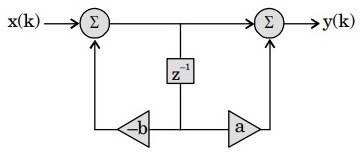
Consider the system shown in the figure below. The transfer function $$\frac{{Y\left( z \right)}}{{X\left( z \right)}}$$  of the system is
Signal Processing mcq question image
Discuss
Answer & Solution
Answer: Option A
No explanation is given for this question. Let's Discuss on Board
40
The impulse response of an LTI system can be obtained by
Discuss
Answer & Solution
Answer: Option B
No explanation is given for this question. Let's Discuss on Board