
The viral claim, the facts, and what a Gulf-to-Red Sea canal would actually mean.
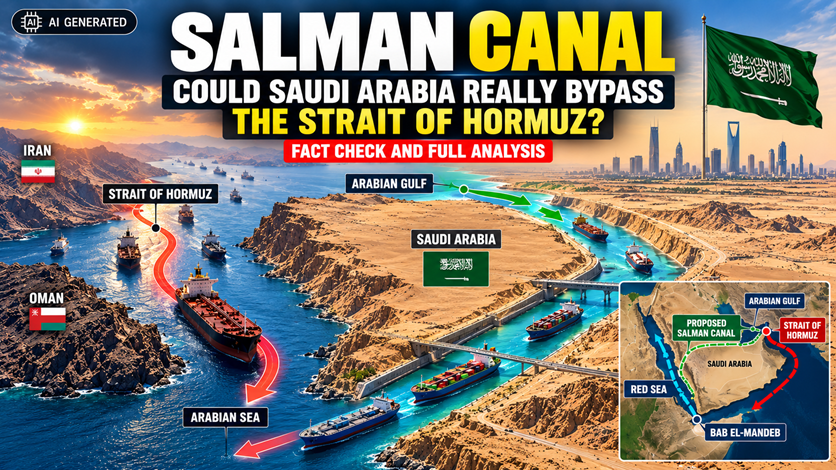
The Strait of Hormuz is one of the most strategically important waterways in the world. Every day, enormous volumes of oil and other energy products pass through this narrow passage between Iran and Oman, connecting the Persian Gulf with the Gulf of Oman and the Arabian Sea.
That dependence has led to a recurring question: Could Saudi Arabia create another maritime route that bypasses the Strait of Hormuz?
One proposal that frequently resurfaces online is the so-called "Salman Canal" — a gigantic canal across the Arabian Peninsula that would connect the Gulf with the Arabian Sea or Red Sea system.
However, the underlying idea is based on a real proposal that has been discussed publicly for years. Saudi Arabia also already operates a very different kind of Hormuz bypass: the East-West oil pipeline, which transports crude from the kingdom's eastern oil fields to the Red Sea.
What Is the Strait of Hormuz?
The Strait of Hormuz is a narrow maritime passage separating Iran from the Arabian Peninsula.
At its narrowest point, the strait is approximately 21 nautical miles (39 km) wide, with designated shipping channels for vessels entering and leaving the Persian Gulf.
Its importance comes from the enormous volume of energy transported through it.
According to the International Energy Agency (IEA), approximately 20 million barrels per day of crude oil and petroleum products passed through the Strait of Hormuz in 2025, representing about 25% of global seaborne oil trade.
Approximately 80% of the oil and oil products passing through the strait in 2025 were destined for Asian markets.
China, India, Japan and other Asian economies therefore have a particularly strong interest in uninterrupted shipping through the waterway.
The strait is not important only for oil. More than 110 billion cubic metres of LNG also passed through Hormuz in 2025.
The IEA estimates that approximately 93% of Qatar's LNG exports and 96% of the UAE's LNG exports transited the strait during that year.
What Is the Salman Canal?
The Salman Canal is the name given to a proposal for an enormous artificial waterway designed to provide an alternative route for ships avoiding the Strait of Hormuz.
A widely reported 2018 proposal from the Riyadh-based Arab Century Centre for Studies described a canal approximately 950 kilometres long.
Reported Features of the Historical Proposal
Approximately 950 km
Approximately 150 metres
Approximately 25 metres
Around $80 billion
The reported concept included approximately 630 km through Saudi Arabia and around 320 km through Yemen. It was intended to provide Gulf states with another potential route for exports without requiring all maritime traffic to pass through Hormuz.
The proposal also discussed possible alternatives involving Oman if conditions in Yemen made the proposed route impractical.
Is Saudi Arabia Currently Building the Salman Canal?
No evidence establishes that the Salman Canal is currently under construction.
There is no operating Salman Canal, and the widely circulated $80-billion proposal should not be presented as an officially approved Saudi construction project.
This distinction is crucial because social-media posts can make the proposal sound like:
Saudi Arabia is building a canal to bypass Hormuz.
The more accurate statement is:
Saudi Arabia Already Has a Hormuz Bypass
Interestingly, Saudi Arabia does not need a canal to bypass Hormuz for one particularly important commodity: oil.
Saudi Arabia operates the East-West Pipeline, also known as the Petroline.
The approximately 1,200-kilometre pipeline transports crude from Saudi Arabia's eastern oil-producing region across the country toward Yanbu on the Red Sea.
This allows Saudi crude to reach a Red Sea export terminal without travelling through the Strait of Hormuz.
The pipeline has a maximum reported capacity of approximately 7 million barrels per day, although actual sustainable flows and exports can be substantially lower depending on operating conditions and Red Sea shipping conditions.
The IEA estimates that Saudi Arabia and the UAE together have approximately 3.5–5.5 million barrels per day of available alternative pipeline capacity for crude exports that can avoid Hormuz, depending on operating conditions.
Pipeline vs Canal: Why the Difference Matters
Eastern Saudi oil fields
↓
Pipeline
↓
Yanbu
↓
Red Sea tanker
The tanker does not need to pass through Hormuz.
Persian Gulf
↓
Canal
↓
Red Sea / Arabian Sea system
↓
International shipping routes
Ships could potentially avoid the Strait of Hormuz.
The Engineering Challenge Would Be Huge
Building a 950-kilometre or larger navigable canal across the Arabian Peninsula would be fundamentally different from digging a conventional irrigation or drainage canal.
Ships require substantial water depth and width. The 2018 proposal reportedly envisioned a canal approximately 150 metres wide and 25 metres deep.
But the geography presents major obstacles.
The proposal would raise difficult engineering questions:
These questions matter because a canal is not simply a trench filled with seawater. It is an integrated maritime infrastructure system requiring navigation channels, ports, safety systems, water management, bridges, potentially locks or pumping infrastructure, and extensive supporting infrastructure.
The $80 Billion Figure Should Not Be Treated as a Final Cost
The widely cited $80 billion figure comes from the earlier proposal and should not be interpreted as a modern, independently validated construction budget.
Large infrastructure projects often experience significant cost changes between preliminary concepts and detailed engineering.
The final cost would depend on factors including:
Therefore, quoting "$80 billion" as though it were the confirmed cost of an approved project would be misleading.
It is better described as an initial estimate associated with the historical proposal.
Would the Canal Really Bypass the Strait of Hormuz?
Yes — in principle.
If a navigable Gulf-to-Red Sea or Gulf-to-Arabian-Sea canal were built, ships using it could avoid the Strait of Hormuz.
Existing Route
Persian Gulf
↓
Strait of Hormuz
↓
Gulf of Oman
↓
Arabian Sea
↓
Indian Ocean
Hypothetical Canal Route
Persian Gulf
↓
Salman Canal
↓
Red Sea / Arabian Sea connection
↓
International maritime routes
Avoiding Hormuz Does Not Mean Avoiding Every Chokepoint
If the canal connects the Gulf to the Red Sea, ships travelling onward to the Indian Ocean would still need to pass through the Bab el-Mandeb and Gulf of Aden.
Bab el-Mandeb is the narrow maritime gateway connecting the Red Sea with the Gulf of Aden.
Its security has become particularly important because of conflict and attacks affecting commercial shipping in the Red Sea region.
Could the Canal Make Hormuz Less Important?
Potentially — but probably not irrelevant.
The Strait of Hormuz currently carries enormous volumes of oil and gas. The IEA says around 20 million barrels per day of oil and petroleum products passed through the strait in 2025.
A large navigable canal could theoretically provide an additional route for some of that traffic.
However, several limitations would remain:
A canal would have a finite shipping capacity and could not automatically replace all Hormuz traffic.
Not every Gulf country would necessarily be able to use the canal equally.
Shipping companies would compare canal fees, transit time and operational restrictions with existing routes.
Large-scale LNG shipping would require the canal to accommodate modern LNG carriers safely and economically.
LNG Is a Major Challenge for the Canal Concept
Qatar is one of the world's largest LNG exporters.
Much of its LNG production is located on the Persian Gulf side of the Arabian Peninsula.
According to the IEA, around 93% of Qatar's LNG exports and 96% of UAE LNG exports passed through Hormuz in 2025.
A canal capable of accommodating large commercial vessels could theoretically provide another maritime route, but that would require the canal to be designed and operated to accommodate the enormous dimensions, draft and traffic requirements of modern LNG carriers.
A more accurate statement would be:
If constructed at sufficient scale, a Gulf-to-Red Sea maritime canal could provide an additional route around Hormuz for some categories of shipping, potentially reducing — but not eliminating — the strait's strategic importance.
Saudi Arabia's Real Strategy Is More Diverse
Saudi Arabia's approach to reducing its exposure to Hormuz is not dependent on one giant canal.
The country already has infrastructure connecting its eastern oil-producing regions with the Red Sea.
The East-West Pipeline has demonstrated its strategic value during periods when shipping through Hormuz or other regional routes has faced disruption.
This illustrates an important point:
A pipeline bypassing Hormuz can still face security threats. Likewise, a future canal could itself become a strategically sensitive piece of infrastructure.
What Would Happen If the Salman Canal Were Actually Built?
1. Gulf Oil Exporters Could Gain Another Route
Saudi Arabia and potentially other Gulf producers could gain additional options for exporting hydrocarbons.
2. Shipping Routes Could Diversify
Some vessels might no longer need to use Hormuz.
3. Saudi Arabia's Logistics Importance Could Increase
Saudi territory could become an even more important transit corridor between the Gulf and wider maritime markets.
4. New Economic Zones Could Develop
Ports, logistics hubs and industrial areas could develop along the route.
5. Hormuz Could Face Reduced Traffic
The impact would depend heavily on canal capacity, vessel restrictions, cost and reliability.
6. The Canal Could Become Strategically Critical
A successful canal could become another major maritime chokepoint.
Why the Proposal Is So Difficult
The biggest question is not simply: "Can Saudi Arabia dig a canal?"
Modern engineering can accomplish extraordinary things.
The more important question is: "Would the economic and strategic benefits justify the enormous construction and operating costs?"
A project of this magnitude would need to compete with alternative investments such as:
The economic calculation would therefore be extremely complicated.
The Biggest Fact-Check: Don't Confuse a Proposal With a Project
What is true?
A large Gulf-to-Arabian-Sea canal has genuinely been proposed. A 2018 report described a roughly 950-kilometre concept called the Salman Canal and cited an initial estimated cost of around $80 billion.
What is not established?
There is no evidence that the Salman Canal is currently an operating waterway or an officially confirmed construction project.
What already exists?
Saudi Arabia already has the East-West oil pipeline connecting its eastern oil-producing region with Yanbu on the Red Sea.
What remains hypothetical?
A canal capable of carrying large ships directly between the Gulf and the western maritime network remains a proposal.
Could It Change the Global Energy Map?
If a sufficiently large canal were ever built, the consequences could be significant.
The Strait of Hormuz would remain geographically important, but its role as the only practical maritime exit for some Gulf traffic could potentially be reduced.
For Saudi Arabia, the canal could strengthen the country's position as a bridge between the Gulf and the wider maritime world.
But the project would also create a new strategic dependency.
The canal itself would need to remain secure, economically competitive and operational.
And if the route relied on the Red Sea, ships could still face risks around Bab el-Mandeb.
Salman Canal vs East-West Pipeline
| Feature | East-West Pipeline | Proposed Salman Canal |
|---|---|---|
| Status | Operational infrastructure | Proposal / concept |
| Main purpose | Transport crude oil | Maritime shipping |
| Avoids Hormuz | Yes | Potentially yes |
| Connects to Red Sea | Yes | Proposed connection |
| Carries ships | No | Potentially |
| Approximate scale | ~1,200 km pipeline | ~950 km historical proposal |
| Major challenge | Security and export capacity | Engineering, cost, waterway capacity and security |
| Existing alternative | Yes | No |
| Impact on LNG | Limited | Potentially greater, depending on vessel and canal design |
Final Verdict
The Salman Canal is not a fictional idea, but it is also not a canal currently being built by Saudi Arabia.
The proposal has been publicly discussed, including a 950-kilometre concept estimated at around $80 billion.
Saudi Arabia already has a much more practical Hormuz bypass for crude oil: the East-West Pipeline to Yanbu.
The Strait of Hormuz nevertheless remains extraordinarily important because of the sheer volume of oil and LNG that passes through it.
A future Gulf-to-Red Sea canal could reduce dependence on the strait for some maritime traffic, but it would face enormous engineering, financial, environmental and geopolitical challenges.
And if the canal used the Red Sea route, ships would still have to consider the strategic Bab el-Mandeb chokepoint.
The Bottom Line
The Salman Canal is a real proposal with potentially enormous strategic implications — but it remains hypothetical. Saudi Arabia already has an operational oil-export bypass around Hormuz, while a full maritime bypass would require a vastly more ambitious project.
Comments 0
Discussion from ExamVeda readers.