ExamVeda
Login
Home
1
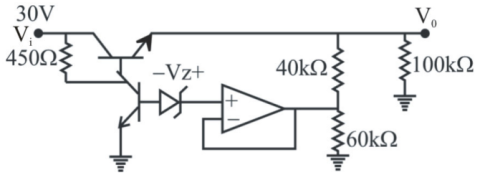
In the given circuit, Vbe = 0.7 V, Vz = 5.3 V, β = 100. V0 is
Analog Electronics mcq question image
Discuss
Answer & Solution
Answer: Option B
No explanation is given for this question. Let's Discuss on Board
2
A signal of 1 kHz is to be amplified, but the circuit board and wires pick up and store 60 Hz component from a nearby electric line. If this component is 40 dB higher than the desired signal, what filter stop band attenuation is necessary to ensure the signal remains 20 dB above the interferer level?
Discuss
Answer & Solution
Answer: Option A
No explanation is given for this question. Let's Discuss on Board
3
A Wien bridge oscillator is a
Discuss
Answer & Solution
Answer: Option D
No explanation is given for this question. Let's Discuss on Board
4
The voltage gain of a common emitter amplifier is:
Discuss
Answer & Solution
Answer: Option A
No explanation is given for this question. Let's Discuss on Board
5
Decreasing the gain in the op-amp non-inverting amplifier circuit could be achieved by:
Discuss
Answer & Solution
Answer: Option C
No explanation is given for this question. Let's Discuss on Board
6
Thermal runaway in a transistor biased in the active region is due to
1. heating of the transistor.
2. change in β due to increase in temperature.
3. change in reverse collector saturation current due to rise in temperature.
4. base emitter voltage VBE which decreases with rise in temperature.
Which of the above statements is/are correct?
Discuss
Answer & Solution
Answer: Option C
No explanation is given for this question. Let's Discuss on Board
7
Pulses of definite width can be obtained from irregular shaped pulses:
Discuss
Answer & Solution
Answer: Option A
Solution:
The correct answer is Option A: When it is given as input to a monostable multivibrator.
Let's break down why:

Monostable Multivibrator:
A monostable multivibrator has one stable state.
When triggered by an input pulse (even an irregular one), it goes into a temporary unstable state for a fixed period of time.
This fixed period is determined by the circuit's components (resistors and capacitors), not the shape of the input pulse.
So, regardless of how the input pulse looks, the output will be a pulse with a definite, predictable width.

Why other options are incorrect:
Bistable Multivibrator: Requires a trigger to flip between two stable states, it doesn't create a pulse of definite width from an irregular input.
Schmitt-trigger: Converts an analog input signal to a digital output signal with hysteresis, but it doesn't necessarily create a pulse of definite width.
Pulse Transformer: Primarily used for voltage or current transformation of pulses, not for shaping them into definite widths. It basically transfers the input pulse, with some modifications to its amplitude and polarity.

In simple terms: Imagine the monostable multivibrator as a timer. You can start the timer with any kind of signal(irregular), but the timer will always run for the same amount of time (definite width).

8
In an Op-Amp Ad = 80dB, CMRR = 40dB, Ac in dB
Discuss
Answer & Solution
Answer: Option A
No explanation is given for this question. Let's Discuss on Board
9
Current gain with feedback Aif = . . . . . . . .
Discuss
Answer & Solution
Answer: Option D
No explanation is given for this question. Let's Discuss on Board
10
An operational amplifier has a slew rate of 100 V/microsecond. For a frequency of 10 MHz, the maximum (peak) value of the sine wave output voltage will be
Discuss
Answer & Solution
Answer: Option D
No explanation is given for this question. Let's Discuss on Board