
ExamVeda
Login
Home
41
Solution of $$\frac{{{\text{dy}}}}{{{\text{dx}}}} = - \frac{{\text{x}}}{{\text{y}}}$$   at x = 1 and y = √3 is
Discuss
Answer & Solution
Answer: Option D
No explanation is given for this question. Let's Discuss on Board
42
The solution to the ordinary differential equation $$\frac{{{{\text{d}}^2}{\text{y}}}}{{{\text{d}}{{\text{x}}^2}}} + \frac{{{\text{dy}}}}{{{\text{dx}}}} - 6{\text{y}} = 0$$    is
Discuss
Answer & Solution
Answer: Option C
No explanation is given for this question. Let's Discuss on Board
43
Consider the differential equation $$\frac{{{\text{dy}}}}{{{\text{dx}}}} = 1 + {{\text{y}}^2}.$$
Which one of the following can be a particular solution of this differential equation?
Discuss
Answer & Solution
Answer: Option A
No explanation is given for this question. Let's Discuss on Board
44
Which ONE of the following is a linear non-homogeneous differential equation, where x and y are the independent and dependent variables respectively?
Discuss
Answer & Solution
Answer: Option A
No explanation is given for this question. Let's Discuss on Board
45
A body originally at 60°C cools down to 40°C in 15 minutes when kept in air at a temperature of 25°C. What will be the temperature of the body at the end of 30 minutes?
Discuss
Answer & Solution
Answer: Option B
No explanation is given for this question. Let's Discuss on Board
46
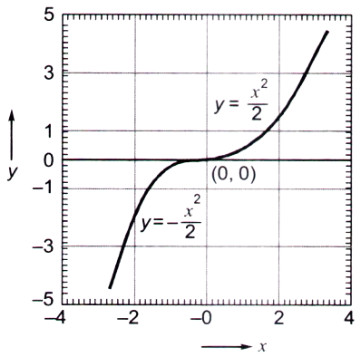
The figure shows the plot of y as a function of x
Differential Equations mcq question image
The function shown is the solution of the differential equation (assuming all initial conditions to be zero) is
Discuss
Answer & Solution
Answer: Option D
No explanation is given for this question. Let's Discuss on Board
47
The following differential equation has $$3\left( {\frac{{{{\text{d}}^2}{\text{y}}}}{{{\text{d}}{{\text{t}}^2}}}} \right) + 4{\left( {\frac{{{\text{dy}}}}{{{\text{dt}}}}} \right)^3} + {{\text{y}}^{\text{2}}} + 2 = {\text{x}}$$
Discuss
Answer & Solution
Answer: Option B
No explanation is given for this question. Let's Discuss on Board
48
The boundary-value problem y'' + λy = 0, y(0) = y(π) = 0 will have non-zero solutions if and only if the values of λ are
Discuss
Answer & Solution
Answer: Option C
No explanation is given for this question. Let's Discuss on Board
49
The general solution of the differential equation $$\frac{{{\text{dy}}}}{{{\text{dx}}}} = \frac{{1 + \cos 2{\text{y}}}}{{1 - \cos 2{\text{x}}}}$$   is
Discuss
Answer & Solution
Answer: Option C
No explanation is given for this question. Let's Discuss on Board
50
The solution of the differential equation $$\frac{{{\text{dy}}}}{{{\text{dx}}}} + 2{\text{xy}} = {{\text{e}}^{ - {{\text{x}}^2}}}$$   with y(0) = 1 is
Discuss
Answer & Solution
Answer: Option B
No explanation is given for this question. Let's Discuss on Board