
ExamVeda
Login
Home
51
If $$\sigma $$ is the total cross-section and f(θ), θ being the angle of scattering, is the scattering amplitude for a quantum mechanical elastic scattering by a spherically symmetric potential, then which of the following is true? Note that k is the magnitude of the wave vector along the $${{\bf{\hat z}}}$$ direction.
Discuss
Answer & Solution
Answer: Option C
No explanation is given for this question. Let's Discuss on Board
52
Which one of the following relations is true for Pauli matrices σx, σy and σz?
Discuss
Answer & Solution
Answer: Option D
No explanation is given for this question. Let's Discuss on Board
53
σi(i = 1, 2, 3) represents the Pauli spin matrices. Which one of the following is not true?
Discuss
Answer & Solution
Answer: Option D
No explanation is given for this question. Let's Discuss on Board
54
A particle is moving in a spherically symmetric potential V(r) = αr2, where α is a positive constant. In a stationary state, the expectation value of the kinetic energy $$\left\langle T \right\rangle $$ of the particle is
Discuss
Answer & Solution
Answer: Option B
No explanation is given for this question. Let's Discuss on Board
55
The commutator [Lx, y], where Lx is the x-component of the angular momentum operator and y is the y-component of the position operator, is equal to
Discuss
Answer & Solution
Answer: Option D
No explanation is given for this question. Let's Discuss on Board
56
A beam of mono-energetic particles having speed v is described by the wave function $$\psi $$ (x) = u(x) exp(ikx), where u(x) is a real function. This corresponds to a current density
Discuss
Answer & Solution
Answer: Option A
No explanation is given for this question. Let's Discuss on Board
57
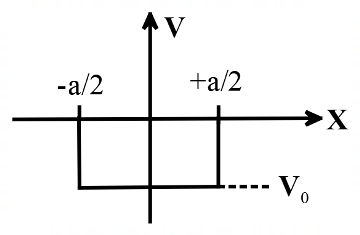
There are only three bound states for a particle of mass m in a one-dimensional potential well of the form shown in the figure. The depth V0 of the potential satisfies
Quantum Mechanics mcq question image
Discuss
Answer & Solution
Answer: Option C
No explanation is given for this question. Let's Discuss on Board
58
A system in a normalized state $$\left| \psi \right\rangle = {c_1}\left| {{\alpha _1}} \right\rangle + {c_2}\left| {{\alpha _2}} \right\rangle $$    with $$\left| {{\alpha _1}} \right\rangle $$ and $$\left| {{\alpha _2}} \right\rangle $$ representing two different eigen states of the system requires that the constants c1 and c2 must satisfy the condition
Discuss
Answer & Solution
Answer: Option D
No explanation is given for this question. Let's Discuss on Board
59
In a hydrogen atom, the accidental or Coulomb degeneracy for the n = 4 state is
Discuss
Answer & Solution
Answer: Option B
No explanation is given for this question. Let's Discuss on Board
60
A particle of mass m is represented by the wave function $$\psi \left( x \right) = A{e^{ikx}},$$   where k is the wave vector and A is a constant. The magnitude of the probability current density of the particle is
Discuss
Answer & Solution
Answer: Option A
No explanation is given for this question. Let's Discuss on Board