
ExamVeda
Login
Home
11
The wheels of a moving car possess
Discuss
Answer & Solution
Answer: Option D
No explanation is given for this question. Let's Discuss on Board
12
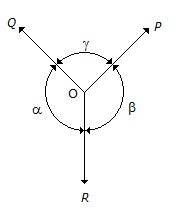
The below figure shows the three coplanar forces P, Q and R acting at a point O. If these forces are in equilibrium, then
Engineering Mechanics mcq question image
Discuss
Answer & Solution
Answer: Option B
No explanation is given for this question. Let's Discuss on Board
13
If a number of coplanar forces acting at a point be in equilibrium, the sum of clockwise moments must be __________ the sum of anticlockwise moments, about any point.
Discuss
Answer & Solution
Answer: Option A
No explanation is given for this question. Let's Discuss on Board
14
A body of weight 'W' is required to move up on rough inclined plane whose angle of inclination with the horizontal is 'α'. The effort applied parallel to the plane is given by (where μ = tanφ = Coefficient of friction between the plane and the body.)
Discuss
Answer & Solution
Answer: Option C
No explanation is given for this question. Let's Discuss on Board
15
The law of motion involved in the recoil of gun is
Discuss
Answer & Solution
Answer: Option C
No explanation is given for this question. Let's Discuss on Board
16
The moment of inertia of a thin rod of mass 'm' and length '$$l$$', about an axis through its centre of gravity and perpendicular to its length is
Discuss
Answer & Solution
Answer: Option D
No explanation is given for this question. Let's Discuss on Board
17
The center of gravity of a triangle lies at the point of
Discuss
Answer & Solution
Answer: Option A
No explanation is given for this question. Let's Discuss on Board
18
The maximum efficiency of a lifting machine is
Discuss
Answer & Solution
Answer: Option D
No explanation is given for this question. Let's Discuss on Board
19
The maximum frictional force, which comes into play, when a body just begins to slide over the surface of the other body, is known as
Discuss
Answer & Solution
Answer: Option C
No explanation is given for this question. Let's Discuss on Board
20
The resultant of two forces P and Q (such that P > Q) acting along the same straight line, but in opposite direction, is given by
Discuss
Answer & Solution
Answer: Option B
No explanation is given for this question. Let's Discuss on Board