
ExamVeda
Login
Home
51
The ratio of the areas of the in-circle and the circum-circle of a square is :
Discuss
Answer & Solution
Answer: Option A
Solution:
Let r1 and r2 be the radii of the in-circle and circum-circle of a square respectively and let each side of the square be a.
Then,
$$\eqalign{ & {r_1} = \frac{a}{2} \cr & {r_2} = \frac{1}{2} \times {\text{diagonal of the sequence}} \cr & {r_2} = \frac{1}{2} \times \sqrt 2 a \cr & {r_2} = \frac{{\sqrt 2 a}}{2}cm \cr} $$
∴ Required ratio :
$$\eqalign{ & = \frac{{\pi \times {{\left( {\frac{a}{2}} \right)}^2}}}{{\pi \times {{\left( {\frac{{\sqrt 2 a}}{2}} \right)}^2}}} \cr & = 1:2 \cr} $$
52
If the circumference of a circle is decreased by 50% then the percentage of decrease in its area is :
Discuss
Answer & Solution
Answer: Option D
Solution:
Let the original circumference be x
Then, new circumference = 50% of x = $$\frac{x}{2}$$
Let original radius = r and new radius = R
$$\eqalign{ & 2\pi r = x \cr & \Rightarrow r = \frac{{x \times 7}}{{2 \times 22}} \cr & \Rightarrow r = \frac{{7x}}{{44}} \cr} $$
$$\eqalign{ & 2\pi R = \frac{x}{2} \cr & \Rightarrow R = \frac{x}{2} \times \frac{7}{{2 \times 22}} \cr & \Rightarrow R = \frac{{7x}}{{88}} \cr} $$
Original area :
$$\eqalign{ & = \pi {r^2} \cr & = \left( {\frac{{22}}{7} \times \frac{{7x}}{{44}} \times \frac{{7x}}{{44}}} \right) \cr & = \frac{{7{x^2}}}{{88}} \cr} $$
New area :
$$\eqalign{ & = \pi {R^2} \cr & = \left( {\frac{{22}}{7} \times \frac{{7x}}{{88}} \times \frac{{7x}}{{88}}} \right) \cr & = \frac{{7{x^2}}}{{352}} \cr} $$
Decrease in area :
$$\eqalign{ & = \left( {\frac{{7{x^2}}}{{88}} - \frac{{7{x^2}}}{{352}}} \right) \cr & = \frac{{21{x^2}}}{{352}} \cr} $$
∴ Decrease % :
$$\eqalign{ & = \left( {\frac{{21{x^2}}}{{352}} \times \frac{{88}}{{7{x^2}}} \times 100} \right)\% \cr & = 75\% \cr} $$
53
A rectangular carpet has an area of 120 m2 and a perimeter of 46 metres. The length of its diagonal is :
Discuss
Answer & Solution
Answer: Option C
Solution:
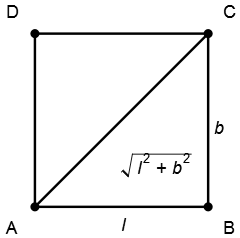
Area mcq solution image
Let the length of carpet be l metres and breadth the b metres
∴ Diagonal = $$\sqrt {{l^2} + {b^2}} $$
According to the question,
$$\eqalign{ & lb = 120{\text{ and }} {\text{2}}\left( {l + b} \right) = 46 \cr & \Rightarrow \left( {l + b} \right) = 23 \cr} $$
On squaring both sides :
$$\eqalign{ & \Rightarrow {\left( {l + b} \right)^2} = {23^2} \cr & \Rightarrow {l^2} + {b^2} + 2lb = 529 \cr & \Rightarrow {l^2} + {b^2} + 2 \times 120 = 529 \cr & \Rightarrow {l^2} + {b^2} = 529 - 240 \cr & \Rightarrow {l^2} + {b^2} = 289 \cr & \therefore \sqrt {{l^2} + {b^2}} = \sqrt {289} = 17 \cr} $$
Diagonal of the carpet = 17 metres
54
The ratio between the length and the perimeter of a rectangular plot is 1 : 3. What is the ratio between the length and breadth of the of the plot ?
Discuss
Answer & Solution
Answer: Option B
Solution:
$$\eqalign{ & \frac{l}{{2\left( {l + b} \right)}} = \frac{1}{3} \cr & \Rightarrow 3l = 2l + 2b \cr & \Rightarrow l = 2b \cr & \Rightarrow \frac{1}{b} = \frac{2}{1} = 2:1 \cr} $$
55
If each side of a rectangle is increased by 50%, its area will increase by :
Discuss
Answer & Solution
Answer: Option B
Solution:
Let original length = $$l$$ metres and original breadth = b metres
Original area : $$ = \left( {lb} \right){m^2}$$
New length :
$$\eqalign{ & = \left( {\frac{{150l}}{{100}}} \right)m \cr & = \left( {\frac{{3l}}{2}} \right)m \cr & \text{New breadth :} \cr & = \left( {\frac{{150b}}{{100}}} \right)m \cr & = \left( {\frac{{3b}}{2}} \right)m \cr & \text{New area :} \cr & = \left( {\frac{{3l}}{2} \times \frac{{3b}}{2}} \right){m^2} \cr & = \left( {\frac{{9lb}}{4}} \right){m^2} \cr & \text{Increase} = 1 - \frac{9lb}{4} = \frac{5lb}{4} \cr & \therefore \text{ Increase % :} \cr & = \left( {\frac{{5lb}}{4} \times \frac{1}{{lb}} \times 100} \right)\% \cr & = 125\% \cr} $$
56
A garden is 24 m long and 14 m wide. There is a path 1 m wide outside the garden along its sides. If the path is to be constructed with square marble tiles 20 cm × 20 cm, the number of tiles required to cover the path is :
Discuss
Answer & Solution
Answer: Option C
Solution:
Area of the path :
$$\eqalign{ & = \left[ {\left( {26 \times 16} \right) - \left( {24 \times 14} \right)} \right]{m^2} \cr & = \left( {416 - 336} \right){m^2} \cr & = 80\,{m^2} \cr} $$
∴ Number of tiles required to cover the path :
$$\eqalign{ & = \frac{{{\text{Area of path}}}}{{{\text{Area of each tile}}}} \cr & = \left( {\frac{{80 \times 100 \times 100}}{{20 \times 20}}} \right) \cr & = 2000 \cr} $$
57
What is the minimum number of identical square tiles required to tile a floor of length 6 m 24 cm and width 4 m 80 cm ?
Discuss
Answer & Solution
Answer: Option B
Solution:
Length of largest tile = H.C.F. of 624 and 480 cm = 48 cm
Area of each tile = (48 × 48) cm2
∴ Required number of tiles :
$$\eqalign{ & = \left( {\frac{{624 \times 480}}{{48 \times 48}}} \right) \cr & = 130 \cr} $$
58
The ratio between the length and the breadth of a rectangular park is 3 : 2. If a man cycling along the boundary of the park at the speed of 12 km/hr completes one round in 8 minutes, the n the area of the park (in square metre) is :
Discuss
Answer & Solution
Answer: Option B
Solution:
$${\text{Perimeter}} = $$   $${\text{Distance covered in 8 minutes}}$$
$$\eqalign{ & \,\,\,\,\,\,\,\,\,\,\,\,\,\,\,\,\,\,\,\,\,\,\, = \left( {\frac{{12000}}{{60}} \times 8} \right)m \cr & \,\,\,\,\,\,\,\,\,\,\,\,\,\,\,\,\,\,\,\,\,\,\, = 1600{\text{ }}\,m \cr} $$
Let the length = 3x metres and breadth = 2x metres
Then,
2 (3x + 2x) = 1600
or, x = 160
Length = 480 m and breadth = 320 m
∴ Area = (480 × 320) m2
           = 153600 square metre
59
An order was placed for supply of carpet of breadth 3 metres, the length of carpet was 1.44 times of breadth. Subsequently the breadth and length were increased by 25 and 40 percent respectively. At the rate of 45 per square metre, what would be the increase in the cost of the carpet ?
Discuss
Answer & Solution
Answer: Option B
Solution:
Original breadth = 3 m
Original length :
$$\eqalign{ & = \left( {1.44 \times 3} \right)m \cr & = 4.32\,m \cr} $$
New breadth :
$$\eqalign{ & = \left( {125\% {\text{ of 3}}} \right)m \cr & = \left( {\frac{{125}}{{100}} \times 3} \right)m \cr & = 3.75\,m \cr} $$
New length :
$$\eqalign{ & = \left( {140\% {\text{ of 4}}{\text{.32}}} \right)m \cr & = \left( {\frac{{140}}{{100}} \times 4.32} \right)m \cr & = 6.048\,m \cr} $$
Original area :
$$\eqalign{ & = \left( {4.32 \times 3} \right){m^2} \cr & = 12.96\,{m^2} \cr} $$
New area :
$$\eqalign{ & = \left( {6.048 \times 3.75} \right){m^2} \cr & = 22.68\,{m^2} \cr} $$
Increase in area :
$$\eqalign{ & = \left( {22.68 - 12.96} \right){m^2} \cr & = 9.72\,{m^2} \cr} $$
∴ Increase in cost :
$$\eqalign{ & = {\text{Rs}}{\text{. }}\left( {9.72 \times 45} \right) \cr & = {\text{Rs}}{\text{.}}\,{\text{437}}{\text{.40}} \cr} $$
60
The dimensions of a rectangle are 51 m and 49 m respectively while side of a square is 50 m. Which of the following statements is correct ?
Discuss
Answer & Solution
Answer: Option C
Solution:
(A) Diagonal of the rectangle :
$$\eqalign{ & = \sqrt {{{\left( {51} \right)}^2} + {{\left( {49} \right)}^2}} m \cr & = \sqrt {2601 + 2401} \,m \cr & = \sqrt {5002} \,m \cr} $$
Diagonal of the square :
$$\eqalign{ & = 50\sqrt 2 \,m \cr & = \sqrt {5000} \,m \cr} $$

(B) Diagonal of a square intersect at right angles but those of a rectangle do not.

(C) Perimeter of rectangle :
= 2(51 + 49) m
= 200 m
Perimeter of square :
= (4 × 50) m
= 200 m

(D) Area of rectangle :
= (50 × 50) m2
= 2500 m2