ExamVeda
Login
Home
31
The ratio of the length of a rod and its shadow is 1 : $$\sqrt 3 $$ The angle of elevation of the sum is
Discuss
Answer & Solution
Answer: Option A
Solution:
Let AB be rod and BC be its shadow
So that AB : BC = 1 : $$\sqrt 3 $$
Let $$\theta $$ be the angle of elevation
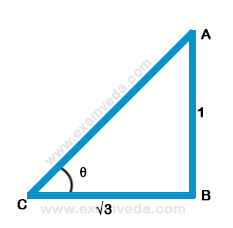
Height and Distance mcq solution image
$$\eqalign{ & \therefore \tan \theta = \frac{{AB}}{{BC}} = \frac{1}{{\sqrt 3 }} = \tan {30^ \circ } \cr & \,\,\,\,\,\,\,\,\,\,\,\,\,\,\,\,\,\,\,\,\,\,\,\,\,\,\,\left( {\because \tan {{30}^ \circ } = \frac{1}{{\sqrt 3 }}} \right) \cr & \therefore \theta = {30^ \circ } \cr} $$
∴ Hence angle of elevation $$ = {30^ \circ }$$
32
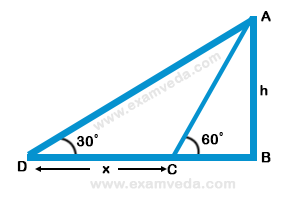
It is found that on walking x metres towards a chimney in a horizontal line through its base, the elevation of its top changes from 30° to 60° . The height of the chimney is
Discuss
Answer & Solution
Answer: Option C
Solution:
In the figure, AB is chimney and CB and DB are its shadow
Height and Distance mcq solution image
$$\eqalign{ & \tan {60^ \circ } = \frac{{AB}}{{BC}} = \frac{h}{{BC}} \cr & \Rightarrow \sqrt 3 = \frac{h}{{BC}} \cr & \Rightarrow BC = \frac{h}{{\sqrt 3 }}\,.......\,\left( {\text{i}} \right) \cr & {\text{and}} \cr & \tan {30^ \circ } = \frac{h}{{DB}} = \frac{h}{{DB + BC}} \cr & \frac{1}{{\sqrt 3 }} = \frac{h}{{x + BC}} \cr & x + BC = h\sqrt 3 \cr & \Rightarrow BC = h\sqrt 3 - x\,.......\,\left( {{\text{ii}}} \right) \cr & {\text{From}}\,\left( {\text{i}} \right)\,{\text{and}}\,\left( {{\text{ii}}} \right) \cr & \frac{h}{{\sqrt 3 }} = h\sqrt 3 - x \cr & \Rightarrow \frac{h}{{\sqrt 3 }} - h\sqrt 3 = - x \cr & x = h\sqrt 3 - \frac{h}{{\sqrt 3 }} \cr & x = h\left( {\sqrt 3 - \frac{1}{{\sqrt 3 }}} \right) \cr & x = h\frac{{3 - 1}}{{\sqrt 3 }} \cr & x = \frac{{2h}}{{\sqrt 3 }} \cr & \therefore h = \frac{{\sqrt 3 }}{2}x \cr} $$
33
A ladder makes an angle of 60° with the ground when placed against a wall. If the foot of the ladder is 2 m away from the wall, then the length of the ladder (in metres) is
Discuss
Answer & Solution
Answer: Option D
Solution:
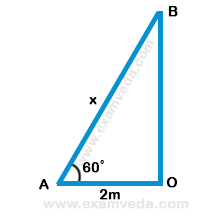
Suppose AB is the ladder of length x m
∴ OA = 2m, ∠OAB = 60°
Height and Distance mcq solution image
$$\eqalign{ & {\text{In right }}\Delta AOB,\,\sec {60^ \circ } = \frac{x}{2} \cr & \Rightarrow 2 = \frac{x}{2} \cr & \Rightarrow x = 4\,m \cr} $$
34
The tops of two poles of height 20 m and 14 m are connected by a wire. If the wire makes an angle of 30° with horizontal, then the length of the wire is
Discuss
Answer & Solution
Answer: Option A
Solution:
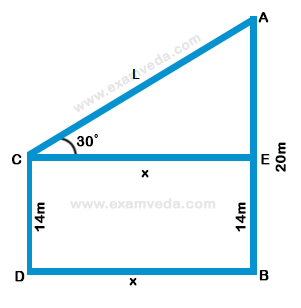
Let AB and CD be two poles
AB = 20 m, CD = 14 m
A and C are joined by a wire
CE || DB and angle of elevation of A is 30°
Let CE = DB = x and AC = L
Height and Distance mcq solution image
Now AE = AB - EB = AB - CD = 20 - 14 = 6 m
$$\eqalign{ & {\text{Now in right }}\Delta ACE, \cr & \sin \theta = \frac{{{\text{Perpendicular}}}}{{{\text{Hypotenuse}}}} = \frac{{AE}}{{AC}} \cr & \Rightarrow \sin {30^ \circ } = \frac{6}{{AC}} \cr & \Rightarrow \frac{1}{2} = \frac{6}{{AC}} \cr & \Rightarrow AC = 2 \times 6 = 12 \cr & \therefore {\text{Length of AC}} = 12\,m \cr} $$
35
A lower subtends an angle of 30° at a point on the same level as its foot. At a second point h metres above the first, the depression of the foot of the tower is 60°. The height of the tower is
Discuss
Answer & Solution
Answer: Option C
Solution:
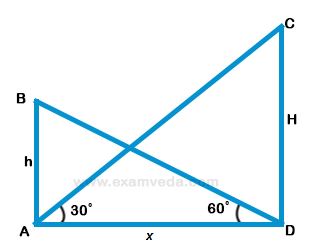
Let CD is the tower and A is a point such that the angle of elevation of C is 30°
B is and their point h m high of A and angle of depression of D is 60°
Height and Distance mcq solution image
$$\eqalign{ & {\text{The}}\,AB = h\,m \cr & {\text{Let}}\,CD = H\,m\,\,\,{\text{and }}\,AD\, = x \cr & {\text{Now}}\,{\text{in}}\,{\text{right}}\,\Delta ABD, \cr & \tan \theta = \frac{{AB}}{{AD}} \cr & \Rightarrow \tan {60^ \circ } = \frac{h}{x} \cr & \Rightarrow \sqrt 3 = \frac{h}{x} \cr & \Rightarrow x = \frac{h}{{\sqrt 3 }}\,.......({\text{i}}) \cr & {\text{Similarly in right }}\Delta ACB, \cr & \tan {30^ \circ } = \frac{{CD}}{{AD}} \cr & \Rightarrow \frac{1}{{\sqrt 3 }} = \frac{H}{x} \cr & \Rightarrow x = \sqrt 3 \,H\,.......\left( {{\text{ii}}} \right) \cr & {\text{From}}\,\left( {\text{i}} \right)\,{\text{and}}\,\left( {{\text{ii}}} \right) \cr & \sqrt 3 \,H = \frac{h}{{\sqrt 3 }} \cr & H = \frac{h}{{\sqrt 3 \times \sqrt 3 }} = \frac{h}{3} \cr & \therefore {\text{Height of tower}} = \frac{h}{3} \cr} $$
36
The angle of depression of a car parked on the road from the top of a 150 m high tower is 30°. The distance of the car from the tower (in metres) is
Discuss
Answer & Solution
Answer: Option B
Solution:
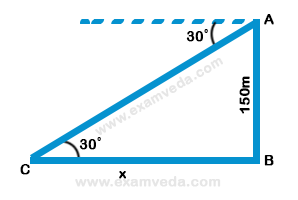
Let AB be the tower of height 150 m
C is car and angle of depression is 30°
Height and Distance mcq solution image
Therefore, ∠ACB = 30° (alternate angle)
In right - angled triangle ABC,
$$\eqalign{ & \frac{{BC}}{{AB}} = \cot {30^ \circ } \cr & \Rightarrow \frac{{BC}}{{150}} = \sqrt 3 \cr & \Rightarrow BC = 150\sqrt 3 \,m \cr} $$
That is, distance of the car from the tower is $$150\sqrt 3 \,m$$
37
If the altitude of the sun is at 60°, then the height of the vertical tower that will cast a shadow of length 30 m is
Discuss
Answer & Solution
Answer: Option A
Solution:
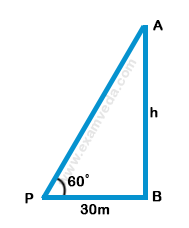
Let AB be tower and a point P distance of 30 m from its foot of the tower which form an angle of elevation pf the sun of 60°
Height and Distance mcq solution image
$$\eqalign{ & {\text{Let height of tower }}AB = h \cr & {\text{Then in right }}\Delta APB, \cr & \tan \theta = \frac{{{\text{Perpendicular}}}}{{{\text{Base}}}} = \frac{{AB}}{{PB}} \cr & \Rightarrow \tan {60^ \circ } = \frac{h}{{30}} \cr & \Rightarrow \sqrt 3 = \frac{h}{{30}} \cr & \Rightarrow h = 30\sqrt 3 \cr} $$
∴ Height of the tower $$ = 30\sqrt 3 \,m$$
38
The tops of two poles of height 16 m and 10 m are connected by a wire of length l metres. If the wire makes an angle of 30° with the horizontal, then l =
Discuss
Answer & Solution
Answer: Option C
Solution:
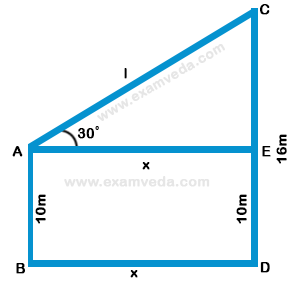
Let AB and CD are two poles AB = 10 m and CD = 16 m
Height and Distance mcq solution image
AC is wire which makes an angle of 30° with the horizontal
Let BD = x, then AE = x
CE = CD - ED = CD - AB = 16 - 10 = 6m
$$\eqalign{ & {\text{Now}}\,{\text{in}}\,\Delta ACE \cr & \sin {30^ \circ } = \frac{{CE}}{{AC}} = \frac{6}{l} \cr & \Rightarrow \frac{1}{2} = \frac{6}{l} \cr & \Rightarrow l = 2 \times 6 = 12\,m \cr} $$
39
The height of a tower is 100 m. When the angle of elevation of the sun changes from 30° to 45°, the shadow of the tower becomes x metres less. The value of x is
Discuss
Answer & Solution
Answer: Option C
Solution:
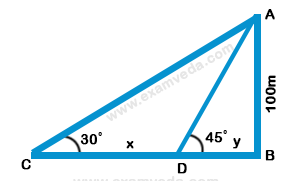
Let AB be tower and AB = 100 m and angles of elevation of A at C and D are 30° and 45° respectively and CD = x
Let BD = y
Height and Distance mcq solution image
$$\eqalign{ & {\text{Now in right }}\Delta ADB, \cr & \tan \theta = \frac{{{\text{Perpendicular}}}}{{{\text{Base}}}} = \frac{{AB}}{{DB}} \cr & \tan {45^ \circ } = \frac{{100}}{y} \cr & \Rightarrow 1 = \frac{{100}}{y} \cr & \Rightarrow y = 100 \cr & {\text{Similarly in right }}\Delta ACB, \cr & \tan {30^ \circ } = \frac{{AB}}{{CB}} \cr & \Rightarrow \frac{1}{{\sqrt 3 }} = \frac{{100}}{{y + x}} \cr & \Rightarrow \frac{1}{{\sqrt 3 }} = \frac{{100}}{{100 + x}} \cr & \Rightarrow 100 + x = 100\sqrt 3 \cr & \Rightarrow x = 100\sqrt 3 - 100 \cr & \Rightarrow x = 100\left( {\sqrt 3 - 1} \right)\,m \cr} $$
40
The angle of elevation of the top of a tower standing on a horizontal plane from a point A is α. After walking a distance 'd' towards the foot of the tower the angle of elevation is found to be β. The height of the tower is
Discuss
Answer & Solution
Answer: Option B
Solution:
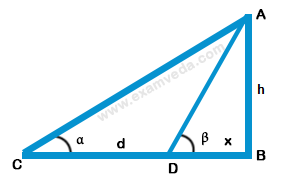
Let AB be the tower and C is a point such that the angle of elevation of A is α.
After walking towards the foot B of the tower, at D the angle of elevation is β.
Let h be the height of the tower and DB = x Now in ΔACB,
Height and Distance mcq solution image
$$\eqalign{ & \tan \theta = \frac{{{\text{Perpendicular}}}}{{{\text{Base}}}} = \frac{{AB}}{{CB}} \cr & \tan \alpha = \frac{h}{{d + x}} \cr & \Rightarrow d + x = \frac{h}{{\tan \alpha }} \cr & \Rightarrow d + x = h\cot \alpha \cr & \Rightarrow x = h\cot \alpha - d\,.......\left( {\text{i}} \right) \cr & {\text{Similarly in right }}\Delta ADB, \cr & \tan \beta = \frac{h}{x} \cr & \Rightarrow x = \frac{h}{{\tan \beta }} \cr & \Rightarrow x = h\cot \beta \,.........({\text{ii}}) \cr & {\text{From}}\,\left( {\text{i}} \right)\,{\text{and}}\,\left( {{\text{ii}}} \right) \cr & h\cot \alpha - d = h\cot \beta \cr & \Rightarrow h\cot \alpha - h\cot \beta = d \cr & \Rightarrow h\left( {\cot \alpha - \cot \beta } \right) = d \cr & \Rightarrow h = \frac{d}{{\cot \alpha - \cot \beta }} \cr} $$
∴ Height of the tower $$ = \frac{d}{{\cot \alpha - \cot \beta }}$$