ExamVeda
Login
Home
91
If x = a (b - c), y = b (c - a), z = c (a - b), then the value of $${\left( {\frac{x}{a}} \right)^3}$$ $$ + {\left( {\frac{y}{b}} \right)^3}$$ $$ + {\left( {\frac{z}{c}} \right)^3}$$ is :
Discuss
Answer & Solution
Answer: Option D
Solution:
Given x = a (b - c), y = b (c - a), z = c (a - b)
x = a (b - c)
⇒ $$\frac{x}{a}$$ = b - c ..... (i)
Similarly, y = b (c - a)
⇒ $$\frac{y}{b}$$ = c - a ..... (ii)
And similarly z = c (a - b)
⇒ $$\frac{z}{c}$$ = c - a ..... (iii)
Adding (i), (ii) and (iii) we get
∵ $$\frac{x}{a}$$ + $$\frac{y}{b}$$ + $$\frac{z}{c}$$ = b - c + c - a + a - b
⇒ $$\frac{x}{a}$$ + $$\frac{y}{b}$$ + $$\frac{z}{c}$$ = 0
$$\eqalign{ & \therefore {\left( {\frac{x}{a}} \right)^3} + {\left( {\frac{y}{b}} \right)^3} + {\left( {\frac{z}{c}} \right)^3} \cr & = 3 \times \frac{x}{a} \times \frac{y}{b} \times \frac{z}{c} \cr & = \frac{{3xyz}}{{abc}} \cr} $$
[If a + b + c = 0, a3 + b3 + c3 = 3abc]
92
The largest number that exactly divides each number of the sequence 15 - 1, 25 - 2, 35 - 3, ....., n5 - n, ..... is :
Discuss
Answer & Solution
Answer: Option C
Solution:
Required number
= (25 - 2)
= (32 - 2)
= 30
93
$$\frac{{{{\left( {963 + 476} \right)}^2} + {{\left( {963 - 476} \right)}^2}}}{{\left( {963 \times 963 + 476 \times 476} \right)}} = ?$$
Discuss
Answer & Solution
Answer: Option A
Solution:
Given expression,
$$ = \frac{{{{\left( {a + b} \right)}^2} + {{\left( {a - b} \right)}^2}}}{{\left( {{a^2} + {b^2}} \right)}}$$     (where a = 963 and b = 476)
$$\eqalign{ & = \frac{{2\left( {{a^2} + {b^2}} \right)}}{{\left( {{a^2} + {b^2}} \right)}} \cr & = 2 \cr} $$
94
Which one of the following numbers is divisible by 3 ?
Discuss
Answer & Solution
Answer: Option A
Solution:
Sum of the digits in 4006020 is 12, which is divisible by 3
Hence, 4006020 is divisible by 3
95
(96 + 1) when divided by 8, would leave a remainder of :
Discuss
Answer & Solution
Answer: Option C
Solution:
(xn - an) is divisible by (x - a) for all values of n
∴ (96 - 16) is divisible by (9 - 1)
⇒ (96 - 1) is divisible by 8
⇒ on dividing (96 + 1) by 8, we get 2 as remainder.
96
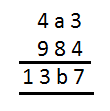
A 3-digit number 4a3 is added to another 3-digit number 984 to give the four-digit number 13b7, which is divisible by 11. Then, (a + b) is :
Discuss
Answer & Solution
Answer: Option A
Solution:
Since 13b7 is divisible by 11, we have,
(7 + 3) - (b + 1) = 0
⇒ 9 - b = 0
⇒ b = 9
Putting b = 9, a + 8 = 9 we get a = 1
Hence, (a + b) = (1 + 9) = 10
Number System mcq solution image
97
$$\frac{{768 \times 768 \times 768 + 232 \times 232 \times 232}}{{768 \times 768 - 768 \times 232 + 232 \times 232}} = ?$$
Discuss
Answer & Solution
Answer: Option A
Solution:
Given expression,
$$ = \frac{{\left( {{a^3} + {b^3}} \right)}}{{\left( {{a^2} - ab + {b^2}} \right)}}$$     (where a = 768 and b = 232)
$$\eqalign{ & = \left( {a + b} \right) \cr & = \left( {768 + 232} \right) \cr & = 1000 \cr} $$
98
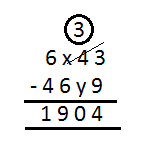
If 6*43 - 46@9 = 1904, which of the following should come in place of * ?
Discuss
Answer & Solution
Answer: Option E
Solution:
Let 6x43 - 46y9 = 1904
Clearly, y = 3 and x = 5
Hence * must be replaced by 5
Number System mcq solution image
99
The numbers 2, 4, 6, 8 ..... 98, 100 are multiplied together. The number of zeros at the end of the product must be :
Discuss
Answer & Solution
Answer: Option C
Solution:
N = 2 × 4 × 6 × 8 × ..... × 98 × 100
    = 250 (1 × 2 × 3 × ..... × 49 × 50)
    = 250 × 50!
Clearly, the highest power of 2 in N is much higher than that of 5
∴ Number of zeros in N = Highest power of 5 in N
= $$\left[ {\frac{{50}}{5}} \right] + \left[ {\frac{{50}}{{{5^2}}}} \right]$$
= 10 + 2
= 12
100
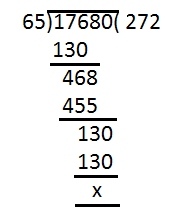
A number divided by 68 gives the quotient 260 and remainder zero. If the same number is divided by 65, the remainder is :
Discuss
Answer & Solution
Answer: Option A
Solution:
Number = (68 × 260) = 17680
On dividing this number by 65, we get zero as remainder
Number System mcq solution image