
ExamVeda
Login
Home
1
252 m of pant cloth and 141 m of shirt cloth are available in a cloth store. To stitch one pant and one shirt, $$2\frac{1}{2}$$ m and $$1\frac{3}{4}$$ m of cloth are needed respectively. Then the approximate number of pants and shirts that can be made out of it are :
Discuss
Answer & Solution
Answer: Option B
Solution:
Number of pants can be made = $$\frac{{252}}{{\frac{5}{2}}}$$ = 100

Number of shirts can be made = $$\frac{{141}}{{\frac{7}{4}}}$$ = 80
Number of pants and shirts = 100, 80
2
In a farm there are cows and hens. If heads are counted there are 180, if legs are counted there are 420. The number of cows in the farm is :
Discuss
Answer & Solution
Answer: Option D
Solution:
Let the number of cows be x.
Then, number of hens would be (180 - x)
According to the question
(180 - x) × 2 + 4x = 420
⇒ 360 - 2x + 4x = 420
⇒ 2x = 420 - 360 = 60
⇒ 2x = 60
∴ x = $$\frac{{60}}{2}$$ = 30
3
$$\frac{1}{{20}}$$ $$ + $$ $$\frac{1}{{30}}$$ $$ + $$ $$\frac{1}{{42}}$$ $$ + $$ $$\frac{1}{{56}}$$ $$ + $$ $$\frac{1}{{72}}$$ $$ + $$ $$\frac{1}{{90}}$$ $$ + $$ $$\frac{1}{{110}}$$  $$ + $$ $$\frac{1}{{132}}$$  is equal to :
Discuss
Answer & Solution
Answer: Option C
Solution:
$$\frac{1}{{20}} + \frac{1}{{30}} + \frac{1}{{42}} + \frac{1}{{56}} + \frac{1}{{72}} + \frac{1}{{90}}$$      $$ + \frac{1}{{110}}$$   $$ + \frac{1}{{132}}$$
$$ = \left( {\frac{1}{{4 \times 5}}} \right) + \left( {\frac{1}{{5 \times 6}}} \right) + \left( {\frac{1}{{6 \times 7}}} \right)$$       $$ + ..... + $$   $$\left( {\frac{1}{{11 \times 12}}} \right)$$
$$ = \left( {\frac{1}{4} - \frac{1}{5}} \right) + \left( {\frac{1}{5} - \frac{1}{6}} \right) + \left( {\frac{1}{6} - \frac{1}{7}} \right)$$       $$ + ..... + $$   $$\left( {\frac{1}{{11}} - \frac{1}{{12}}} \right)$$
$$ = \frac{1}{4} - \frac{1}{5} + \frac{1}{5} - \frac{1}{6} + \frac{1}{6} - \frac{1}{7} \, + .....$$      $$ + \frac{1}{{11}}$$  $$ - \frac{1}{{12}}$$
$$\eqalign{ & = \frac{1}{4} - \frac{1}{{12}} \cr & = \frac{{3 - 1}}{{12}} \cr & = \frac{2}{{12}} \cr & = \frac{1}{6} \cr} $$
4
The greatest number among the following : $$0.7 + \sqrt {0.16} ,$$   $$1.02 - \frac{{0.6}}{{24}},$$   $$1.2 \times 0.83,$$   and $$\sqrt {1.44} $$
Discuss
Answer & Solution
Answer: Option B
Solution:
$$\eqalign{ & {\text{0}}{\text{.7 + }}\sqrt {0.16} = 0.7 + 0.4 \cr & \,\,\,\,\,\,\,\,\,\,\,\,\,\,\,\,\,\,\,\,\,\,\,\,\,\,\,\,\,\, = 1.1 \cr & 1.02 - \frac{{0.6}}{{24}} = 1.02 - 0.025 \cr & \,\,\,\,\,\,\,\,\,\,\,\,\,\,\,\,\,\,\,\,\,\,\,\,\,\,\, = 0.995 \cr & 1.2 \times 0.83 = 0.996 \cr & \sqrt {1.44} = \sqrt {\frac{{144}}{{100}}} \cr & \,\,\,\,\,\,\,\,\,\,\,\,\,\, = \frac{{12}}{{10}} \cr & \,\,\,\,\,\,\,\,\,\,\,\,\,\,\, = 1.2 \cr & {\text{ So }}\sqrt {1.44} {\text{ is the greatest}}{\text{.}} \cr} $$
5
The least number that must be subtracted from 63520 to make the result a perfect square is -
Discuss
Answer & Solution
Answer: Option D
Solution:
According to the question,
As we know that the square of 252 is which that is near to the value of 63520.
Therefore, 63520 - x = 63504
∴ x = 16
6
If n is a whole number greater then 1, then n2 (n2 - 1) is always divisible by -
Discuss
Answer & Solution
Answer: Option B
Solution:
n2(n2 - 1)
put n = 2
= 22(22 - 1)
= 4(4 - 1)
= 4 × 3
= 12
Check the option it is divisible by 12.
$$\eqalign{ & {\text{Take n = 3}} \cr & \Rightarrow {{\text{3}}^3}\left( {{3^3} - 1} \right) \cr & \Rightarrow 9\left( {9 - 1} \right) \cr & \Rightarrow 9 \times 8 = 72 \cr & {\text{It is divisible by 12}} \cr & {\text{So 12 is answer}} \cr} $$
7
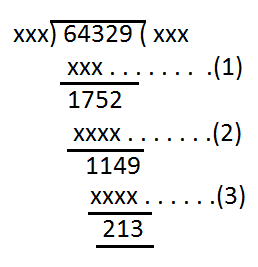
64329 is divided by a certain number, 175, 114 and 213 appears as three successive remainders. The divisor is -
Discuss
Answer & Solution
Answer: Option C
Solution:
Number System mcq solution image
$$\eqalign{ & {\text{Number at (1) = 643 - 175}} \cr & \,\,\,\,\,\,\,\,\,\,\,\,\,\,\,\,\,\,\,\,\,\,\,\,\,\,\,\,\,\,\,\,\,{\text{ = 468}} \cr & {\text{Number at (2) = 1752 - 114}} \cr & \,\,\,\,\,\,\,\,\,\,\,\,\,\,\,\,\,\,\,\,\,\,\,\,\,\,\,\,\,\,\,\,\,\,{\text{ = 1638 }} \cr & {\text{Number at (3) = 1149 - 213 }} \cr & \,\,\,\,\,\,\,\,\,\,\,\,\,\,\,\,\,\,\,\,\,\,\,\,\,\,\,\,\,\,\,\,\,\,\,{\text{ = 936}} \cr & {\text{HCF of 468, 1638, 936 = 234}} \cr & {\text{The divisor is 234}}{\text{.}} \cr} $$
8
Three numbers are in the ratio 1 : 2 : 3, and the sum of their cubes is 4500. The smallest number will be -
Discuss
Answer & Solution
Answer: Option B
Solution:
$$\eqalign{ & x:2x:3x \cr & {x^3} + 8{x^3} + 27{x^3} = 4500 \cr & 36{x^3} = 4500 \cr & {x^3} = \frac{{4500}}{{36}} = 125 \cr & x = 5 \cr & {\text{Smallest number is 5}} \cr} $$
9
The number 2272 and 875 are divided by a 3 digit number N, giving the same remainders. The sum of the digit is :
Discuss
Answer & Solution
Answer: Option A
Solution:
Let the remainder in each case be x
Then, (2272 - x) and (875 - x) are exactly divisible by three digit number
Difference :
= (2272 - x) - (875 - x)
= 1397
Factor of 1397 = 11 × 127
Since, both 11 and 127 are prime number
Three digit number is 127
Sum of digits = 1 + 2 + 7 = 10
Note: - In this type of questions the number which divide the given number and leaves no remainder is either difference of number or a factor of difference.
10
When 231 is divided by 5 the remainder is -
Discuss
Answer & Solution
Answer: Option B
Solution:
$${{\text{2}}^{31}} \div 5$$
\[\begin{gathered} {\text{power }}\,\,\,\,\,\,\,\,\,{\text{ remainder}} \hfill \\ \left[ \begin{gathered} {2^1}\,\,\, \to \,\,\,\frac{2}{5} \to \,\,\,2 \hfill \\ {2^2}\,\,\, \to \,\,\,\frac{4}{5} \to \,\,\,4 \hfill \\ {2^3}\,\,\, \to \,\,\,\frac{8}{5} \to \,\,\,3 \hfill \\ {2^4}\,\,\, \to \,\,\,\frac{{16}}{5} \to \,\,1 \hfill \\ \end{gathered} \right]{\text{cycle 1}} \hfill \\ \left[ {{2^5}\,\,\, \to \,\,\,\frac{{243}}{5} \to \,\,2} \right]{\text{cycle 2}} \hfill \\ \end{gathered} \]

$$\eqalign{ & {\text{Divided = }}\frac{{{2^{31}}}}{5} = \frac{{{2^{4 \times 7}} \times {2^3}}}{5} \cr & \Rightarrow {\text{remainder = 3}} \cr & {\text{So }}{{\text{2}}^3}{\text{ has 3 remainder }} \cr & {{\text{2}}^{31}}{\text{ has 3 remainder}} \cr} $$