
ExamVeda
Login
Home
71
A number is divisible by 11 if the difference between the sums of the digit in odd even places respectively is :
Discuss
Answer & Solution
Answer: Option D
Solution:
Clearly, (D) is true.
72
6 × 3 (3 - 1) is equal to :
Discuss
Answer & Solution
Answer: Option C
Solution:
= 6 × 3 (3 - 1)
= 6 × 3(2)
= 6 × 6
= 36
73
325325 is a six-digit number. It is divisible by :
Discuss
Answer & Solution
Answer: Option D
Solution:
(325 - 325) = 0.
Which is divisible by 7
So, the given number is divisible by 7
(5 + 3 + 2) - (2 + 5 + 3) = 0
So, the given number is divisible by 11
And,
$$\frac{{325325}}{{13}} = 25025$$
So, 325325 is divisible by 13
74
If a and b are two numbers such that ab = 0, then -
Discuss
Answer & Solution
Answer: Option B
Solution:
ab = 0
⇒ a = 0 or b = 0 or both are zero
75
The number of zeros at the end of 60! is :
Discuss
Answer & Solution
Answer: Option B
Solution:
Clearly, highest power of 2 is much higher as compared to that of 5 in 60!,
So, Required number of zeros
= Highest power of 5
= $$ \left[ {\frac{{60}}{5}} \right] + \left[ {\frac{{60}}{{{5^2}}}} \right]$$
= 12 + 2
= 14
76
In a division problem, the divisor is 7 times of quotient and 5 times of remainder. If the dividend is 6 times of remainder, then the quotient is equal to :
Discuss
Answer & Solution
Answer: Option B
Solution:
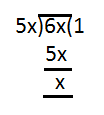
Divisor :
= 7 × quotient
= 5 × remainder and dividend
= 6 × remainder
Number System mcq solution image
Let remainder be x
Then, divisor = 5x and dividend = 6x
On dividing 6x by 5x, we get 1 as quotient and x as remainder.
∴ Quotient = 1
77
What should be the maximum value of q in the following equation?
5P9 - 7Q2 + 9R6 = 823
Discuss
Answer & Solution
Answer: Option C
Solution:
⇒ 5P9 - 7Q2 + 9R6 = 823
⇒ (500 + 10P + 9) - (700 + 10Q + 2) + (900 + 10R + 6) = 823
⇒ (500 + 900 - 700) + 10 (P + R - Q) + (9 + 6 - 2) = 823
⇒ 700 + 10 (P + R - Q) = 810
⇒ 700 + 10 (P + R - Q) = 700 + 110
⇒ 10 (P + R - Q) = 110
⇒ P + R - Q = 11
⇒ Q = (P + R - 11)
To get maximum value of Q we take P = 9 and R = 9
This gives Q = (9 + 9 - 11) = 7
Hence, the maximum value of Q is 7
78
Let n be a natural number such that $$\frac{1}{2}$$ + $$\frac{1}{3}$$ + $$\frac{1}{7}$$ + $$\frac{1}{n}$$   is also a natural number. Which of the following statements is not true ?
Discuss
Answer & Solution
Answer: Option D
Solution:
$$\eqalign{ & = \left( {\frac{1}{2} + \frac{1}{3} + \frac{1}{7}} \right) + \frac{1}{n} \cr & = \frac{{\left( {21 + 14 + 6} \right)}}{{42}} + \frac{1}{n} \cr & = \left( {\frac{1}{{42}} + \frac{1}{n}} \right) \cr} $$
This sum is a natural number when n = 42
So, each one of the statements that 2 divides ; 3 divides n and 7 divides n is true.
Hence, n > 84 is false
79
If 37 X 3 is a four-digit natural number divisible by 7, then the place marked as X must have the value :
Discuss
Answer & Solution
Answer: Option A
Solution:
37 × 3 is divisible by 7
⇒ (7 × 3 - 3) is either 0 or divisible by 7
⇒ 7 × 0 is divisible by 7
⇒ X = 0 or X = 7
80
If m and n are positive integers, then the digit in the unit's place of 5n + 6m is always :
Discuss
Answer & Solution
Answer: Option A
Solution:
In 5n we have 5 as unit digit and in 6m we have 6 as unit digit.
∴ 5 + 6 = 11(i.e unit digit always be 1)