
ExamVeda
Login
Home
61
The students of three classes are in the ratio 4 : 6 : 9. If 12 students are increased in each class the ratio changes to 7 : 9 : 12. Then the total number of students in the three classes before the increase is = ?
Discuss
Answer & Solution
Answer: Option B
Solution:
Let class A, B and C then Number of student ratio in A : B : C = 4 : 6 : 9 = 4x : 6x : 9x
And Now 12 Student join in all Class and their ratio become
A : B : C = 7 : 9 : 12 = 7x : 9x : 12x

∴ in A → 7x - 4x = 12 , In B → 9x - 6x = 12 and In C →12x - 9x = 12
i.e. x = 4
Total number of Student before new student are
= 4 × 4 + 6 × 4 + 9 × 4
= 76
62
Two vessels A and B contain milk 8 : 5 and 5 : 2 respectively. The ratio in which these two mixtures be mixed to get a new mixture containing $$69\frac{3}{{13}}$$ % milk is =?
Discuss
Answer & Solution
Answer: Option D
Solution:
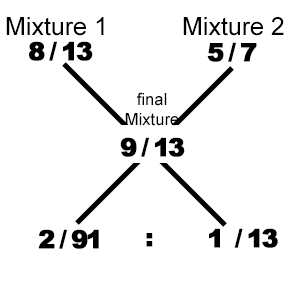
Milk in 1 litre mix. in A = $$\frac{8}{{13}}$$
Milk in 1 litre mix. in B = $$\frac{5}{{7}}$$
Milk in 1 litre of final mix. = $$\frac{{900}}{{13}} \times \frac{1}{{100}} \times 1 = \frac{9}{{13}}$$

By the rule of alligation, we have :
Ratio mcq solution image
∴ Required ratio $$ = \frac{2}{{91}} : \frac{1}{{13}} = 2 : 7$$
63
In two types of stainless steel the ratio of chromium and steel are 2 : 11 and 5 : 21 respectively. In what proportion should the two types be mixed so that the ratio of chromium to steel in the mixed type becomes 7 : 32 = ?
Discuss
Answer & Solution
Answer: Option C
Solution:
Given:
⇒ Let the alloys be mixed in the ratio of $$x:y$$   (Assumption)
⇒ In 1st alloy, chromium = $$\frac{2x}{13}$$
⇒ In 1st alloy, steel = $$\frac{11x}{13}$$
⇒ In 2nd alloy, chromium = $$\frac{5y}{26}$$
⇒ In 2nd alloy, steel = $$\frac{21y}{26}$$

⇒ The ratio in which 2 alloys must be mixed to get a new alloy with a ratio of chromium and steel be 7 : 32 =?

Now we have,
$$\eqalign{ & \left( {\frac{{2x}}{{13}} + \frac{{5y}}{{26}}} \right) : \left( {\frac{{11x}}{{13}} + \frac{{21y}}{{26}}} \right) = 7 : 32 \cr & \Rightarrow \frac{{\left( {\frac{{2x}}{{13}} + \frac{{5y}}{{26}}} \right)}}{{ \left( {\frac{{11x}}{{13}} + \frac{{21y}}{{26}}} \right) }} = \frac{7}{{32}} \cr & \Rightarrow \frac{{\frac{{4x + 5y}}{{26}}}}{{ \frac{{22x + 21y}}{{26}} }} = \frac{7}{{32}} \cr & \Rightarrow \frac{{4x + 5y}}{{22x + 21y}} = \frac{7}{{32}} \cr & \Rightarrow 128x + 160y = 154x + 147y \cr & \Rightarrow 154x - 128x = 160y - 147y \cr & \Rightarrow 26x = 13y \cr & \Rightarrow \frac{x}{y} = \frac{{13}}{{26}} \cr & \therefore \frac{x}{y} = \frac{1}{2} \cr} $$

∴ Ratio in which 2 alloys must be mixed to get a new alloy with a ratio of chromium and Steel to be 7 : 32 is 1 : 2
64
One - fourth of sixty percent of a number is equal to two - fifths of twenty percent of another number. What is the respective ratio of the first number to the second number ?
Discuss
Answer & Solution
Answer: Option E
Solution:
Let the numbers be x and y
$$\eqalign{ & {\text{Then,}} \cr & = \frac{1}{4}{\text{ of }}\left( {60\% {\text{ of }}x} \right) \cr & = \frac{2}{5}{\text{ of }}\left( {20\% {\text{ of }}y} \right) \cr & \Rightarrow \left( {\frac{1}{4} \times \frac{{60}}{{100}} \times x} \right) = \left( {\frac{2}{5} \times \frac{{20}}{{100}} \times y} \right) \cr & \Rightarrow \frac{{3x}}{{20}} = \frac{{2y}}{{25}} \cr & \Rightarrow \frac{x}{y} = \frac{2}{{25}} \times \frac{{20}}{3} = \frac{8}{{15}} \cr & \Rightarrow x:y = 8:15 \cr} $$
65
The total number of boys in a school is 16% more than the total number of girls in the school. What is the respective ratio of the total number of boys to the total number of girls in the school ?
Discuss
Answer & Solution
Answer: Option E
Solution:
Let the number of girls be x
Then,
$$\eqalign{ & {\text{Number of boys}} \cr & = 116\% {\text{ of }}x = \frac{{29}}{{25}}x \cr & \therefore {\text{Required ratio}} \cr & = \frac{{29}}{{25}}x:x \cr & = 29:25 \cr} $$
66
The ratio of urea and potash in a mixed fertilizer is 7 : 3. Express the quantity of urea present as percentage of the total amount of fertilizer.
Discuss
Answer & Solution
Answer: Option D
Solution:
$$\eqalign{ & {\text{Required percentage}} \cr & = \left( {\frac{7}{{7 + 3}} \times 100} \right)\% \cr & = \left( {\frac{7}{{10}} \times 100} \right)\% \cr & = 70\% \cr} $$
67
If the annual income of A, B and C are in the ratio 1 : 3 : 7 and the total annual income of A and C is Rs. 800000, then the monthly salary of B (in Rs. ) is = ?
Discuss
Answer & Solution
Answer: Option B
Solution:
  A : B : C
Annual Income   1 : 3 : 7
Let x   :   3x   :   7x

Given A + C ⇒ x + 7x = 8x
⇒ 8x = 800000
⇒ x = 100000
⇒ Annual salary of B = 3x
⇒ 3 × 100000 = 300000
$$\eqalign{ & \therefore {\text{Monthly salary}} \cr & {\text{ = }}\frac{{300000}}{{12}} \cr & = {\text{Rs}}.\,25000 \cr} $$
68
Annual income of Amit and Veer are the ratio 3 : 2, while the ratio of their expenditure is 5 : 3. If at the end of the year each saves Rs. 1000. The annual income of Amit is = ?
Discuss
Answer & Solution
Answer: Option D
Solution:
  Amit   :   Veer
Income 1 : 3
Expensex   5 : 3
Saving 1000 : 1000

∴ Income ⇒ expenses + Savings
$$\eqalign{ & \therefore \frac{{3x - 1000}}{{2x - 1000}} = \frac{5}{3} \cr & \Rightarrow 9x - 3000 = 10x - 5000 \cr & \Rightarrow x = 2000 \cr} $$
∴ Annual income of Amit is = 3x
= 3 × 2000
= Rs. 6000
69
The ratio of the income of A and B as well as B and C is 3 : 2. If one - third of A's income exceeds one - fourth of C's income by Rs. 1000, what is B's income in Rs = ?
Discuss
Answer & Solution
Answer: Option A
Solution:
Given,
A : B = 3 : 2
B : C = 3 : 2
Equal the value of B in both equation
A : B = 3 : 2 (multiply with 3) and
B : C = 3 : 2 (multiply with 2)
i.e. A : B = 9 : 6 and
B : C = 6 : 4
∴ A : B : C = 9 : 6 : 4

Now $$\frac{A}{3}$$ - 1000 = $$\frac{C}{4}$$
i.e. $$\frac{9x}{3}$$ - 1000 = $$\frac{4x}{4}$$
⇒ 3x - 1000 = x
⇒ x = 500

∴ Income of B is = 6x = 6 × 500 = 3000
70
Profits of a business are divided among three partners A, B and C in such a way that 4 times the amount received by A is Equal to 6 times the amount received by B and 11 times the amount received by C. The ratio in which the three received the amount is.
Discuss
Answer & Solution
Answer: Option C
Solution:
$$\eqalign{ & = 4{\text{A}} = 6{\text{B}} = 11{\text{C}} = k(say) \cr & {\text{Then,}} \cr & {\text{A}} = \frac{k}{4}, \cr & {\text{B}} = \frac{k}{6}, \cr & {\text{C}} = \frac{k}{{11}} \cr & \Rightarrow {\text{A}}:{\text{B}}:{\text{C}} = \frac{1}{4}:\frac{1}{6}:\frac{1}{{11}} \cr & \,\,\,\,\,\,\,\,\,\,\,\,\,\,\,\,\,\,\,\,\,\,\,\, = 33:22:12 \cr} $$