
ExamVeda
Login
Home
11
A man can walk uphill at the rate of $$2\frac{1}{2}$$ km/hr and downhill at the rate of $$3\frac{1}{4}$$ km/hr. If the total time required to walk a certain distance up the hill and return to the starting point was 4 hr 36 min, then what was the distance walked up the hill by the man ?
Discuss
Answer & Solution
Answer: Option D
Solution:
Average speed :
$$\eqalign{ & = \frac{{\left( {2 \times \frac{5}{2} \times \frac{{13}}{4}} \right)}}{{\left( {\frac{5}{2} + \frac{{13}}{4}} \right)}}{\text{ km/hr}} \cr & {\text{ = }}\left( {\frac{{65}}{4} \times \frac{4}{{23}}} \right){\text{ km/hr}} \cr & = \left( {\frac{{65}}{{23}}} \right){\text{ km/hr}} \cr} $$
Total time taken :
= 4 hr 36 min
$$= 4\frac{36}{60}\,\, hr$$
$$= 4\frac{3}{5}\,\, hr$$
$$= \frac{23}{5}\,\, hr$$
Total distance covered uphill and downhill :
$$\eqalign{ & = \left( {\frac{{65}}{{23}} \times \frac{{23}}{5}} \right){\text{ km}} \cr & = 13{\text{ km}} \cr} $$
∴ Distance walked uphill :
$$\eqalign{ & = \left( {\frac{{13}}{2}} \right){\text{ km}} \cr & = 6\frac{1}{2}{\text{ km}} \cr} $$
12
If a train runs at 40 kmph, it reaches its destination late by 11 minutes but if it runs at 50 kmph, it is late by 5 min only. The correct time for the train to complete its journey is :
Discuss
Answer & Solution
Answer: Option C
Solution:
Let the correct time to complete the journey be x min
Distance covered in (x + 11) min at 40 kmph
= Distance covered in (x + 5) min at 50 kmph
$$\eqalign{ & \therefore \frac{{\left( {x + 11} \right)}}{{60}} \times 40 = \frac{{\left( {x + 5} \right)}}{{60}} \times 50 \cr & \Leftrightarrow x = 19{\text{ min}} \cr} $$
13
A cyclist drove one kilometre, with the wind in his back, in 3 minutes and drove the same way back, against the wind, in 4 minutes. If we assume that the cyclist always puts constant force on the pedals, how much time would it take him to drive 1 km without wind ?
Discuss
Answer & Solution
Answer: Option C
Solution:
Let the cyclist's speed without wind be x km/hr
And the speed of the wind be y km/hr
Then,
$$\eqalign{ & \Rightarrow \frac{1}{{x + y}} = \frac{3}{{60}} \cr & \Rightarrow x + y = 20.....(i) \cr} $$
And
$$\eqalign{ & \Rightarrow \frac{1}{{x - y}} = \frac{4}{{60}} \cr & \Rightarrow x - y = 15.....(ii) \cr} $$
Adding (i) and (ii), we get:
2x = 35 or x = 17.5
Putting x = 17.5 in (i), we get : y = 2.5
Time taken to drive 17.5 km without wind = 1 hr
Time taken to drive 1 km without wind
$$\eqalign{ & = \left( {\frac{1}{{17.5}}} \right){\text{ hr}} \cr & {\text{ = }}\left( {\frac{1}{{17.5}} \times 60} \right){\text{ min}} \cr & {\text{ = 3}}\frac{3}{7}{\text{ min}} \cr} $$
14
Two cyclists start from the same place in opposite directions. One goes towards north at 18 kmph and the other goes towards south at 20 kmph. What time will they take to be 47.5 km apart ?
Discuss
Answer & Solution
Answer: Option A
Solution:
To be (18 + 12) km apart, they take 1 hour
To be 47.5 km apart, they take :
$$\eqalign{ & {\text{ = }}\left( {\frac{1}{{38}} \times 47.5} \right){\text{ hrs}} \cr & {\text{ = 1}}\frac{1}{4}{\text{ hrs}} \cr} $$
15
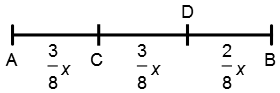
A train approaches a tunnel AB. Inside the tunnel is a cat located at a point that is $$\frac{3}{8}$$ of the distance AB measured from the entrance A. When the train whistles, that cat runs. If the cat moves to the entrance A of the tunnel, the train catches the cat exactly at the entrance. If the cat moves to the exit B, the train catches the cat at exactly the exit. The ratio of the speed of the train to that of the cat is of the order :
Discuss
Answer & Solution
Answer: Option B
Solution:
Let the length AB = x
Speed Time and Distance mcq solution image
Then, if C is the position of the cat, we have AC = $$\frac{3}{8}$$x
When the cat runs towards the entrance, the train catches it at the entrance.
This means that when the train reaches the entrance, the cat has travelled a distance of $$\frac{3}{8}$$x.
Let us now consider the case when the cat runs towards the exit.
So, when the train reaches A, the cat reaches a point D such that CD = $$\frac{3}{8}$$x
Then,
$$\eqalign{ & \text{BD} = \left[ {x - \left( {\frac{3}{8}x + \frac{3}{8}x} \right)} \right] \cr & \text{BD} = \frac{x}{4} \cr} $$
Since the train catches the cat at the exit, so the train covers distance x (= AB) in the same time in which that cat covers distance $$\frac{x}{4}$$ (= BD)
∴ Required ratio :
$$\eqalign{ & = x:\frac{x}{4} \cr & = 4:1 \cr} $$
16
With an uniform speed, a car covers a distance in 8 hours. had the speed been increased by 4 km/hr, the same distance could have been covered in 7 hr and 30 min. What is the distance covered ?
Discuss
Answer & Solution
Answer: Option B
Solution:
Let the speed of car be x km/hr
Distance = Speed × Time
Distance = 8x km
According to the question,
$$\eqalign{ & \Rightarrow \left( {x + 4} \right) \times 7.5 = 8x \cr & \Rightarrow 7.5x + 30 = 8x \cr & \Rightarrow 8x - 7.5x = 30 \cr & \Rightarrow 0.5x = 30 \cr & \Rightarrow x = \frac{{30}}{{0.5}} = 60{\text{ km/hr}} \cr} $$
Required distance :
= 8 × 60
= 480 km
17
A star is 8.1 × 10¹³ km away from the earth. Suppose light travels at the speed of 3.0 × 10⁵ km per second. How long will it take the light from the star to reach the earth ?
Discuss
Answer & Solution
Answer: Option B
Solution:
Required time :
$$\eqalign{ & = \left( {\frac{{8.1 \times {{10}^{13}}}}{{3.0 \times {{10}^5}}}} \right){\text{seconds}} \cr & = 2.7 \times {10^8}{\text{ seconds}} \cr & = \left( {\frac{{2.7 \times {{10}^8}}}{{60 \times 60}}} \right){\text{hours}} \cr & = 7.5 \times {10^4}{\text{ hours}} \cr} $$
18
The speed of A and B are in the ratio 3 : 4. A takes 20 minutes more than B to reach a destination. In what time does A reach the destination ?
Discuss
Answer & Solution
Answer: Option A
Solution:
Ratio of speed = 3 : 4
Ratio of time taken = $$\frac{1}{3}$$ : $$\frac{1}{4}$$ = 4 : 3
Let A and B take 4x and 3x minutes respectively to reach a destination.
Then,
⇔ 4x - 3x = 20
⇔ x = 20
∴ Time taken by A
= 4x
= (4 × 20) min
= 80 min
= $$1\frac{1}{3}$$ hours
19
The average speed of a train in the onward journey is 25% more than that in the return journey. The train halts for one hour on reaching the destination. The total time taken for the complete to and fro journey is 17 hours, covering a distance of 800 km. The speed of the train in the onward journey is :
Discuss
Answer & Solution
Answer: Option D
Solution:
Let the speed in return journey be x km/hr
Then, speed in onward journey :
$$\eqalign{ & = \left( {\frac{{125}}{{100}}x} \right){\text{ km/hr}} \cr & = \left( {\frac{5}{4}x} \right){\text{ km/hr}} \cr} $$
Average speed :
$$\eqalign{ & {\text{ = }}\left( {\frac{{2 \times \frac{5}{4}x \times x}}{{\frac{5}{4}x + x}}} \right){\text{ km/hr}} \cr & {\text{ = }}\left( {\frac{{10x}}{9}} \right){\text{ km/hr}} \cr & \therefore \left( {800 \times \frac{9}{{10x}}} \right) = 16 \cr & \Leftrightarrow x = \left( {\frac{{800 \times 9}}{{16 \times 10}}} \right) \cr & \Leftrightarrow x = 45 \cr} $$
So, speed in onward journey :
$$\eqalign{ & = \left( {\frac{5}{4} \times 45} \right){\text{ km/hr}} \cr & = 56.25{\text{ km/hr}} \cr} $$
20
Ravi walks to and fro to a shopping mall. He spends 30 minutes shopping. If he walks at a speed of 10 km an hour, he returns home at 19.00 hours. If he walks at 15 km an hour, her returns home at 18.30 hours. How far must he walk in order to return home at 18.15 hours ?
Discuss
Answer & Solution
Answer: Option E
Solution:
Let the to and fro distance to the mall be x km
Then,
$$\eqalign{ & \Rightarrow \frac{x}{{10}} - \frac{x}{{15}} = \frac{{30}}{{60}} \cr & \Rightarrow \frac{x}{{10}} - \frac{x}{{15}} = \frac{1}{2} \cr & \Rightarrow \frac{x}{{30}} = \frac{1}{2} \cr & \Rightarrow x = 15 \cr} $$
. Time taken to travel 15 km at 10 km/hr
$$\eqalign{ & = \left( {\frac{{15}}{{10}}} \right){\text{ hr}} \cr & = \frac{3}{2}{\text{ hr}} \cr & = 1\frac{1}{2}{\text{ hrs}} \cr} $$
Since 30 minutes were spent in shopping, so Ravi started for the mall 2 hours before 19.00 hrs i.e., at 17.00 hrs
Now, required time for to and fro journey :
$$\eqalign{ & {\text{ = }}\left( {18.15{\text{ hrs}} - 17.00{\text{ hrs}}} \right) - 30{\text{ min}} \cr & {\text{ = 45 min}} \cr & {\text{ = }}\frac{3}{4}{\text{ hrs}} \cr} $$
Hence, required speed :
$$\eqalign{ & {\text{ = }}\left( {15 \times \frac{4}{3}} \right){\text{ km/hr}} \cr & = 20{\text{ km/hr}} \cr} $$