ExamVeda
Login
Home
41
A train 300 metres long takes 40 seconds to cross a platform 900 metres long. The speed of the train in, km per hour is :
Discuss
Answer & Solution
Answer: Option D
Solution:
$$\eqalign{ & {\text{Speed of train :}} \cr & = \frac{{900 + 300}}{{40}} \cr & = 30{\text{ m/s}} \cr & {\text{Speed (in km/hr):}} \cr & = 30 \times \frac{{18}}{5} \cr & = 108{\text{ km/hr}} \cr} $$
42
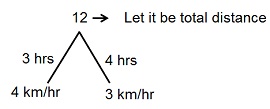
Rubi goes to a multiplex at the speed of 3 km/hr to see a movie and reaches 5 minutes late. If she travels at the speed of 4 km/hr she reaches 5 minutes early. The the distance of the multiplex from her starting point is :
Discuss
Answer & Solution
Answer: Option A
Solution:
Speed Time and Distance mcq solution image
Time difference = (4 - 3) = 1 hr
But, according to the question,
60 × $$\frac{1}{6}$$ = 10 minutes
So, distance = 12 × $$\frac{1}{6}$$ = 2 km
43
A train travelling at a speed of 30 m/sec crosses a platform, 600 metres long in 30 seconds. The length (in metres) of train is :
Discuss
Answer & Solution
Answer: Option D
Solution:
Total distance covered by the train in 30 seconds with the speed of 30 m/s is
= 30 × 30 m/s
= 900 metres
Total distance - train's length + platform's length
900 = train's length + 600
(when train crosses platform it covers length equal to length of train + length of platform)
Train's length = 900 - 600
Train's length = 300 metres
44
The distance between place A and B is 999 km. An express train leaves place A at 6 am and runs at a speed of 55.5 km/hr. The train stops on the way for 1 hour 20 minutes. It reaches B at :
Discuss
Answer & Solution
Answer: Option A
Solution:
Time will be taken by train if it does not stop :
$$\eqalign{ & = \frac{{{\text{Distance }}}}{{{\text{Speed}}}} \cr & = \frac{{999{\text{ kms}}}}{{55.5{\text{ km/hr}}}} \cr} $$
Without stop = 18 hr
But if stops on the way for 1 hour 20 minutes before reaching B.
Total time :
= 18 hr + 1 hr 20 min
= 19 hour 20 minutes
Reaching time at B :
= 6 am + 19 hr 20 min
= 1.20 am
45
A man travels some distance at a speed of 12 km/hr and returns at a speed of 9 km/hr. If the total time taken by him is 2 hr 20 min, the distance is :
Discuss
Answer & Solution
Answer: Option D
Solution:
Let the distance be x km
According to the question,
$$\eqalign{ & \frac{x}{{12}} + \frac{x}{9} = 2 + \frac{{20}}{{60}} \cr & \frac{{3x + 4x}}{{36}} = \frac{7}{3} \cr & \frac{{7x}}{{36}} = \frac{7}{3} \cr & \boxed{x = 12{\text{ km}}} \cr} $$
46
A, B and C start at the same time in the same direction to run around a circular stadium. A completes a round in 252 sec, B in 308 sec and C in 198 sec, all starting from the same point. After what time will they again meet at the stating point again ?
Discuss
Answer & Solution
Answer: Option A
Solution:
Time taken by A
= 252 sec
= 22 ×32 ×7
Time taken by B
= 308 sec
= 22 × 7 × 11
Time taken by C
= 198 sec
= 2 × 9 × 11
Together will meet at starting point :
= L.C.M. (252, 308, 198)
= 22 × 32 × 7 × 11 sec
So, required time (minutes)
$$\eqalign{ & {\text{ = }}\frac{{4 \times 9 \times 7 \times 11}}{{60}} \cr & = 46\min 12\sec \cr} $$
47
A car completed a journey of 400 km in $$12\frac{1}{2}$$ hrs. The first $$\frac{3}{4}$$ of the journey was done at 30 km/hr. Calculate the speed for the rest of the journey.
Discuss
Answer & Solution
Answer: Option B
Solution:
$$\eqalign{ & {\text{Total journey = 400}} \cr & \frac{3}{4}{\text{ Journey = 400}} \times \frac{3}{4} \cr & \,\,\,\,\,\,\,\,\,\,\,\,\,\,\,\,\,\,\,\,\,\,\,\,\,\,\,\,\,\, = 300{\text{ km}} \cr} $$
Remaining journey = 100 km
Let the speed of car for the rest of journey = x km/hr
According to the question,
$$\eqalign{ & \frac{{300}}{{30}} + \frac{{100}}{x} = 12\frac{1}{2} \cr & 10 + \frac{{100}}{x} = \frac{{25}}{2} \cr & \frac{{100}}{x} = \frac{{25 - 20}}{2} \cr & x = \frac{{100 \times 2}}{5} \cr & x = 40{\text{ km/hr}} \cr} $$
48
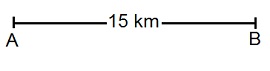
A and B are 15 km apart and when travelling towards each other meet after half an hour where as they meet two and a half hours later if they travel in the same direction. The faster of the two travels at the speed of :
Discuss
Answer & Solution
Answer: Option B
Solution:
Speed Time and Distance mcq solution image
Let the speed of A be x km/hr and speed of B be y km/hr
So, According to the question,
$$\eqalign{ & \frac{{15}}{{x + y}} = \frac{1}{2} \cr & x + y = 30.....(i) \cr & {\text{And,}} \cr & \frac{{15}}{{x - y}} = \frac{5}{2} \cr & 5x - 5y = 30.....(ii) \cr} $$
Multiply equation (i) by 5 and add
\[\begin{gathered} 5x + 5y = 150 \hfill \\ 5x - 5y = \,\,\,30 \hfill \\ \overline {10x\,\,\,\,\,\,\,\,\, = 180\,\,} \hfill \\ \end{gathered} \]
$$\boxed{x = 18{\text{ km/hr}}}$$

And y = 30 - $$x$$
⇒ y = 30 -18
⇒ y = 12 km/hr
∴ The faster travels at the speed of 18 km/hr
49
Two trains of equal length take 10 sec and 15 sec respectively to cross a telegraph post. If the length of each train be 120 metres, in what time (in seconds) will they cross each other travelling in opposite direction ?
Discuss
Answer & Solution
Answer: Option C
Solution:
$$\eqalign{ & {{\text{S}}_1} = \frac{{120}}{{10}}{\text{ m/sec}} \cr & \,\,\,\,\,\,\,\, = {\text{12 m/sec}} \cr & {{\text{S}}_2} = \frac{{120}}{{15}}{\text{ m/sec}} \cr & \,\,\,\,\,\,\,\, = 8{\text{ m/sec}} \cr} $$
Time taken to cross each other :
$$\eqalign{ & {\text{ = }}\frac{{{l_1} + {l_2}}}{{{{\text{V}}_{{\text{rel}}{\text{.}}}}}} \cr & = \frac{{240}}{{20}} \cr & = 12\sec \cr} $$
50
A person, who can walk down a hill at the rate of $$4\frac{1}{2}$$ km/hr and up the hill at the rate of 3 km/hr. He ascends and comes down to his starting point in 5 hours. How far did he ascend ?
Discuss
Answer & Solution
Answer: Option D
Solution:
Let the height of the hill = x km
$$\because $$ The distance will be same man either ascend and descend
$$\frac{{x{\text{ km}}}}{{\frac{9}{2}{\text{ km/h}}}} + \frac{x}{{3{\text{ km/h}}}} = 5{\text{ hrs}}$$

\[\left\{ \begin{gathered} \because {\text{ Time = }}\frac{{{\text{Distance}}}}{{{\text{Speed}}}} \hfill \\ {\text{Total Time = Ascending}} \hfill \\ {\text{ time + Descending time}} \hfill \\ \end{gathered} \right\}\]

$$\eqalign{ & \Rightarrow \frac{{2x}}{9} + \frac{x}{3} = 5 \cr & \Rightarrow \frac{{2x + 3x}}{9} = 5 \cr & \Rightarrow 5x = 5 \times 9 \cr & \Rightarrow x = 9{\text{ km}} \cr} $$