ExamVeda
Login
Home
91
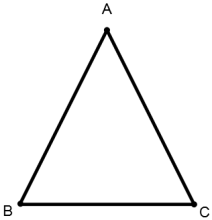
If the measures of the sides of triangle are (x2 - 1), (x2 + 1) and 2x cm, then the triangle would be :
Discuss
Answer & Solution
Answer: Option C
Solution:
According to question,
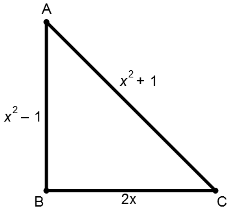
Triangles mcq solution image
Sides AB = x2 - 1
          BC = 2x
          AC = x2 + 1
By using Pythagoras theorem
AC2 = AB2 + BC2
(x2 + 1)2 = (x2 - 1)2 + (2x)2
x4 + 1 + 2x2 = x2 + 1 - 2x2 + 4x2
(x2 + 1)2 = (x2 + 1)2
∴ The triangle is right angle Δ
92
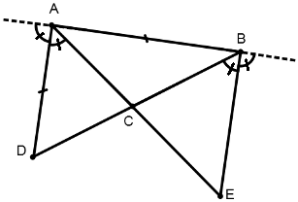
In ΔABC, ∠C is an obtuse angle. The bisectors of the exterior angles at A and B meet BC and AC produced at D and E respectively. If AB = AD = BE, then ∠ACB = ?
Discuss
Answer & Solution
Answer: Option B
Solution:
According to question,
Triangles mcq solution image
Let ∠CAB = x and ∠CBA = y
$$\eqalign{ & \Rightarrow \angle CAD = \frac{{180 - x}}{2} = 90 - \frac{x}{2} \cr & {\text{and}} \cr & \Rightarrow \angle EBC = \frac{{180 - y}}{2} = 90 - \frac{y}{2} \cr & {\text{also}}\,\angle AEB = \angle EAB = x \cr} $$
(∵ AB = EB ⇒ ABE is an isosceles triangle)
and ∠ADB = ∠ABD = y
(∵ AB = AD ⇒ ADB is an isosceles triangle)
In ΔAEB,
∠AEB + ∠ABE + ∠BAE = 180°
x + x + y + 90 - $$\frac{y}{2}$$ = 180°
⇒ 4x + y = 180°
Similarly in ΔADB
4y + x = 180°
⇒ 4y + x + 4x + y = 180 + 180
⇒ 5x + 5y = 360°
⇒ x + y = 72°
In triangle ABC,
∠ACB + x + y = 180°
⇒ ∠ACB = 180 - 72
⇒ ∠ACB = 108°
93
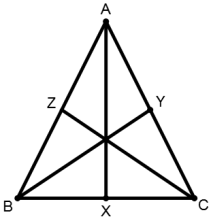
Let ABC be an equilateral triangle and AX, BY, CZ be the altitude. Then the right statement out of the four give responses is :
Discuss
Answer & Solution
Answer: Option A
Solution:
According to question,
Triangles mcq solution image
In an equilateral triangle
AB = BC = AC
∠A = ∠B = ∠C = 60°
∴ AX = BY = CZ
(All altitudes are same in an equilateral triangles)
94
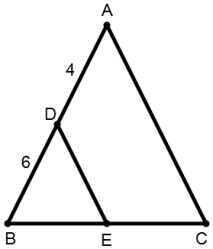
In ΔABC, DE || AC, D and E are two points on AB and CB respectively. If AB = 10 cm and AD = 4 cm, then BE : CE is
Discuss
Answer & Solution
Answer: Option D
Solution:
According to question,
Triangles mcq solution image
Given :
AB = 10 cm
AD = 4 cm
DE || AC
ΔABC ∼ ΔDBE
$$\eqalign{ & \therefore \frac{{BD}}{{AD}} = \frac{{BE}}{{CE}} \cr & \,\,\,\,\,\,\frac{{BE}}{{CE}} = \frac{6}{4} \cr & \,\,\,\,\,\,\frac{{BE}}{{CE}} = \frac{3}{2} \cr & \,\,\,\,\,\,BE:CE = 3:2 \cr} $$
95
If the three angles of a triangle are: $${\left(x + 15 \right)^ \circ },$$   $${\left({\frac{{6x}}{5} + 6} \right)^ \circ }$$  and $${\left({\frac{{2x}}{3} + 30} \right)^ \circ }$$   then the triangle is:
Discuss
Answer & Solution
Answer: Option B
Solution:
According to question,
 $$ \Rightarrow \left( {x + {{15}^ \circ }} \right) + {\left( {\frac{{6x}}{5} + 6} \right)^ \circ } + $$      $${\left( {\frac{{2x}}{3} + 30} \right)^ \circ } = $$    $${180^ \circ }$$
 $$\,\,\,\,\,\,\,\,\,\,\,\,\left\{ {\angle A + \angle B + \angle C = {{180}^ \circ }} \right\}$$
 $$ \Rightarrow x + \frac{{6x}}{5} + \frac{{2x}}{3} = $$     $${180^ \circ } - \left(15 + 6 + 30\right)$$
$$\eqalign{ & \Rightarrow \frac{{15x + 18x + 10x}}{{15}} = 180 - 51 \cr & \Rightarrow 43x = 129 \times 15 \cr & \Rightarrow x = {45^ \circ } \cr & \Rightarrow {\text{each}}\,{\text{angle}} \cr & \Rightarrow {\left( {x + 15} \right)^ \circ } = 45 + 15 = {60^ \circ } \cr & \Rightarrow {\left( {\frac{{6x}}{5} + 6} \right)^ \circ } = {60^ \circ } \cr & \Rightarrow {\left( {\frac{{2x}}{3} + 30} \right)^ \circ } = {60^ \circ } \cr} $$
∵ All three angles are equal 60°
⇒ Triangle will be equilateral triangle
96
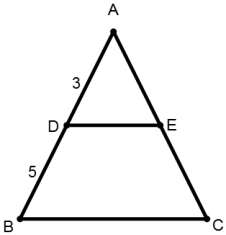
If in a triangle ABC, D and E are on the sides AB and AC, such that, DE is parallel to BC and $$\frac{{AD}}{{BD}}$$ = $$\frac{3}{5}$$. If AC = 4 cm, then AE is
Discuss
Answer & Solution
Answer: Option A
Solution:
According to question,
Triangles mcq solution image
Given :
AD = 3
BD = 5
AB = 8
AC = 4
AE = ?
By applying B. P. T
$$\eqalign{ & \frac{{AD}}{{AB}} = \frac{{AE}}{{AC}} = \frac{{DE}}{{BC}} \cr & \frac{3}{8} = \frac{{AE}}{4} \cr & AE = \frac{3}{2} = 1.5\,{\text{cm}} \cr} $$
97
In a ΔABC, ∠A + ∠B = 118°, ∠A + ∠C = 96°. Find the value of ∠A.
Discuss
Answer & Solution
Answer: Option D
Solution:
According to question,
Triangles mcq solution image
   ∠A + ∠B = 118°
   ∠A + ∠C = 96°
   ∠A = ?
As we know that
   ∠A + ∠B + ∠C = 180°
   ∠C = 180° - (∠A + ∠B)
   ∠C = 180° - 118°
∴ ∠C = 62°
   ∠A = 96° - 62°
   ∠A = 34°
98
For a triangle ABC, D and E are two points on AB and AC such that AD = $$\frac{1}{4}$$ AB, AE = $$\frac{1}{4}$$ AC. If BC = 12 cm, then DE is :
Discuss
Answer & Solution
Answer: Option C
Solution:
According to question,
Triangles mcq solution image
By using B.P.T
$$\eqalign{ & \frac{{AD}}{{AB}} = \frac{{AE}}{{AC}} = \frac{{DE}}{{BC}} \cr & \frac{{AD}}{{AB}} = \frac{{DE}}{{BC}} \cr & \Rightarrow \,\frac{1}{4} = \frac{{DE}}{{12}} \cr & \Rightarrow DE = 3\,{\text{cm}} \cr} $$
99
In triangle ABC a straight line parallel to BC intersects AB and AC at D and E respectively. If AB = 2AD, then DE : BC is
Discuss
Answer & Solution
Answer: Option C
Solution:
According to question,
Triangles mcq solution image
Given :
AB = 2AD
$$\frac{{AB}}{{AD}} = \frac{2}{1}$$
By applying B. P. T
$$\eqalign{ & \frac{{AD}}{{AB}} = \frac{{DE}}{{BC}} = \frac{{AE}}{{AC}} \cr & \frac{{DE}}{{BC}} = \frac{1}{2} \cr & \therefore DE:BC = 1:2 \cr} $$
100
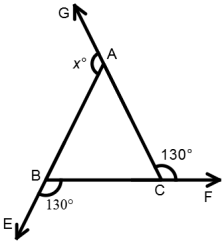
ABC is a triangle and the sides AB, BC and CA are produced to E, F and G respectively. If ∠CBE = ∠ACF = 130°, then the value of ∠GAB is :
Discuss
Answer & Solution
Answer: Option A
Solution:
We know that
⇒ Add of total exterior angle of a triangle (polygon) = 360°
Triangles mcq solution image
⇒ So, 130° + 130° + x° = 360°
x° = 100°