
ExamVeda
Login
Home
31
A cube of length 1 cm is taken out from a cube of length 8 cm. What is the weight of the remaining portion ?
Discuss
Answer & Solution
Answer: Option D
Solution:
Volume of the bigger cube = (83) cm3 = 512 cm3
Volume of the cut-out cube = (13) cm3 = 1 cm3
Volume of the remaining portion = (512 - 1) cm3 = 511 cm3

$$\frac{{{\text{Weight of the remaining portion}}}}{{{\text{Weight of the original cube}}}}$$      $$ = \frac{{511}}{{512}}$$
32
Capacity of a cylindrical vessel is 25.872 litres. If the height of the cylinder is three times the radius of its base, what is the area of the base ?
Discuss
Answer & Solution
Answer: Option B
Solution:
Volume of cylinder :
$$\eqalign{ & = 25.872\,{\text{litres}} \cr & = \left( {25.872 \times 1000} \right){\text{c}}{{\text{m}}^{\text{3}}} \cr & = 25872\,{\text{ c}}{{\text{m}}^3} \cr} $$
Let the radius of the base of the cylinder be r cm
Then, height = (3r) cm
$$\eqalign{ & \therefore \frac{{22}}{7} \times {r^2} \times \left( {3r} \right) = 25872 \cr & \Rightarrow {r^3} = \frac{{25872 \times 7}}{{66}} \cr & \Rightarrow {r^3} = 2744 \cr & \Rightarrow r = \root 3 \of {2744} \cr & \Rightarrow r = 14 \cr} $$
Hence, area of the base :
$$\eqalign{ & = \pi {r^2} \cr & = \left( {\frac{{22}}{7} \times 14 \times 14} \right){\text{ c}}{{\text{m}}^2} \cr & = 616\,{\text{ c}}{{\text{m}}^2} \cr} $$
33
What part of a ditch, 48 metres long, 16.5 metres board and 4 metres deep can be filled by the earth got by digging a cylindrical tunnel of diameter 4 metres and length 56 metres ?
Discuss
Answer & Solution
Answer: Option B
Solution:
Volume of earth dug :
$$\eqalign{ & = \left( {\frac{{22}}{7} \times 2 \times 2 \times 56} \right){{\text{m}}^3} \cr & = 704\,{{\text{m}}^3} \cr} $$
Volume of ditch :
$$\eqalign{ & = \left( {48 \times 16.5 \times 4} \right){{\text{m}}^3} \cr & = 3168\,{{\text{m}}^3} \cr} $$
∴ Required fraction :
$$\eqalign{ & = \frac{{704}}{{3168}} \cr & = \frac{2}{9} \cr} $$
34
If the area of the base of a right circular cone is 3850 cm2 and its height is 84 cm, then the curved surface area of the cone is :
Discuss
Answer & Solution
Answer: Option B
Solution:
$$\eqalign{ & \pi {r^2} = 3850 \cr & \Rightarrow {r^2} = \left( {\frac{{3850 \times 7}}{{22}}} \right) = 1225 \cr & \Rightarrow r = 35 \cr & {\text{Now, }}r = 35{\text{ cm, }}h = 84{\text{ cm}} \cr & {\text{So,}} \cr & l = \sqrt {{{\left( {35} \right)}^2} + {{\left( {84} \right)}^2}} \cr & \Rightarrow l = \sqrt {1225 + 7056} \cr & \Rightarrow l = \sqrt {8281} \cr & \Rightarrow l = 91{\text{ cm}} \cr} $$
∴ Curved surface area :
$$\eqalign{ & = \left( {\frac{{22}}{7} \times 35 \times 91} \right){\text{ c}}{{\text{m}}^2} \cr & = 10010{\text{ c}}{{\text{m}}^2} \cr} $$
35
Ice cream completely filled in a cylinder of diameter 35 cm and height 32 cm is to be served by completely filling identical disposable cones of diameter 4 cm and height 7 cm. The maximum number of persons that can be served this way is :
Discuss
Answer & Solution
Answer: Option C
Solution:
Volume of cylinder :
$$\eqalign{ & = \left( {\pi \times \frac{{35}}{2} \times \frac{{35}}{2} \times 32} \right){\text{ c}}{{\text{m}}^3} \cr & = 9800\pi {\text{ c}}{{\text{m}}^3} \cr} $$
Volume of 1 cone :
$$\eqalign{ & = \left( {\frac{1}{3} \times \pi \times 2 \times 2 \times 7} \right){\text{ c}}{{\text{m}}^3} \cr & = \frac{{28\pi }}{3}{\text{ c}}{{\text{m}}^3} \cr} $$
∴ Number of persons that can be served :
$$\eqalign{ & = \left( {9800\pi \times \frac{3}{{28\pi }}} \right) \cr & = 1050 \cr} $$
36
The radii of two sphere are in the ratio 3 : 2. Their volumes will be in the ratio :
Discuss
Answer & Solution
Answer: Option C
Solution:
Let the radii of the two spheres be 3r and 2r respectively
Then, required ratio :
$$\eqalign{ & = \frac{{\frac{4}{3}\pi {{\left( {3r} \right)}^3}}}{{\frac{4}{3}\pi {{\left( {2r} \right)}^3}}} \cr & = \frac{{27}}{8} \cr & = 27:8 \cr} $$
37
The volume of the largest possible cube that can be inscribed in a hollow spherical ball of radius r cm is :
Discuss
Answer & Solution
Answer: Option C
Solution:
Clearly, the diagonal of the largest possible cube will be equal to the diameter of the sphere
Let the edge of the cube be a
$$\eqalign{ & \sqrt 3 a = 2r \cr & \Rightarrow a = \frac{2}{{\sqrt 3 }}r \cr} $$
Volume :
$$\eqalign{ & = {a^3} \cr & = {\left( {\frac{2}{{\sqrt 3 }}r} \right)^3} \cr & = \frac{8}{{3\sqrt 3 }}{r^3} \cr} $$
38
A metallic cone of radius 12 cm and height 24 cm is ,melted and made into spheres of radius 2 cm each. How many spheres are there ?
Discuss
Answer & Solution
Answer: Option A
Solution:
$$\eqalign{ & {\text{Number of spheres :}} \cr & = \frac{{{\text{Volume of cone}}}}{{{\text{Volume of 1 sphere}}}} \cr & = \frac{{\frac{1}{3}\pi \times 12 \times 12 \times 24}}{{\frac{4}{3}\pi \times 2 \times 2 \times 2}} \cr & = 108 \cr} $$
39
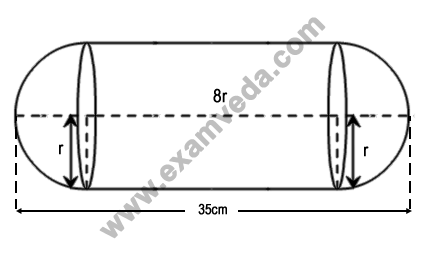
A solid is in the form of a right circular cylinder with hemispherical ends. The total length of the solid is 35 cm. The diameter of the cylinder is $$\frac{1}{4}$$ of its height. The surface area of the solid is :
Discuss
Answer & Solution
Answer: Option D
Solution:
Let the radius of the cylinder and the hemisphere be r cm
Diameter of the cylinder = (2r) cm
Height of the cylinder = (4 × 2r) cm = 8r cm
Total length of the solid :
= (8r + r + r) cm = 10r cm
⇒ 10r = 35
⇒ r = 3.5
Volume and Surface Area mcq solution image
∴ Surface area of the solid :
= Curved surface area of the cylinder + 2 × (Curved surface area of the hemisphere)
$$ = \left( {2 \times \frac{{22}}{7} \times 3.5 \times 28 + 2 \times 2 \times \frac{{22}}{7} \times 3.5 \times 3.5} \right){\text{ c}}{{\text{m}}^2}$$
$$\eqalign{ & = \left( {616 + 154} \right){\text{ c}}{{\text{m}}^2} \cr & = 770{\text{ c}}{{\text{m}}^2} \cr} $$
40
A hemispherical bowl has 3.5 cm radius. It is to be painted inside as well as outside. The cost of painting it at the rate of Rs. 5 per 10 sq. cm will be :
Discuss
Answer & Solution
Answer: Option A
Solution:
Radius of a hemispherical bowl = 3.5 cm
Inner and outer surface area of the bowl :
$$\eqalign{ & = 4\pi {r^2} \cr & = 4 \times \frac{{22}}{7} \times 3.5 \times 3.5 \cr & = 154{\text{ sq}}{\text{.cm}} \cr} $$
Total cost of painting at the rate of Rs. 5 per 10 sq.cm :
$$\eqalign{ & = 154 \times \frac{5}{{10}} \cr & = {\text{Rs}}{\text{. 77}} \cr} $$