
ExamVeda
Login
Home
41
If two bodies having masses m1 and m2 (m1 > m2) have equal kinetic energies, the momentum of body having mass m1 is _________ the momentum of body having mass m2.
Discuss
Answer & Solution
Answer: Option C
No explanation is given for this question. Let's Discuss on Board
42
The algebraic sum of the resolved parts of a number of forces in a given direction is equal to the resolved part of their resultant in the same direction. This is known as
Discuss
Answer & Solution
Answer: Option B
Solution:
The algebraic sum of the resolved parts of a number of forces in a given direction is equal to the resolved part of their resultant in the same direction. This is known as the Principle of resolution of forces.

Here's the explanation:

The Principle of resolution of forces states that when you have multiple forces acting in different directions, you can break them down or resolve them into their individual components along a specific direction.
The algebraic sum (taking into account the signs of forces in that direction) of these resolved components will be equal to the resolved part of their resultant force in the same direction.
This principle is a fundamental concept in engineering mechanics and is often used to simplify the analysis of complex force systems.

So, the correct answer is Option B: Principle of resolution of forces.
43
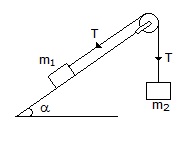
In the shown figure, if the angle of inclination of the plane is increased, then acceleration of the system will
Engineering Mechanics mcq question image
Discuss
Answer & Solution
Answer: Option B
No explanation is given for this question. Let's Discuss on Board
44
Three forces acting on a rigid body are represented in magnitude, direction and line of action by the three sides of a triangle taken in order. The forces are equivalent to a couple whose moment is equal to
Discuss
Answer & Solution
Answer: Option B
No explanation is given for this question. Let's Discuss on Board
45
The M.I. of hollow circular section about a central axis perpendicular to section as compared to its M.I. about horizontal axis is
Discuss
Answer & Solution
Answer: Option B
No explanation is given for this question. Let's Discuss on Board
46
A weight of 1000 N can be lifted by an effort of 80 N. If the velocity ratio is 20, the machine is
Discuss
Answer & Solution
Answer: Option A
Solution:
Understanding the Question:
Imagine a simple machine like a pulley system. It helps you lift heavy objects with less effort.
We have a weight (load) of 1000 N that needs to be lifted.
We only need to apply an effort of 80 N to lift it.
The velocity ratio (VR) is 20. This tells us how much the machine multiplies the effort. A VR of 20 means the effort moves 20 times the distance the load moves.

Mechanical Advantage (MA):
The machine's mechanical advantage (MA) shows how much it multiplies the effort.
We calculate MA by dividing the load by the effort: MA = Load / Effort = 1000 N / 80 N = 12.5

Efficiency:
Efficiency tells us how effective the machine is. It's the ratio of MA to VR:
Efficiency = (MA / VR) * 100% = (12.5 / 20) * 100% = 62.5%

Reversible vs. Non-reversible Machines:
A reversible machine has an efficiency greater than 50%. It can work in the reverse direction without extra help. For example, it can both lift a weight and lower it smoothly.
A non-reversible machine has an efficiency less than 50%. To reverse it (lower the weight), you might need to apply an external force.

Answer:
Since the efficiency (62.5%) is greater than 50%, the machine is reversible. The correct option is A.
47
A ladder is resting on a rough ground and leaning against a smooth vertical wall. The force of friction will act
Discuss
Answer & Solution
Answer: Option C
No explanation is given for this question. Let's Discuss on Board
48
A ladder is resting on a smooth ground and leaning against a rough vertical wall. The force of friction will act
Discuss
Answer & Solution
Answer: Option D
No explanation is given for this question. Let's Discuss on Board
49
The moment of inertia of a rectangular section 3 cm wide and 4 cm deep about X-X axis is
Discuss
Answer & Solution
Answer: Option C
No explanation is given for this question. Let's Discuss on Board
50
The product of either force of couple with the arm of the couple is called
Discuss
Answer & Solution
Answer: Option D
No explanation is given for this question. Let's Discuss on Board