ExamVeda
Login
Home
1
A lap joint is always in _________ shear.
Discuss
Answer & Solution
Answer: Option C
Solution:
A lap joint can experience both single and double shear.

In a single shear lap joint, the forces act in a single plane, and the joint is subjected to shear along one plane only.
In a double shear lap joint, the forces are distributed over two planes, effectively reducing the shear stress in each plane.

Therefore, the correct answer is Option C: Both A and B.
2
A pressure vessel is said to be a thin shell when the ratio of wall thickness of the vessel to its diameter is __________ $$\frac{1}{{10}}.$$
Discuss
Answer & Solution
Answer: Option B
Solution:
The correct answer is Option B: Less than

Here's why:

In mechanical engineering, specifically in the study of pressure vessels, we categorize them as either "thin shells" or "thick shells" based on the ratio of their wall thickness (t) to their inner diameter (D).

A pressure vessel is considered a thin shell when the wall thickness is relatively small compared to its diameter. This allows us to make certain simplifying assumptions in our calculations of stress and strain.

The generally accepted criterion is:

If t/D < 1/10, then the vessel is considered a thin shell. This means the wall thickness (t) must be less than one-tenth of the diameter (D). If the wall thickness is too large compared to the diameter (t/D >= 1/10), it's considered a thick shell, and different, more complex formulas are needed.
3
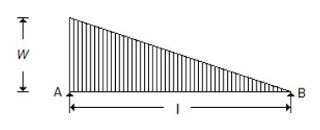
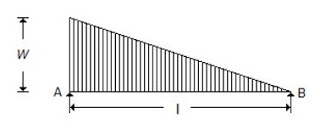
A simply supported beam with a gradually varying load from zero at ‘B’ and ‘w’ per unit length at ‘A’ is shown in the below figure. The shear force at ‘B’ is equal to
Strength of Materials mcq question image
Discuss
Answer & Solution
Answer: Option A
Solution:
Strength of Materials mcq solution image
4
The columns whose slenderness ratio is less than 80, are known as
Discuss
Answer & Solution
Answer: Option A
Solution:
* Slenderness Ratio: This is a way to measure how likely a column is to buckle (bend sideways) under a load. It's calculated by dividing the column's effective length by its least radius of gyration.

* Short Columns: These are columns that are relatively stocky. They tend to fail due to crushing (the material being squeezed) rather than buckling.

* Long Columns: These are columns that are relatively slender. They are more likely to buckle under load.

* Medium Columns:These columns behaviour lies between short and long columns.

* General Rule: A common rule of thumb is that columns with a slenderness ratio less than 80 are generally classified as short columns. They primarily fail due to compressive stresses exceeding the material's yield strength.

* Weak Columns: This term isn't directly related to slenderness ratio in the same defining way as short or long columns. A weak column could be weak due to material properties or manufacturing defects, regardless of its slenderness ratio.

Therefore, a slenderness ratio less than 80 indicates a short column that's prone to crushing rather than buckling.
5
When a bar of length l, width b and thickness t is subjected to a pull of P, its
Discuss
Answer & Solution
Answer: Option C
No explanation is given for this question. Let's Discuss on Board
6
When a bar of length l, width b and thickness t is subjected to a push of P, its
Discuss
Answer & Solution
Answer: Option D
No explanation is given for this question. Let's Discuss on Board
7
The center to center distance, between two consecutive rivets in a row, is called
Discuss
Answer & Solution
Answer: Option B
No explanation is given for this question. Let's Discuss on Board
8
According to Unwin's formula, the relation between diameter of rivet hole (d) and thickness of plate (t) is given by (where d and t are in mm)
Discuss
Answer & Solution
Answer: Option D
No explanation is given for this question. Let's Discuss on Board
9
When it is indicated that a member is elastic, it means that when force is applied, it will
Discuss
Answer & Solution
Answer: Option C
No explanation is given for this question. Let's Discuss on Board
10
In riveted boiler joints, all stresses, shearing, bearing and tensile are based on the
Discuss
Answer & Solution
Answer: Option B
No explanation is given for this question. Let's Discuss on Board