
ExamVeda
Login
Home
61
The total number of students in section A and B of a class is 110. The number of students in section A is 10 more than that of section B. The average score of the students in B, in a test, is 20% more than that of students in A. If the average score of all the students in the class is 72, then what is the average score of the students in A?
Discuss
Answer & Solution
Answer: Option A
Solution:
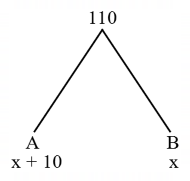
Average mcq question image
A + B = 110
x + 10 + x = 110
x = 50
A = 60
B = 50
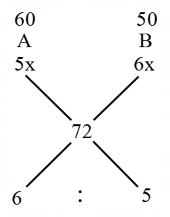
Average mcq question image
$$\frac{{6{\text{x}} - 72}}{{72 - 5{\text{x}}}} = \frac{6}{5}$$
(x - 12) × 5 = 72 - 5x
5x - 60 = 72 - 5x
10x = 132
A = 5x = 66
62
The average of thirteen numbers is 80. The average of the first five numbers is 74.5 and that of the next five numbers is 82.5. The 11th number is 6 more than the 12th number is 6 less than the 13th number. What is the average of the 11th and the 13th numbers?
Discuss
Answer & Solution
Answer: Option A
Solution:
Average of 13 numbers = 80
⇒ Sum of 13 numbers = 80 × 13 = 1040
Average of the first 5 numbers = 74.5
⇒ Sum of the first 5 numbers = 74.5 × 5 = 372.5
Average of next 5 numbers (6th to 10th) = 82.5
⇒ Sum of the next 5 numbers (6th to 10th) = 82.5 × 5 = 412.5
⇒ Sum of the last 3 numbers = 1040 - 372.5 - 412.5 = 255
Let the 12th number be x
11th number = x + 6 and 13th number = x + 6
According to the question,
⇒ x + 6 + x + x + 6 = 255
⇒ x = 81
⇒ 11th number = x + 6 = 81 + 6 = 87
⇒ 13th number = x + 6 = 81 + 6 = 87
∴ Average of 11th and 13th number = $$\frac{{87 + 87}}{2}$$  = 87
63
Average of all even numbers between 222 and 250 is . . . . . . . .
Discuss
Answer & Solution
Answer: Option C
Solution:
$$\eqalign{ & {\text{Numbers are }}224,\,226,\,.....\,248 \cr & {S_n} = \frac{{13}}{2}\left[ {224 + 248} \right] \cr & = \frac{{13}}{2} \times 472 \cr & {\text{Average}} = \frac{{13 \times 472}}{{2 \times 13}} = 236 \cr & \cr & {\bf{Alternate:}} \cr & {\text{Average of all even number between }}222{\text{ and }}250 \cr & \Rightarrow a = 224 \cr & l = 248 \cr & {\text{Average}} = \frac{{a + l}}{2} \cr & = \frac{{224 + 248}}{2} \cr & = 236 \cr} $$
64
Average of first five odd multiples of 3 is
Discuss
Answer & Solution
Answer: Option C
Solution:
According to the question,
First five odd multiples of 3 is = 3, 9, 15, 21, 27
$$\eqalign{ & \therefore {\text{Average}} = \frac{{3 + 9 + 15 + 21 + 27}}{5} \cr & = \frac{{75}}{5} \cr & = 15 \cr} $$
65
The average of 33 numbers is 74. The average of the first 17 numbers is 72.8 and that of the last 17 numbers is 77.2. If the 17th number is excluded, then what will be the average of the remaining numbers (correct to one decimal place)?
Discuss
Answer & Solution
Answer: Option A
Solution:
Average of 33 members = 74
Sum of numbers = 33 × 74 = 2442
Sum of the first 17 numbers = 1237.6
Sum of the last 17 numbers = 17 × 77.2 = 1312.4
17th number = 1237.6 + 1312.4 - 2442 = 108
Average of 32 numbers $$ = \frac{{2442 - 108}}{{32}} = 72.9$$
66
The arithmetic mean (average) of the first 10 whole number is
Discuss
Answer & Solution
Answer: Option D
Solution:
According to the question,
First 10 whole numbers are = 0, 1, 2, 3, 4, 5, 6, 7, 8, 9
∴ Average of 10 whole numbers
$$\eqalign{ & = \frac{{0 + 1 + 2 + 3 + 4 + 5 + 6 + 7 + 8 + 9}}{{10}} \cr & = \frac{{45}}{{10}} \cr & = 4.5 \cr} $$
67
Find the weighted arithmetic mean of the first 'n' natural numbers, the weights being the corresponding numbers.
Discuss
Answer & Solution
Answer: Option C
Solution:
$$\eqalign{ & {\text{Weighted arithmetic mean}} \cr & = \frac{{1 \times 1 + 2 \times 2 + 3 \times 3 + \,.....\,n \times n}}{{1 + 2 + 3 + \,.....\, + n}} \cr & = \frac{{n\left( {n + 1} \right)\left( {2n + 1} \right) \times 2}}{{6 \times n\left( {n + 1} \right)}} \cr & = \frac{{2n + 1}}{3} \cr} $$
68
The average of three numbers a, b and c is 2 more than c. The average of a and b is 48. If d is 10 less than c, then the average of c and d is:
Discuss
Answer & Solution
Answer: Option D
Solution:
$$\eqalign{ & \frac{{a + b + c}}{3} = c + 2 \cr & a + b + c = 3c + 6 \cr & a + b = 2c + 6 \to \left( {\text{i}} \right) \cr & \frac{{a + b}}{2} = 48 \cr & a + b = 96 \cr & {\text{From equation }}\left( {\text{i}} \right) \cr & 96 = 2c + 6 \cr & c = 45 \cr & d = 35 \cr & {\text{The average of }}\left( {c + d} \right) \cr & = \frac{{45 + 35}}{2} \cr & = 40 \cr} $$
69
What is the difference between the average of first 148 even positive numbers and the average of first 129 odd positive numbers?
Discuss
Answer & Solution
Answer: Option A
Solution:
Average of first 148 positive number
$$\eqalign{ & = \frac{{N\left( {N + 1} \right)}}{N} \cr & = N + 1 \cr & = 148 + 1 \cr & = 149 \cr} $$
Average of first 129 odd number $$ = \frac{{{N^2}}}{N} = N = 129$$
Difference = 149 - 129 = 20
70
The average of all odd numbers from 113 to 159 is . . . . . . . .
Discuss
Answer & Solution
Answer: Option D
Solution:
Average of all odd numbers from 113 to 159, by using Arithmetic progression formula,
$$\eqalign{ & {\text{Average}} = \frac{{\frac{n}{2}\left[ {a + l} \right]}}{n} \cr & = \frac{1}{2}\left[ {a + l} \right] \cr & = \frac{1}{2} \times \left[ {113 + 159} \right] \cr & = \frac{{272}}{2} \cr & = 136 \cr} $$