ExamVeda
Login
Home
31
The numbers 2272 and 875 are divided by a three-digit numbers N, giving the same remainder. The sum of the digits of N is :
Discuss
Answer & Solution
Answer: Option A
Solution:
Clearly, (2272 - 875) = 1397, is exactly divisible by N.
Now, 1397 = 11 × 127
∴ The required 3-digit number is 127, the sum of whose digits is 10
32
The remainder when (1523 + 2323) is divided by 19, is :
Discuss
Answer & Solution
Answer: Option A
Solution:
(xn + an) is divisible by (x + a) when n is odd
∴ (1523 + 2323) is divisible by (15 + 23)
⇒ (1523 + 2323) is divisible by 38 and hence by 19
⇒ On dividing (1523 + 2323) by 19, we get 0 as remainder.
33
Which one of the following numbers is divisible by 15 ?
Discuss
Answer & Solution
Answer: Option A
Solution:
Consider the number is 17325
Its unit digit is 5, so it is divisible by 5
Sum of its digits = (5 + 2 + 3 + 7 + 1) = 18, which is divisible by 3
So, the given number is divisible by 3
And since 5 and 3 are co-primes,
So the given number is divisible by (5 × 3), i.e., 15
34
How many numbers will be there between 300 and 500, where 4 comes only one time ?
Discuss
Answer & Solution
Answer: Option B
Solution:
From 300 to 399, we note that when '4' comes only one time = 19 such instances.
From 400 to 499, we note that when '4' comes only one time = 80 such instances.
So, total = (19 + 80) = 99 such instances.
35
A number when divided by three consecutive numbers 9, 11, 13 leaves the remainders 8, 9 and 8 respectively. If the order of divisors is reversed, the remainders will be :
Discuss
Answer & Solution
Answer: Option B
Solution:
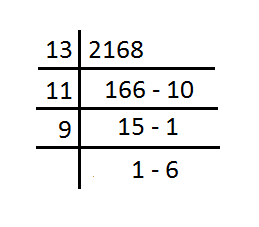
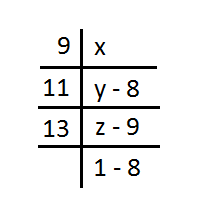
Number System mcq solution image
z = 13 × 1 + 8 = 21
y = 11 × z + 9 = 11 × 21 + 9 = 240
x = 9 × y + 8 = 9 × 240 + 8 = 2168
Now, when order of divisor is reversed, we have :
Number System mcq solution image
∴ Respective remainders are 10, 1 and 6
36
The divisor is 25 times the quotient and 5 times the remainder. If the quotient is 16, then the dividend is :
Discuss
Answer & Solution
Answer: Option D
Solution:
Quotient = 16, Divisor = (25 × 16) = 400
5 × Remainder = Divisor
⇒ Remainder = $$\frac{400}{5}$$ = 80
Divided = (400 × 16) + 80 = 6480
37
The remainder when 784 is divided by 342 is :
Discuss
Answer & Solution
Answer: Option B
Solution:
784 = (73)28 = (343)28
Now, (xn - an) is divisible by (x - a) for all values of n
∴ [(343)28 - 1] is divisible by (343 - 1)
⇒ [(343)28 - 1] is divisible by 342
⇒ (784 - 1) is divisible by 342
⇒ On dividing 784 by 342, we get 1 as remainder.
38
The difference between the square of two consecutive odd integers is always divisible by :
Discuss
Answer & Solution
Answer: Option D
Solution:
Let the two consecutive odd integers be (2m + 1) and (2m + 3)
Then, (2m + 3)2 - (2m + 1)2
= [(2m + 3) + (2m + 1)] [(2m + 3) - (2m + 1)]
= (4m + 4) × 2
= 8m + 8
= 8(m + 1), which is always divisible by 8
39
The smallest number that must be added to 803642 in order to obtain a multiple of 11 is :
Discuss
Answer & Solution
Answer: Option C
Solution:
On dividing 803642 by 11, we get 4 as remainder.
Required number to be added = (11 - 4) = 7
40
A 4-digit number is formed by repeating a 2-digit number such as 2525, 3232 etc. Any number of this form is exactly divisible by :
Discuss
Answer & Solution
Answer: Option D
Solution:
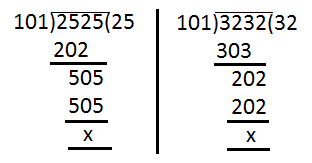
Clearly, 2525 is not divisible by any of the numbers 7, 11 and 13
The smallest 3-digit prime number is 101
Number System mcq solution image
Hence (D) is true.