
ExamVeda
Login
Home
11
Codes consisting of light and dark marks which may be optically read is known as
Discuss
Answer & Solution
Answer: Option B
Solution:
Bar code : A barcode (also bar code) is an optical, machine-readable, representation of data; the data usually describes something about the object that carries the barcode. Initially, barcodes were only scanned by special optical scanners called barcode readers. Barcode was invented by Norman Joseph Woodland and Bernard Silver and patented in US in 1952.
For Example :
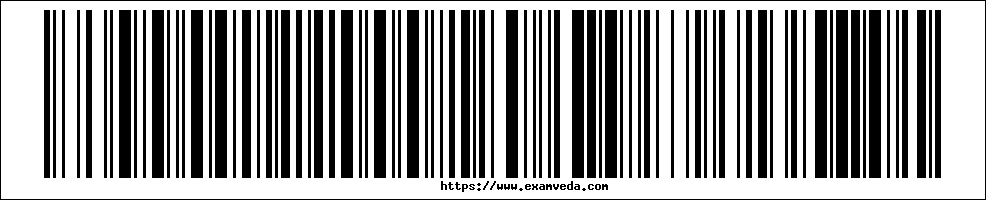
Computer Fundamental Miscellaneous mcq solution image
12
A type of channel used to connect a central processor and peripherals which uses multipling is known as
Discuss
Answer & Solution
Answer: Option C
Solution:
A type of channel used to connect a central processor and peripherals which uses multipling is known as Multiplexer.
13
The first generation of computers available was based on the bit micro processors.
Discuss
Answer & Solution
Answer: Option E
Solution:
The statement given in the question is factually incorrect because first-generation computers were not based on microprocessors.

First-generation computers, developed between 1940 and 1956, used vacuum tubes as their primary electronic component for processing and computation.

Microprocessors were introduced much later and became the foundation of the fourth generation of computers.

Therefore, the first generation of computers cannot be associated with 4-bit, 8-bit, 16-bit, or 64-bit microprocessors.

Hence, Option E: None of the above is the correct answer.
14
The complete picture of data stored in database is known as
Discuss
Answer & Solution
Answer: Option B
Solution:
Option A: Record

This option is incorrect. A record in a database refers to a single row of data in a table, which represents a single instance of the entity described by the table. It is not the complete picture of the data stored in the database.

Option B: Scheme

This option is correct. A schema (often spelled "scheme" in some contexts) is the complete picture of data stored in a database. It includes the structure of the database, such as tables, relationships, constraints, and other elements that define how the data is organized and accessed.

Option C: System flowchart

This option is incorrect. A system flowchart is a graphical representation of the processes and flow of data within a system. It does not specifically refer to the complete picture of data stored in a database.

Option D: Dbms

This option is incorrect. A DBMS (Database Management System) is software that provides an interface to create, read, update, and delete data in a database. It is the tool used to manage the database, not the representation of the data itself.

Conclusion:

The complete picture of data stored in a database is known as the schema, making Option B: Scheme the correct answer.
15
Which of the following is intended to be used in all applications runs on mainframe computers.
Discuss
Answer & Solution
Answer: Option C
Solution:
PL/1 : PL/I is a procedural, imperative computer programming language designed for scientific, engineering, business and system programming uses. It has been used by various academic, commercial and industrial organizations since it was introduced in the 1960s, and continues to be actively used.
PL/I's main domains are data processing, numerical computation, scientific computing, and system programming; it supports recursion, structured programming, linked data structure handling, fixed-point, floating-point, complex, character string handling, and bit string handling. The language syntax is English-like and suited for describing complex data formats, with a wide set of functions available to verify and manipulate them.
16
A language which is close to that used within the computer is
Discuss
Answer & Solution
Answer: Option C
Solution:
The correct answer is (C) Low-level language.
Here's why:
Low-level languages are designed to be very close to the computer's hardware.
They use instructions that the computer can directly understand, often represented in binary code (0s and 1s) or assembly language.
Assembly language is a type of low-level language that uses mnemonics (short codes) to represent machine instructions.
High-level languages (like Python, Java, C++) are designed to be easier for humans to read and write, and they need to be translated into machine code before the computer can execute them.
Therefore, the language closest to what the computer uses internally is a low-level language.
17
Which is a unit representing the no bits of discrete.
Discuss
Answer & Solution
Answer: Option A
Solution:
In digital systems or discrete system we use a symbol synonymous to pulses per second is called baud rate.
18
The device that can both feed data into and accept data from a computer is
Discuss
Answer & Solution
Answer: Option C
Solution:
Input-Output device : In computing, input/output or I/O (or, informally, io or IO) is the communication between an information processing system, such as a computer, and the outside world, possibly a human or another information processing system. Inputs are the signals or data received by the system and outputs are the signals or data sent from it. The term can also be used as part of an action; to "perform I/O" is to perform an input or output operation.
19
The personnel who deals with the computer & its management put together are called
Discuss
Answer & Solution
Answer: Option B
Solution:
Humanware is hardware and software that emphasizes user capability and empowerment and the design of the user interface. The process of building humanware generally consists of these steps:
1. Define users (age, mindset, environmental context, previous product experience and expectations, and so forth) and what they really want to do.
2. Identify tasks they will need to do or capabilities they will want
3. Specify usability objectives (if possible, these should be measurable, such as how long to do something or how many mouse clicks to get to a specified task point) for each task or capability.
4. Build a prototype of the user interface (it can be a paper or simulated prototype if time is short)
5. Test and verify or correct the prototype
6. Provide the prototype and usability objectives to the program designers and coders.

Source : techtarget.com

20
A modern digital computer has
Discuss
Answer & Solution
Answer: Option D
Solution:
A modern digital computer has Extremely high speed, Large memory and Almost unlimited accuracy. These computers are versatile in a sense that they can carry out different type of jobs at a time without any interference. They modify their behaviour based on the information they process.