ExamVeda
Login
Home
91
The data sheet for a certain JFET ( Junction Field Effect Transistor) indicates that IDSS (drain to source current with gate shorted) = 15 mA and VGS(off) (Cut-off value of gate to source voltage) = -5V. What is the drain current for VGS = -2V?
Discuss
Answer & Solution
Answer: Option D
No explanation is given for this question. Let's Discuss on Board
92
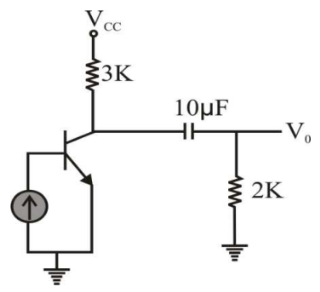
The lower cut-off frequency of the transistor stage in the adjoining figure is
Analog Electronics mcq question image
Discuss
Answer & Solution
Answer: Option C
No explanation is given for this question. Let's Discuss on Board
93
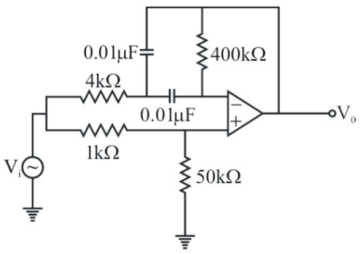
The circuit given in the figure is a
Analog Electronics mcq question image
Discuss
Answer & Solution
Answer: Option C
No explanation is given for this question. Let's Discuss on Board
94
A monostable multivibrator is frequently used:
Discuss
Answer & Solution
Answer: Option B
No explanation is given for this question. Let's Discuss on Board
95
The phase shift oscillator requires
Discuss
Answer & Solution
Answer: Option A
No explanation is given for this question. Let's Discuss on Board
96
The Class-B push-pull amplifier is an efficient two-transistor circuit, in which the two transistors operate in the following way:
Discuss
Answer & Solution
Answer: Option C
No explanation is given for this question. Let's Discuss on Board
97
The common-mode voltage gain is . . . . . . . .
Discuss
Answer & Solution
Answer: Option A
No explanation is given for this question. Let's Discuss on Board
98
Introducing a resistor in the emitter of a common emitter amplifier stabilizes the dc operating point against variation in
Discuss
Answer & Solution
Answer: Option C
No explanation is given for this question. Let's Discuss on Board
99
gm of MOSFET is controlled by
Discuss
Answer & Solution
Answer: Option A
Solution:
The correct answer is Option A: gate-source voltage.
Let's break down why:
gm (transconductance) of a MOSFET tells us how much the drain current (Id) changes for a small change in the gate-source voltage (Vgs).
Think of it like this: If you slightly adjust the voltage on the gate (Vgs), how much does the current flowing through the MOSFET from drain to source (Id) change?

Option A: gate-source voltage (Vgs) - This is the primary way to control gm. A higher Vgs generally leads to a higher gm.

Option B: drain-source voltage (Vds) - While Vds *does* influence the drain current, and therefore indirectly *can* affect gm, it's not the primary control. gm is *defined* by the relationship between gate voltage and drain current. Vds mainly affects the *saturation* region of operation, but the *control* is still largely through the gate.

Option C: drain current (Id) - gm and Id are related, but Id doesn't directly *control* gm. Instead, gm is a *property* that describes how Id responds to changes in Vgs.

Option D: gate current (Ig) - In a MOSFET, the gate current is ideally very, very small (close to zero). Therefore, it does not control gm. The gate is insulated.

In simpler terms: The gate-source voltage (Vgs) is like the accelerator pedal in a car. It directly controls how much current (Id) flows through the MOSFET. gm is a measure of how sensitive the current flow is to changes in the accelerator pedal.

100
A 741 OP-AMP has an open loop gain 200,000. The output offset voltage is 2 mV. If the input terminals are shorted, the output voltage is
Discuss
Answer & Solution
Answer: Option A
No explanation is given for this question. Let's Discuss on Board