
ExamVeda
Login
Home
31
A periodic signal x(t) has a trigonometric Fourier series expansion
$$x\left( t \right) = {a_0} + \sum\limits_{n = 1}^\infty {\left( {{a_n}\,\cos \,n{\omega _0}t + {b_n}\sin \,n{\omega _0}t} \right)} $$
If $$x\left( t \right) = - x\left( { - t} \right) = - x\left( {{{t - \pi } \over {{\omega _0}}}} \right),$$      we can conclude that
Discuss
Answer & Solution
Answer: Option A
No explanation is given for this question. Let's Discuss on Board
32
If $$F\left( s \right) = L\left| {f\left( t \right)} \right| = {K \over {\left( {s + 1} \right)\left( {{s^2} + 4} \right)}},$$       then $$\mathop {\lim }\limits_{t \to \infty } f\left( t \right)$$  is given by
Discuss
Answer & Solution
Answer: Option C
No explanation is given for this question. Let's Discuss on Board
33
The input to a channel is a bandpass signal. It is obtained by linearly modulating a sinusoidal carrier with a single-tone signal. The output of the channel due to this input is given by
$$y\left( t \right) = \left( {{1 \over {100}}} \right)\cos \left( {100t - {{10}^{ - 6}}} \right)\cos \left( {{{10}^6}t - 1.56} \right)$$
The group delay (tg) and the phase delay (tp) in seconds, of the channel are
Discuss
Answer & Solution
Answer: Option D
No explanation is given for this question. Let's Discuss on Board
34
Let x(t) be the input to a linear, time-invariant system. The required output is 4x(t - 2). The transfer function of the system should be
Discuss
Answer & Solution
Answer: Option C
No explanation is given for this question. Let's Discuss on Board
35
Let y[n] denote the convolution of h[n] and g[n], where h[n] = $${\left( {\frac{1}{2}} \right)^n}$$ u[n] and g[n] is a causal sequence. If y[0] = 1 and y[1] = $$\frac{1}{2},$$ then g[1] equals
Discuss
Answer & Solution
Answer: Option A
No explanation is given for this question. Let's Discuss on Board
36
The trigonometric Fourier series of an even function of time does not have
Discuss
Answer & Solution
Answer: Option C
No explanation is given for this question. Let's Discuss on Board
37
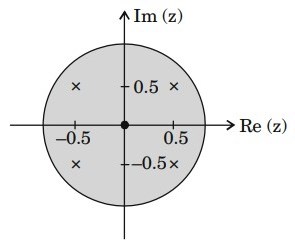
The pole-zero diagram of a causal and stable discrete-time system is shown in the figure. The zero at the origin has multiplicity 4. The impulse response of the system is h[n]. If h[0] = 1, we can conclude
Signal Processing mcq question image
Discuss
Answer & Solution
Answer: Option A
No explanation is given for this question. Let's Discuss on Board
38
Letx(t) be the input and y(t) be the output of a continuous time system. Match the system properties P1, P2 and P3 with system relations R1, R2, P3, P4.
Properties
P1 : Linear but NOT time-invariant
P2 : Time-invariant but NOT linear
P3 : Linear and time-invariant
Relations
R1 : y(t) = t2x(t)
R2 : y(t) = t |x(t)|
R3 : y(t) = |x(t)|
R4 : y(t) = x(t - 5)
Discuss
Answer & Solution
Answer: Option B
No explanation is given for this question. Let's Discuss on Board
39
The z-transform of the following real exponential sequence
x(nT) = an, nT ≥ 0
         = 0, nT < 0, a > 0
Discuss
Answer & Solution
Answer: Option B
No explanation is given for this question. Let's Discuss on Board
40
Consider a single input single output discrete-time system with x[n] as input and y[n] as output, where the two are related as
$$y\left[ n \right] = \left\{ {\matrix{ {n\left| {x\left[ n \right]} \right|,} & {{\rm{for}}\,0 \le n \le 10} \cr {x\left[ n \right] - x\left[ {n - 1} \right],} & {{\rm{otherwise}}} \cr } } \right.$$
Which one of the following statements is true about the system?
Discuss
Answer & Solution
Answer: Option A
No explanation is given for this question. Let's Discuss on Board