
ExamVeda
Login
Home
41
Let the input be u and the output be y of a system, and the other parameters are real constants. Identify which among the following systems is not a linear system :
Discuss
Answer & Solution
Answer: Option C
No explanation is given for this question. Let's Discuss on Board
42
The z-transform of the time function $$\sum\limits_{k = 0}^\infty {\delta \left( {n - K} \right)} $$   is
Discuss
Answer & Solution
Answer: Option C
No explanation is given for this question. Let's Discuss on Board
43
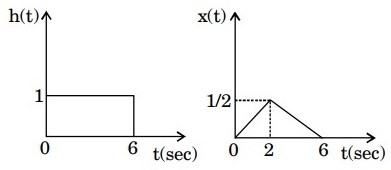
The impulse response and the excitation function of a linear time invariant causal system are shown in figure (a) and (b) respectively. The output of the system at t = 2 sec is equal to
Signal Processing mcq question image
Discuss
Answer & Solution
Answer: Option B
No explanation is given for this question. Let's Discuss on Board
44
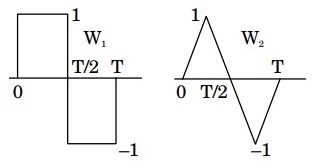
One period (0, T) each of two periodic waveforms W1 and W2 are shown in the figure. The magnitudes of the nth Fourier series coefficients of W1 and W2, for n ≥ 1, n is odd, are respectively proportional to
Signal Processing mcq question image
Discuss
Answer & Solution
Answer: Option C
No explanation is given for this question. Let's Discuss on Board
45
The Fourier Transform of the signal $$x\left( t \right) = {e^{ - 3{t^2}}}$$   is of the following form, where A and B are constants
Discuss
Answer & Solution
Answer: Option B
No explanation is given for this question. Let's Discuss on Board
46
The signal x(t) is described by
$$x\left( t \right) = \left\{ {\matrix{ {1\,{\rm{for}}} & { - 1 \le t \le + 1} \cr {0,} & {{\rm{otherwise}}} \cr } } \right.$$
Two of the angular frequencies at which its Fourier transform becomes zero are
Discuss
Answer & Solution
Answer: Option A
No explanation is given for this question. Let's Discuss on Board
47
The trigonometric Fourier series of an even function does not have the
Discuss
Answer & Solution
Answer: Option C
No explanation is given for this question. Let's Discuss on Board
48
The impulse response of a system is h(t) = tu(t). For an input u(t - 1), the output is
Discuss
Answer & Solution
Answer: Option C
No explanation is given for this question. Let's Discuss on Board
49
The unit impulse response of a linear time invariant system is the unit step function u(t). For t > 0, the response of the system to an excitation e-at u(t), a > 0 will be
Discuss
Answer & Solution
Answer: Option C
No explanation is given for this question. Let's Discuss on Board
50
A signal x(n) = sin(ω0n + f) is the input to a linear time-invariant system having a frequency response H(ejω). If ihe output of the system Ax(n - n0), then the most general form of ∠H(ejω) will be
Discuss
Answer & Solution
Answer: Option B
No explanation is given for this question. Let's Discuss on Board